Radio Diaries: What we can learn from parakeet invasion
UC biologist talks about fiendishly smart monk parakeets

The podcast "The Last Archive" spoke to a University of Cincinnati biologist about how nonnative monk parakeets came to live in the United States and how they foiled efforts to eradicate them.
The episode was rebroadcast this week by Radio Diaries.
UC College of Arts and Sciences Assistant Professor Elizabeth Hobson studies the behavior of social animals such as the parakeets and bobwhite quail in her biology lab.

Assistant Professor Elizabeth Hobson studies the social structures of animals such as monk parakeets. Photo/Annemarie van der Marel
Hobson told "The Last Archive" that studying monk parakeets in the wild is extremely difficult because the intelligent birds often destroy leg bands or other tools researchers use to identify individuals.
Even capturing wild birds for study is difficult.
"It's really hard to go out and catch birds in the same way two days in a row, two weeks in a row or even two months in a row," Hobson said. "They see a trap and they're onto you. So that makes it frustrating."
The podcast is produced by best-selling writer Malcolm Gladwell.
Hobson's lab has discovered interesting features of monk parakeet society. They live in dominance hierarchies in which each bird must work to maintain or improve its social standing in the pecking order.
Hobson found that birds risk losing their social standing after even brief absences from the colony. They also have a keen understanding not only of their place in the hierarchy but also of the places of other members of the colony, which informs their decisions about whom to fight and whom to avoid.
The podcast tells the story of how the birds came to colonize several states and how they have foiled efforts to remove them.
"They're continually outsmarting us," Hobson told the podcast. "In the lab we joke that we feel like they're getting together at night and plotting how to ruin our experiments."
Listen to the Last Archive podcast.
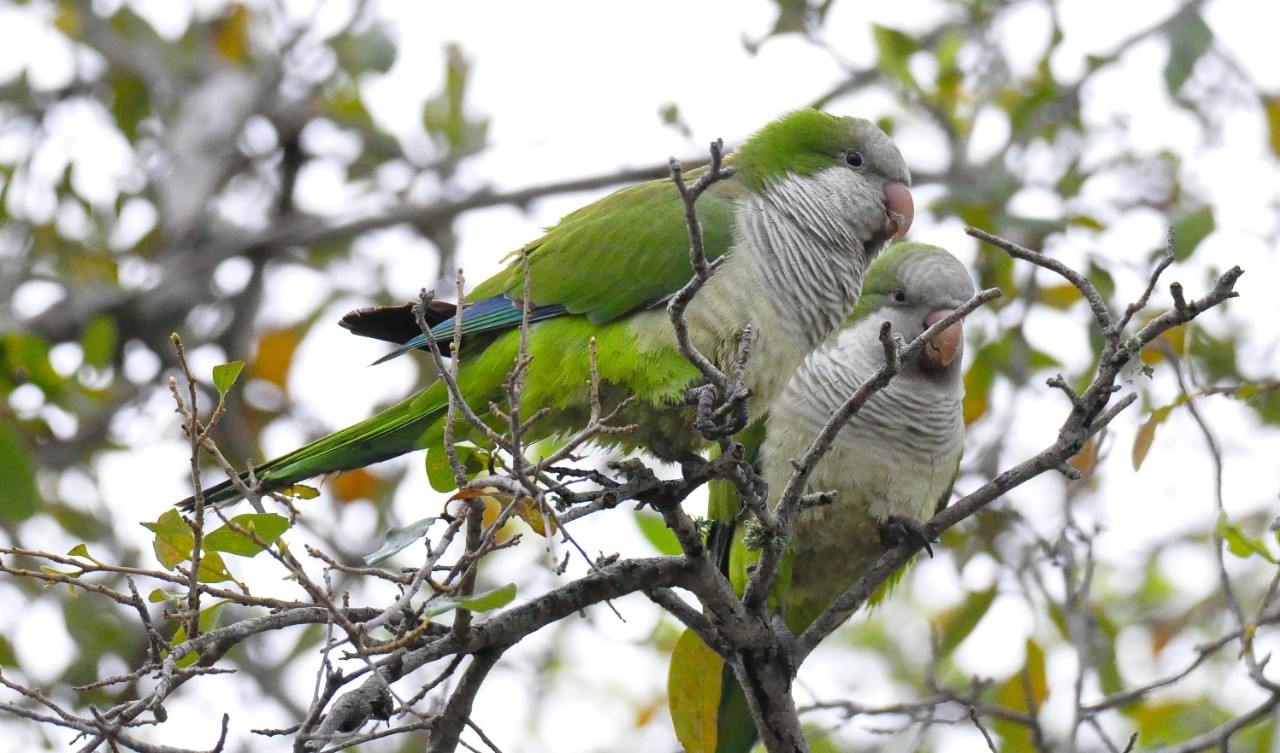
Featured image at top: Nonnative monk parakeets have colonized several states including Florida. Photo/Michael Miller

UC Assistant Professor Elizabeth Hobson studies the dominance hierarchies of social animals such as bobwhite quail in her biology lab. Photo/Andrew Higley/UC Marketing + Brand
Related Stories
Sugar overload killing hearts
November 10, 2025
Two in five people will be told they have diabetes during their lifetime. And people who have diabetes are twice as likely to develop heart disease. One of the deadliest dangers? Diabetic cardiomyopathy. But groundbreaking University of Cincinnati research hopes to stop and even reverse the damage before it’s too late.
Is going nuclear the solution to Ohio’s energy costs?
November 10, 2025

The Ohio Capital Journal recently reported that as energy prices continue to climb, economists are weighing the benefits of going nuclear to curb costs. The publication dove into a Scioto Analysis survey of 18 economists to weigh the pros and cons of nuclear energy. One economist featured was Iryna Topolyan, PhD, professor of economics at the Carl H. Lindner College of Business.
App turns smartwatch into detector of structural heart disease
November 10, 2025

An app that uses an AI model to read a single-lead ECG from a smartwatch can detect structural heart disease, researchers reported at the 2025 Scientific Sessions of the American Heart Association. Although the technology requires further validation, researchers said it could help improve the identification of patients with heart failure, valvular conditions and left ventricular hypertrophy before they become symptomatic, which could improve the prognosis for people with these conditions.