The New York Times: Woolly mammoth left diary in her tusk
UC professor explains how we are learning more about Ice Age behemoths

The New York Times talked to a geosciences professor about what we can learn about mammoths from their tusks.
UC College of Arts and Sciences paleoecologist Joshua Miller studies animals such as caribou and extinct mammoths and mastodons to learn more about environmental changes over time. For example, he and his research partners in 2022 revealed the epic annual migration of male mastodons that roamed hundreds of miles each year across what is now Indiana.
The Times reported on a new study by the University of Alaska that examined the life of a mammoth nicknamed Elma. From her tusks, which grow throughout the mammoth's lifetime, researchers can use isotopic analysis to follow her movements across the landscape.
They learned that she was born in what is now the Canadian Yukon but moved hundreds of miles west into central Alaska where she likely was killed by people. Her remains were recovered in an ancient hunting and fishing camp.
Miller was not part of the study but has conducted similar research on ancient mammoth and mastodon remains in his lab at UC. Miller said as we learn more about the lives of individual animals, we can recreate the fascinating life history of the species.
“There are answers out there,” Miller told the Times. “We’re just starting to build it. And that’s exciting.”
Read the New York Times story.
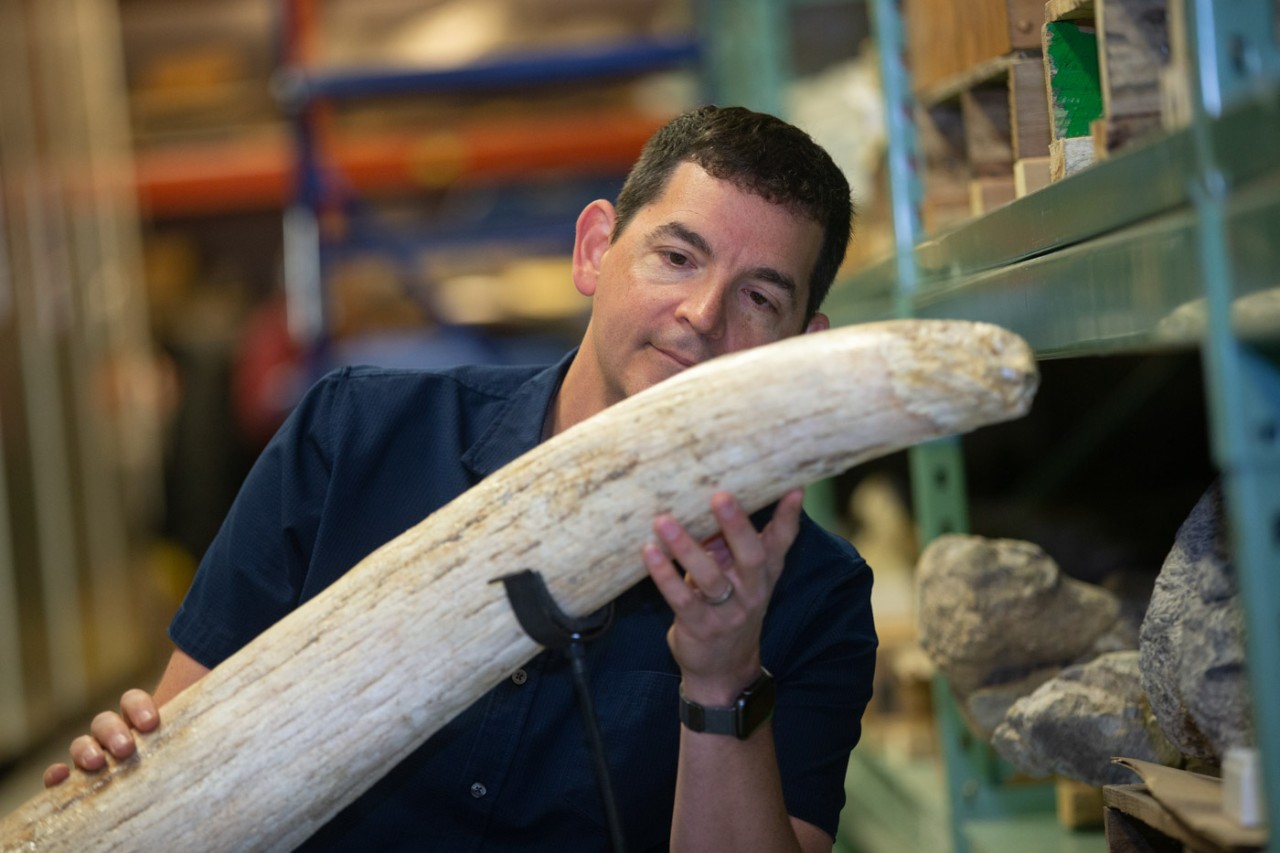
Featured image at top: UC Assistant Professor Joshua Miller examines a mastodon tusk at the Cincinnati Museum Center's Geier Collections and Research Center. Photo/Andrew Higley/UC Marketing + Brand

UC Assistant Professor Joshua Miller poses with a bronze mammoth outside the Cincinnati Museum Center's Geier Collections and Research Center. Photo/Andrew Higley/UC Marketing + Brand
Related Stories
Sugar overload killing hearts
November 10, 2025
Two in five people will be told they have diabetes during their lifetime. And people who have diabetes are twice as likely to develop heart disease. One of the deadliest dangers? Diabetic cardiomyopathy. But groundbreaking University of Cincinnati research hopes to stop and even reverse the damage before it’s too late.
Is going nuclear the solution to Ohio’s energy costs?
November 10, 2025

The Ohio Capital Journal recently reported that as energy prices continue to climb, economists are weighing the benefits of going nuclear to curb costs. The publication dove into a Scioto Analysis survey of 18 economists to weigh the pros and cons of nuclear energy. One economist featured was Iryna Topolyan, PhD, professor of economics at the Carl H. Lindner College of Business.
App turns smartwatch into detector of structural heart disease
November 10, 2025

An app that uses an AI model to read a single-lead ECG from a smartwatch can detect structural heart disease, researchers reported at the 2025 Scientific Sessions of the American Heart Association. Although the technology requires further validation, researchers said it could help improve the identification of patients with heart failure, valvular conditions and left ventricular hypertrophy before they become symptomatic, which could improve the prognosis for people with these conditions.