Hewlett Packard Enterprise makes gift to the University of Cincinnati
New gift of supercomputing resources propels advanced research computing at UC

A recent gift from Hewlett Packard Enterprise (HPE) to the University of Cincinnati’s Advanced Research Computing Center will make high-performance computing at the UC center even more valuable to UC’s research enterprise.
HPE’s supercomputing resources will be used for testing and creating learning environments at the Advanced Research Computing Center (ARCC) at Digital Futures, an interdisciplinary research facility at UC.
This gift allows our extraordinary students and faculty to stay on the leading edge of the technology, advance our nation, and solve problems that matter.
Jane Combs director, Advanced Research Computing Center
The ARCC’s high-performance computing infrastructure supports and accelerates computational research and scholarship and provides tools and services used by researchers for artificial intelligence, modeling and simulation and machine learning.
Jane Combs, director of the ARCC, explains that the center consists of multiple computers that can be used individually or as one supercomputer.
“The addition of the HPE’s gift of supercomputing resources will also allow staff and students to test new ideas and learn new skills without concern of degrading the UC’s production systems, which serves to support mission-critical national scientific research,” she said. “Students can learn in a safe playground environment instead of being heavily restricted on production systems which can impede their skill acquisition. Partnerships such as ours are important. This gift allows our extraordinary students and faculty to stay on the leading edge of the technology, advance our nation, and solve problems that matter.”
Since 1939, HPE has been a leader in technology and corporate culture, inspiring innovators, and entrepreneurs around the globe.
“Making supercomputing and training accessible to research students is critical to developing fundamental skills in computational science to accelerate scientific breakthroughs and AI,” said Trish Damkroger, chief product officer and senior vice president, HPC, AI & Labs at HPE. “We are proud to deepen our collaboration with UC’s Advanced Research Computing Center to make supercomputing resources available to both researchers and UC students that will prepare them for the workforce, create new knowledge, and make a long-lasting contribution to society.”
Combs points out that the ARCC processes research data from “cradle to grave,” meaning it allows for safe and secure transfer, analysis and storage of research data.
The ARCC’s super-fast servers, tools, storage, and expert services are available to the computational community of greater Cincinnati. The ARCC is taking on new clients.
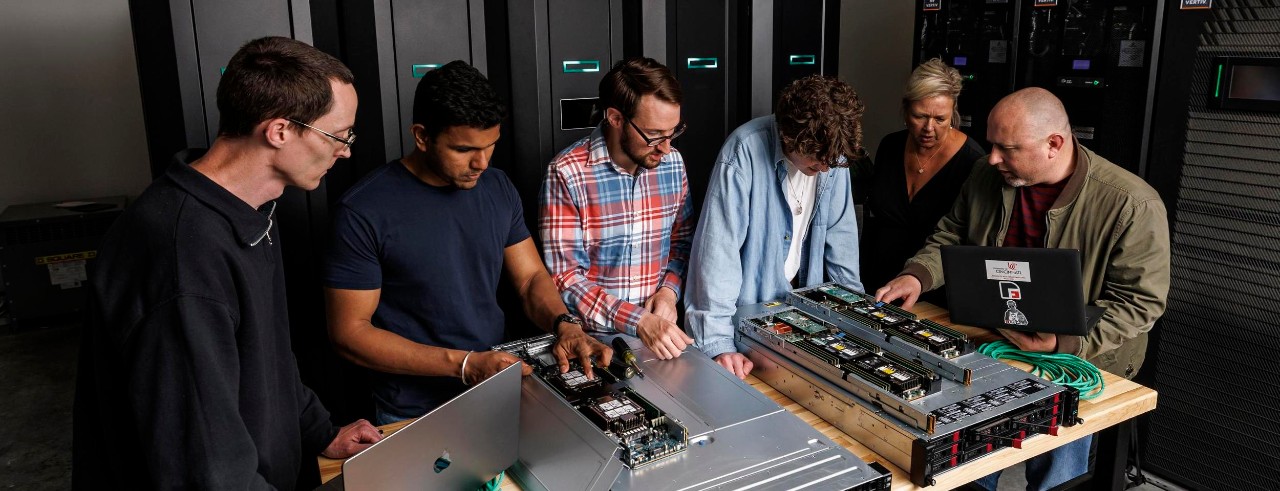
Featured image at top: Jane Combs and students and staff from the ARCC team. Photo/Chris Radcliffe for the UC Foundation
Next, Now
With its focus on innovation and impact, Next, Now: The Campaign for Cincinnati is where ambition meets action. At the University of Cincinnati and UC Health, we’re driven by next; thinking bolder and dreaming bigger to create the tomorrow we envision, today. Learn more at nextnow.uc.edu.
Related Stories
Sugar overload killing hearts
November 10, 2025
Two in five people will be told they have diabetes during their lifetime. And people who have diabetes are twice as likely to develop heart disease. One of the deadliest dangers? Diabetic cardiomyopathy. But groundbreaking University of Cincinnati research hopes to stop and even reverse the damage before it’s too late.
App turns smartwatch into detector of structural heart disease
November 10, 2025

An app that uses an AI model to read a single-lead ECG from a smartwatch can detect structural heart disease, researchers reported at the 2025 Scientific Sessions of the American Heart Association. Although the technology requires further validation, researchers said it could help improve the identification of patients with heart failure, valvular conditions and left ventricular hypertrophy before they become symptomatic, which could improve the prognosis for people with these conditions.
Combination immunotherapy helps overcome melanoma treatment resistance
November 10, 2025

MSN highlighted research led by the University of Cincinnati Cancer Center's Trisha Wise-Draper showing a combination of immunotherapy medications can activate a robust immune response and help overcome treatment resistance in patients with refractory melanoma.