WVXU: UC study tests tongue exercises to improve swallowing function after stroke

WVXU highlighted a new trial at the University of Cincinnati that will test an at-home tongue endurance exercise to improve patients’ swallowing function after a stroke.
Up to three-quarters of all stroke survivors have some form of difficulty swallowing (dysphagia) after a stroke.
"When you have a stroke, or another condition that impairs your swallowing, it impacts your life in an incredible way," Brittany Krekeler, PhD, assistant professor and clinician-scientist at the UC College of Medicine’s Dysphagia Rehabilitation Laboratory, told WVXU.
The study will enroll patients who have trouble swallowing three to six months after their stroke. Patients enrolled in the study will receive a device with a pressurized bulb that connects to their phone or tablet through Bluetooth to give them real-time feedback about how hard they are pressing the bulb with their tongue.
Participants in the trial will press their tongue to the bulb, with the device recording the number of times they do so and if they meet their goal. They’ll complete the exercises three times a day for eight weeks, with their goal increasing as they build endurance.
"We're trying to target fatigue resistance or endurance of the tongue instead of strength because to swallow, you don't have to push your tongue as hard as you can every single time, you have to generate enough pressure to move whatever is in your mouth through your throat into your esophagus," Krekeler said. "What we're doing in this study is training people to press repeatedly over a longer period of time with the hope that that will carry over to more functional swallowing change."
Local 12 also highlighted Krekeler's research and how the tongue exercises helped patient Kevin Moss improve his swallowing function after a brain stem stroke. Read or watch the Local 12 story.
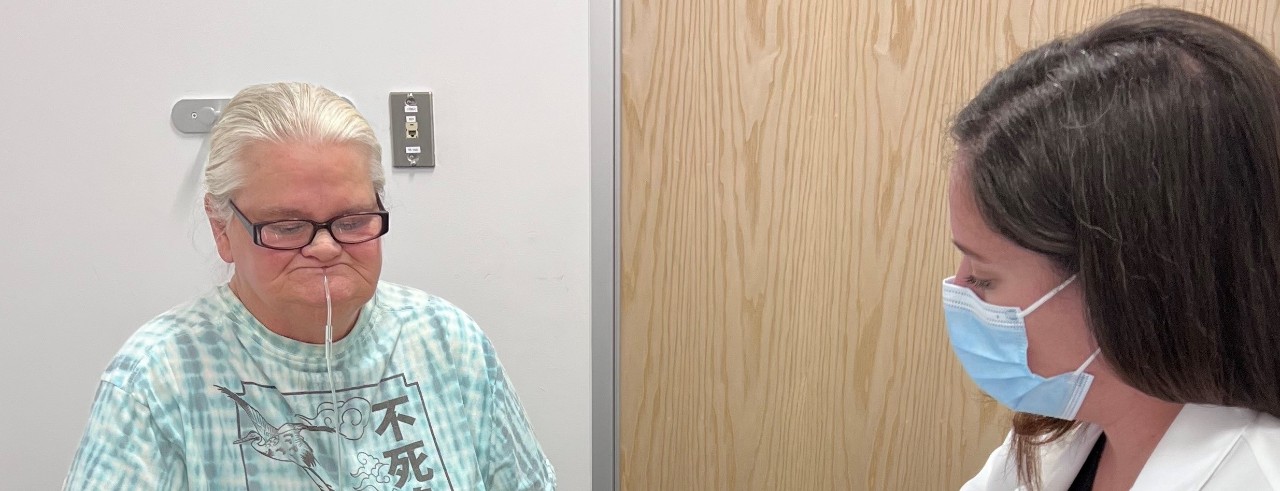
Featured photo at top of a patient working in the Dysphagia Rehabilitation Laboratory. Photo/Rachel Treinen Photography.
Related Stories
UC launches Bearcats Affordability Grant
January 7, 2026
The University of Cincinnati is making college more attainable for students across Ohio with the creation of the Bearcats Affordability Grant. The new grant will provide a pathway to tuition-free college for students of families who make less than $75,000 per year. Beginning in fall 2026, the Bearcats Affordability Grant will cover the remaining cost of tuition for Ohio residents who are Pell eligible.
BearcatGPT AI platform now available to all UC faculty and staff
December 9, 2025
University of Cincinnati Digital Technology Solutions is excited to announce that BearcatGPT, the university’s private, secure AI platform, is now available to all UC faculty and staff.
Sugar overload killing hearts
November 10, 2025
Two in five people will be told they have diabetes during their lifetime. And people who have diabetes are twice as likely to develop heart disease. One of the deadliest dangers? Diabetic cardiomyopathy. But groundbreaking University of Cincinnati research hopes to stop and even reverse the damage before it’s too late.