
Space Force awards $11.5M grant to UC to fix orbiting satellites
Space Force awards $11.5M grant to UC to fix orbiting satellites
Engineers want to build satellites that can fix other satellites in space

The U.S. Space Force awarded an $11.5 million grant to the University of Cincinnati and two other institutions to develop satellite-based robotics technologies for servicing other satellites or removing debris in orbit.
UC Professor Ou Ma and his research team have been working on the vexing problem for several years. When satellites break, which is surprisingly often, they can become billion-dollar paperweights that put other satellites at risk.
“If you find a car having a problem on the road, you can tow it back to the garage for fixing,” Ma said. “If a satellite goes wrong in orbit, you can’t take it back. You have to live with it. And some problems can even kill the entire mission.”
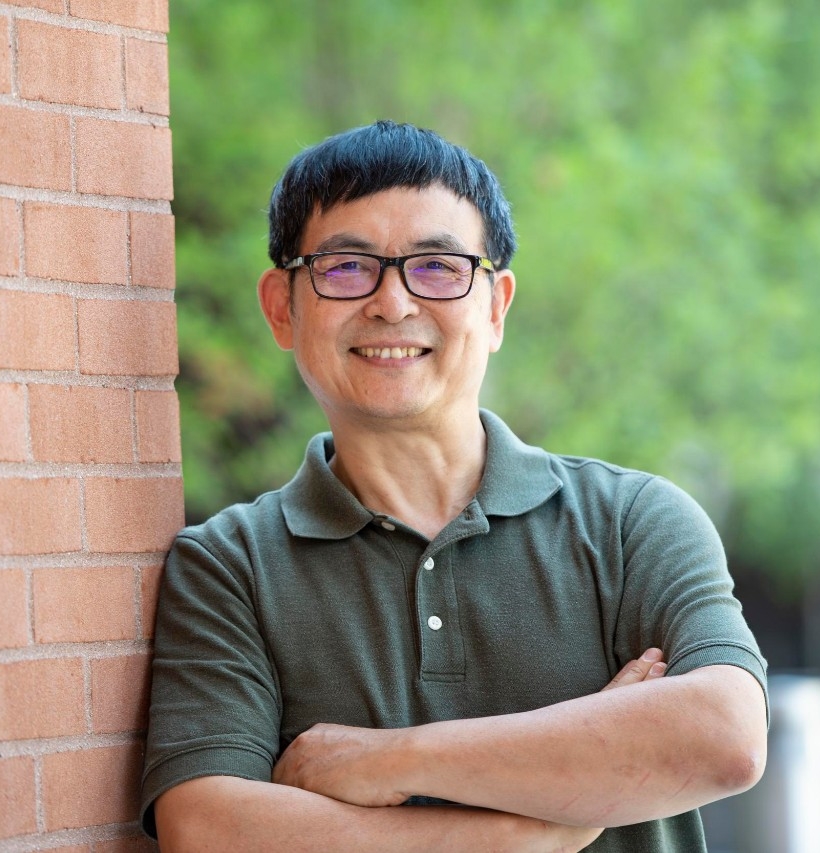
UC Professor Ou Ma. Photo/Colleen Kelley/UC Marketing + Brand
In his Intelligent Robotics and Autonomous Systems Lab, Ma and his research partners in UC’s College of Engineering and Applied Science will develop the technology needed for a satellite equipped with robotic arms to service another satellite in space. It’s a growing field known as In-space servicing, assembly and manufacturing, with implications for national security and commercialization.
“Refueling, replacing a hardware module or fixing an antenna: On the ground, it would be a minor service, but in space it’s not minor at all,” Ma said.
Some missions might be as simple as retrieving unresponsive satellites so they don’t pose a navigational threat to other orbiting spacecraft or assets.
It’s a huge risk. You don’t want to try making repairs in space without extremely high confidence.
Ou Ma, UC Aerospace Engineering Professor
Many services require physical interactions with the satellites, but an inadvertent bump can send both the servicing and the serviced satellites rotating wildly away from each other.
“It’s a huge risk. You don’t want to make a capture or repair in space without extremely high confidence. So you must thoroughly test the operation in a lab environment,” Ma said.
“This award to Professor Ma is evidence of the value the U.S. Space Force places on UC’s research expertise and accomplishments,” said Patrick Limbach, UC’s vice president for research. “This award will leverage UC’s existing investments in the Space Research Institute for Research and Discovery and ensure our institution continues to be a leader in this field.”
The project also will demonstrate new robotic arm cooperative control technologies. Ma is uniquely qualified for leading this task. He helped develop the robotic arms aboard the International Space Station and has worked on space robotics projects with NASA, the Air Force Research Laboratory, the Canadian Space Agency and the German Aerospace Center.
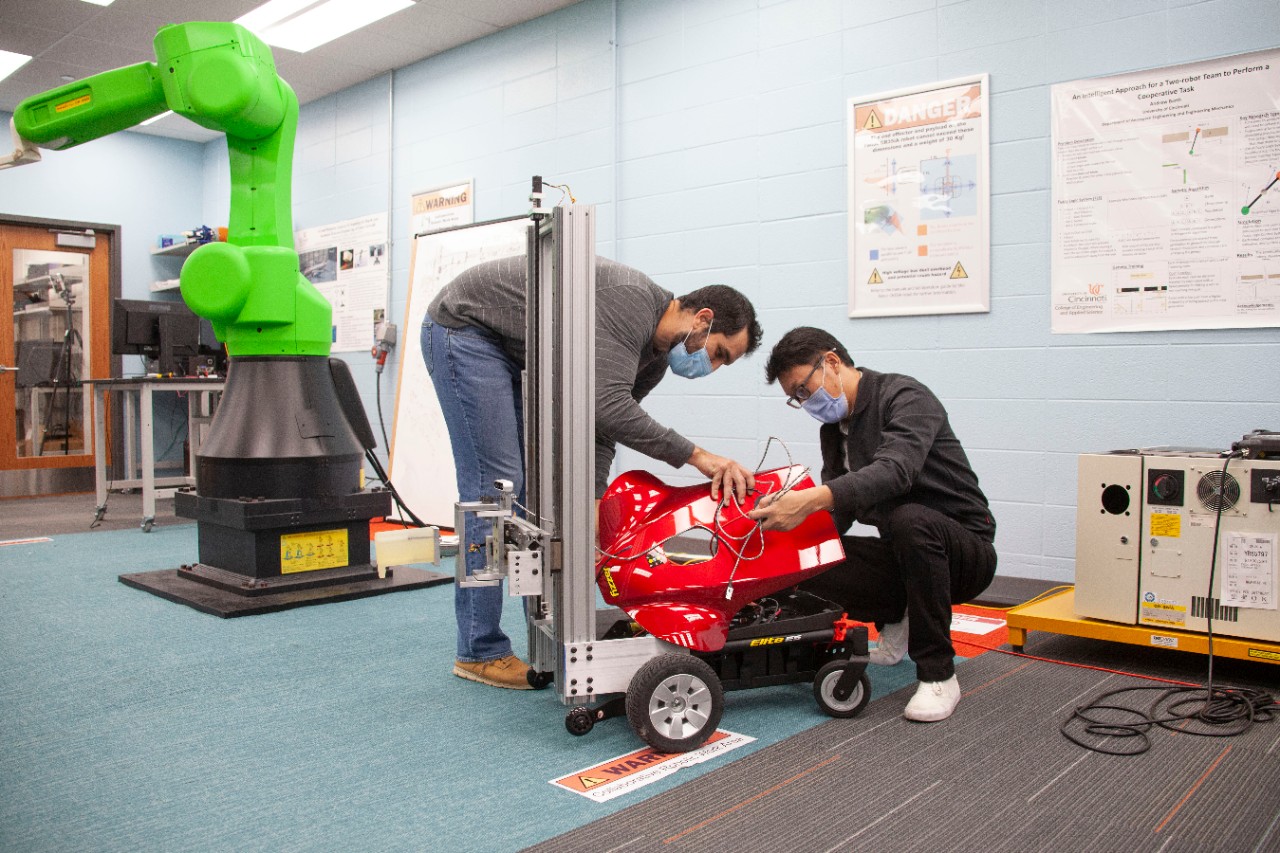
Students work with robots in UC's Intelligent Robotics and Autonomous Systems Lab. Photo/Ravenna Rutledge/UC Marketing + Brand
Research partners
The project builds on UC’s work in advanced manufacturing and robotics, UC College of Engineering and Applied Science Dean John Weidner said.
“Being able to do this work in the most challenging environment possible will serve us well for terrestrial applications,” Weidner said.
UC will work with Clemson University and the University of Arizona along with four aerospace companies, including Sierra Lobo, Inc., based in Fremont, Ohio.
UC has a storied tradition in aerospace science and engineering. After setting foot on the moon, the late astronaut Neil Armstrong left NASA to teach at UC. Many UC graduates have launched careers at NASA, the Jet Propulsion Laboratory, Lockheed Martin, Boeing, SpaceX and other aerospace research firms across the country.
“It’s significant funding that shows the excellence of our program,” said Paul Orkwis, head of UC’s Department of Aerospace Engineering and Engineering Mechanics.
“You hear people say, ‘it’s not rocket science.’ Well, this is rocket science. It’s hard,” Orkwis said. “Virtually all the work done in space today is autonomous and at a distance. But what we’re learning affects everything we do from cell phones to GPS.”
The grant will support the research work of 16 graduate and undergraduate students per year at UC and its two partner universities, Ma said.
Ma’s collaborators include aerospace engineering professors Donghoon Kim, Kelly Cohen and Rajnikant Sharma. Cohen and Ma are part of the UC’s Space Research Institute for Discovery and Exploration, which works with a large group of faculty and students on a variety of projects ranging from unmanned and autonomous vehicles to supersonic propulsion.
Featured image at top: The space shuttle Discovery deploys a satellite during a 1985 mission. Photo/NASA
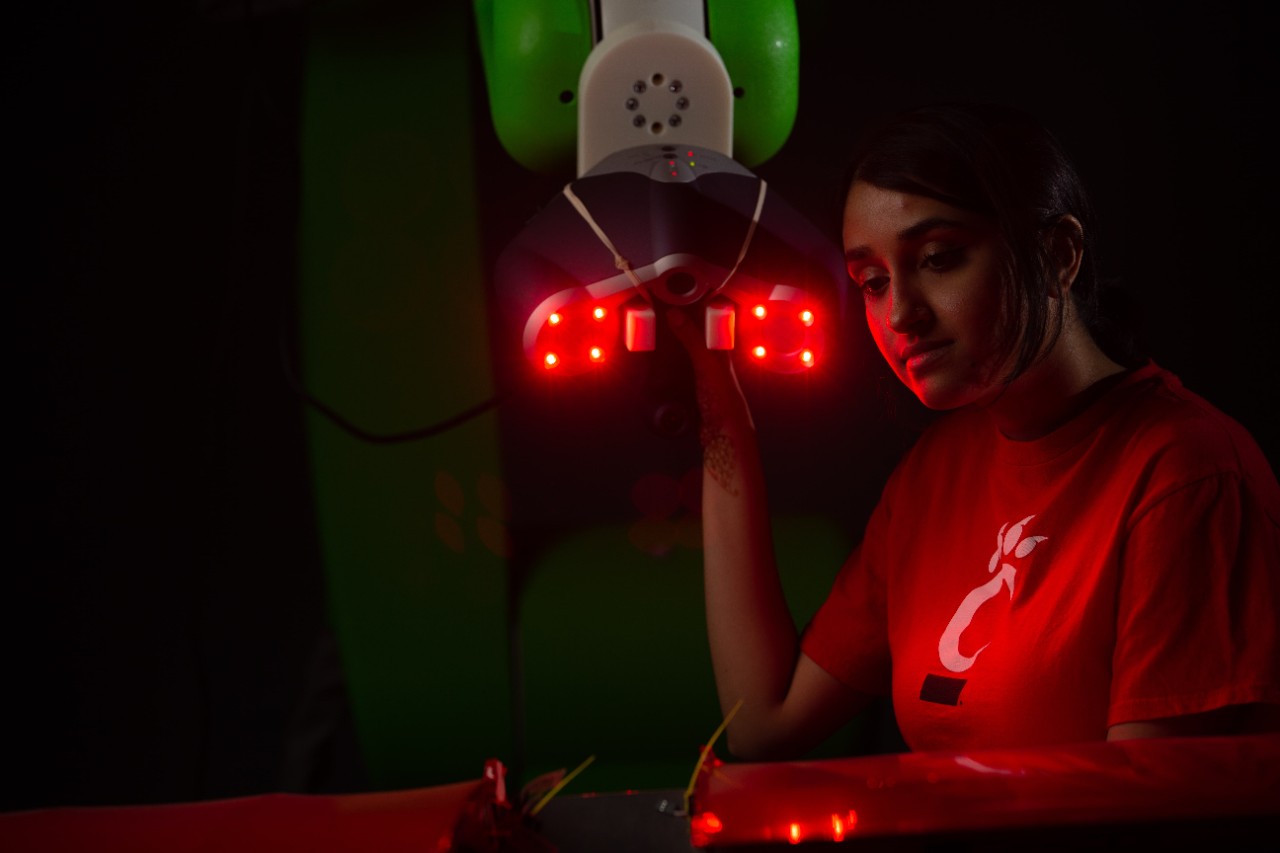
An engineering student uses a device that can detect imperfections in surfaces in UC's Intelligent Robotics and Autonomous Systems Lab. Photo/Andrew Higley/UC Marketing + Brand
Next Lives Here
The University of Cincinnati is leading public urban universities into a new era of innovation and impact. Our faculty, staff and students are saving lives, changing outcomes and bending the future in our city's direction. Next Lives Here.
Related Stories
UC launches Bearcats Affordability Grant
January 7, 2026
The University of Cincinnati is making college more attainable for students across Ohio with the creation of the Bearcats Affordability Grant. The new grant will provide a pathway to tuition-free college for students of families who make less than $75,000 per year. Beginning in fall 2026, the Bearcats Affordability Grant will cover the remaining cost of tuition for Ohio residents who are Pell eligible.
BearcatGPT AI platform now available to all UC faculty and staff
December 9, 2025
University of Cincinnati Digital Technology Solutions is excited to announce that BearcatGPT, the university’s private, secure AI platform, is now available to all UC faculty and staff.
Sugar overload killing hearts
November 10, 2025
Two in five people will be told they have diabetes during their lifetime. And people who have diabetes are twice as likely to develop heart disease. One of the deadliest dangers? Diabetic cardiomyopathy. But groundbreaking University of Cincinnati research hopes to stop and even reverse the damage before it’s too late.