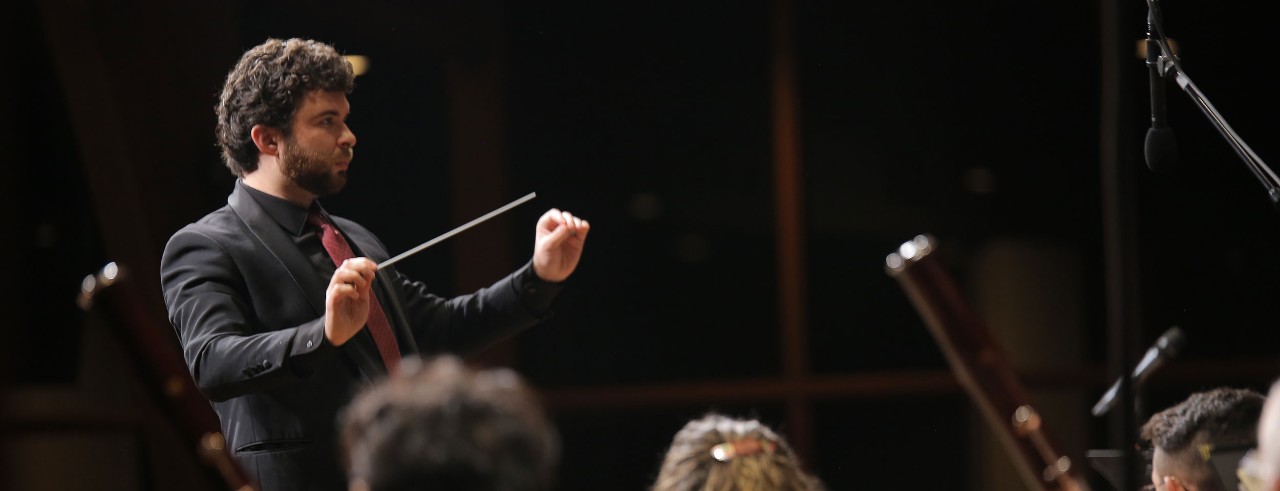
Life at CCM: Student conductor takes the lead on stage
Watch Michael Patterson conduct the CCM Philharmonia, and learn about his experience at the college

Many students at the University of Cincinnati College-Conservatory of Music balance a rigorous performance schedule with their studies — pushing the boundaries of traditional classroom experiences to turn CCM stages into their own creative laboratories. In orchestral performances, one could consider the conductor as the "lead scientist" who guides the ensemble during a concert, but Michael Patterson explains the magic on stage is a group effort.
The electric thrill of musical collaboration is reason enough to love making music for the rest of my life.
Michael Patterson DMA Orchestral Conducting student

Michael Patterson celebrates with fellow CCM students after a performance. Photo/Provided by Michael Patterson.
"Conductors do everything and nothing simultaneously," says Patterson, a first-year DMA student in Orchestral Conducting at CCM. "On one hand, you cannot make music without the musicians in front of you. They offer you their sound and the interpretation of their part of the music. Without them, there is no music."
"On the other hand, conducting feels like painting with sound as a medium," he adds. "You graciously take each and every sound offered to you and choose how to “paint” with them. All of it is nonverbal. Through eye communication, bodily gesture, and sheer energy, one is able to convey to the ensemble how to recreate the piece of music being performed. It’s pure magic and it’s so THRILLING!"
Patterson chose CCM because of the opportunity to study with Director of Orchestral Studies Mark Gibson, who leads the CCM Philharmonia. During the fall semester, Gibson programed a concert featuring four works considered to be "under the radar" and gave his student conductors the spotlight to lead the orchestra during the performance. The concert showcased graduate student conductors Xiao Geng, Patterson, Carlos Avendaño-Garcia, Sandra Cepero Alvarez and Moyue Zhou. Watch Patterson conduct the CCM Philharmonia in the first movement of Beethoven's Symphony No. 4, recorded from the orchestra POV during the performance.
"The Beethoven 4 performance was so much fun! I must thank my colleagues in the orchestra for giving their all with me," Patterson says. How did he prepare for the concert? "Studying, studying and more studying."
There’s no great secret to learning a piece to conduct — it takes hours of reviewing the music score, he adds. Patterson memorizes theory and harmony, form, pulse and tempo, where to direct his attention in the ensemble and, most importantly, the sound he wants to create.
Patterson will next conduct a portion of the repertoire included on the CCM Philharmonia's upcoming concert, "Love and Death." Mark Gibson leads the ticketed performance on Saturday, Jan. 27; tickets on sale through the CCM Box Office.
Now officially halfway through his first year in DMA studies at CCM, Patterson says the college is "buzzing with life."
"There is plenty of opportunity to learn whatever you want to learn and see whatever you want to see," Patterson says. "There have been nights where I had to choose whether to attend an opera or wind symphony concert. Not only are there a plethora of ensemble concerts to attend (and all of them are stellar!), but every student recital is also amazing.
"The resources here are plenty and the opportunities are wide. Whatever you want to learn, to hear, to ask or to pursue, CCM probably has it at a masterful level."
There's More To Explore
Learn more about CCM Orchestral Studies and watch performance videos.
Watch a concert or show at CCM! View our performance calendar.
Featured image at the top: Michael Patterson conducting an orchestra on stage. Photo/provided.
Related Stories
Sugar overload killing hearts
November 10, 2025
Two in five people will be told they have diabetes during their lifetime. And people who have diabetes are twice as likely to develop heart disease. One of the deadliest dangers? Diabetic cardiomyopathy. But groundbreaking University of Cincinnati research hopes to stop and even reverse the damage before it’s too late.
App turns smartwatch into detector of structural heart disease
November 10, 2025

An app that uses an AI model to read a single-lead ECG from a smartwatch can detect structural heart disease, researchers reported at the 2025 Scientific Sessions of the American Heart Association. Although the technology requires further validation, researchers said it could help improve the identification of patients with heart failure, valvular conditions and left ventricular hypertrophy before they become symptomatic, which could improve the prognosis for people with these conditions.
Duo authentication changes coming January 2026
November 10, 2025
Effective Wednesday, January 21, 2026, Duo authentication via SMS text messages and phone calls will no longer be supported. Switch to the Duo Mobile app on an iOS or Android device (such as a smartphone or tablet). The Duo Mobile app supports Duo Push, which offers the most secure and user-friendly authentication experience.