U.S. News & World Report: Could spinal cord stimulation ease depression?

U.S. News & World Report highlighted a recent University of Cincinnati trial that found electrical stimulation of the spinal cord is feasible, well-tolerated and shows therapeutic potential to treat depression.
The results of the trial were published in the journal Molecular Psychiatry on Dec. 20.
Principal investigator Francisco Romo-Nava, MD, PhD, said pathways of neurons located in the spinal cord convey information from the body to regions of the brain that are involved in the emotional experience we know as mood. When functioning properly, the brain uses this information to constantly make adjustments to help regulate a person’s mood.
While major depressive disorder can have many different causes, one contributor could be this pathway being overloaded with information.
Romo-Nava obtained a patent in 2020 for noninvasive spinal cord stimulation designed to decrease the flow of information in the brain-body circuit so that the brain is better able to readjust and regulate itself.
A total of 20 patients were enrolled in the trial, with half randomized to receive the active version of the spinal cord stimulation and half receiving a different version of current that was not expected to have much of an effect.
Patients went to the Lindner Center of HOPE for three 20-minute sessions a week for eight weeks, for a total of 24 spinal stimulation sessions.
Romo-Nava said like with most pilot studies, the primary focus of the study was the feasibility and safety of the intervention and how well patients tolerated the stimulation. The study was designed so that the dose of stimulation could be decreased if needed, but Romo-Nava said all patients tolerated the initially prescribed dose well.
“We used a current that is so small that it’s about 10 times smaller than the one known to induce tissue damage, so that’s also pretty encouraging because there’s a lot to explore in terms of what is the optimal dose and session frequency,” said Romo-Nava, associate professor in the Department of Psychiatry and Behavioral Neurosciences at UC, associate chief research officer for the Research Institute at the Lindner Center of HOPE and a UC Health physician scientist.
Read the U.S. News & World Report story.
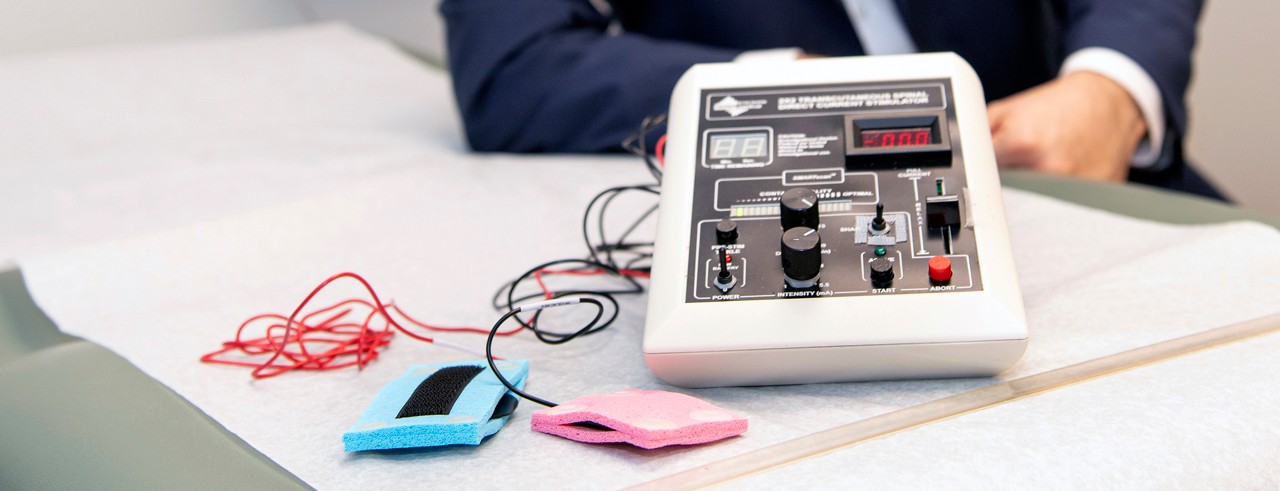
Featured photo at top of spinal cord stimulation device and electrodes. Photo/Colleen Kelley/UC Marketing + Brand.
Related Stories
Sugar overload killing hearts
November 10, 2025
Two in five people will be told they have diabetes during their lifetime. And people who have diabetes are twice as likely to develop heart disease. One of the deadliest dangers? Diabetic cardiomyopathy. But groundbreaking University of Cincinnati research hopes to stop and even reverse the damage before it’s too late.
Is going nuclear the solution to Ohio’s energy costs?
November 10, 2025

The Ohio Capital Journal recently reported that as energy prices continue to climb, economists are weighing the benefits of going nuclear to curb costs. The publication dove into a Scioto Analysis survey of 18 economists to weigh the pros and cons of nuclear energy. One economist featured was Iryna Topolyan, PhD, professor of economics at the Carl H. Lindner College of Business.
App turns smartwatch into detector of structural heart disease
November 10, 2025

An app that uses an AI model to read a single-lead ECG from a smartwatch can detect structural heart disease, researchers reported at the 2025 Scientific Sessions of the American Heart Association. Although the technology requires further validation, researchers said it could help improve the identification of patients with heart failure, valvular conditions and left ventricular hypertrophy before they become symptomatic, which could improve the prognosis for people with these conditions.