WVXU: Study finds invasive plants are thriving in Southwest Ohio
UC biologist Denis Conover talks to Cincinnati Edition about ways to curb invasive species

University of Cincinnati botanist Denis Conover spoke to WVXU's Cincinnati Edition about ways members of the public can help to prevent the spread of nonnative, invasive plants such as Callery pear trees, English ivy and Higan cherry.
Conover said some nonnative plants in gardens, arboretums, back yards and other places are escaping cultivation to spread across wild forests in Southwest Ohio.

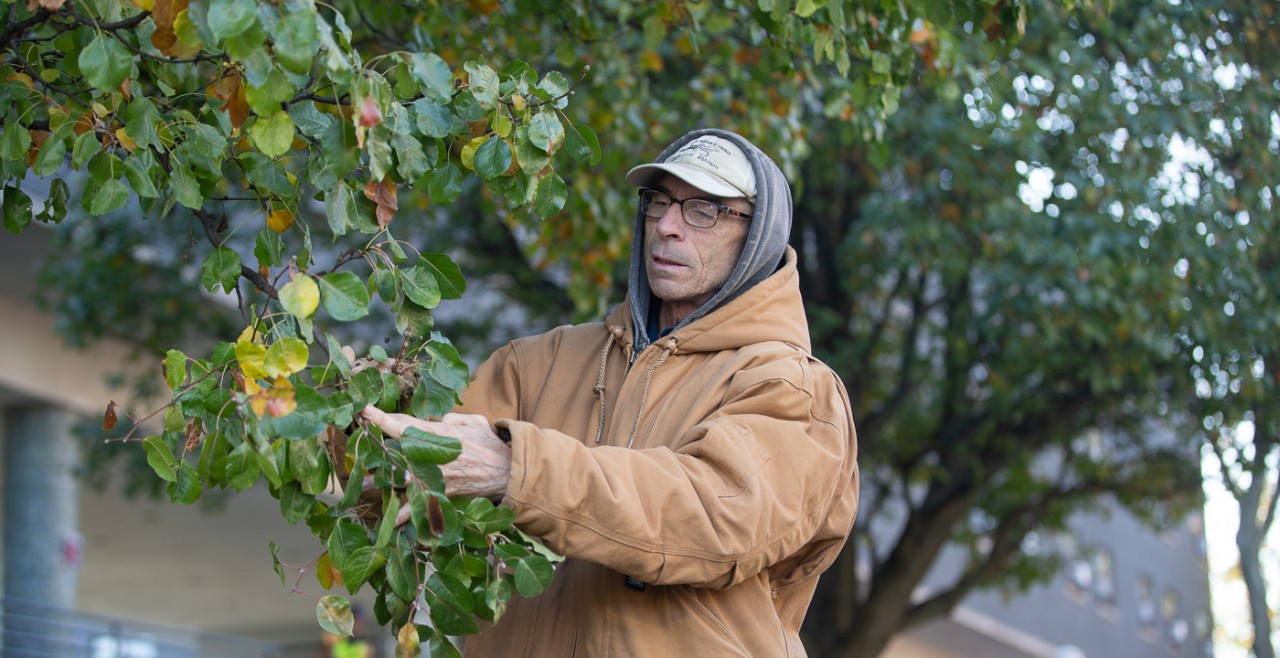
UC Professor-Educator Denis Conover is studying the impact of nonnative, invasive species on wild areas in Southwest Ohio. Photo/Andrew Higley/UC Marketing + Brand
He pointed to a close example, the landscaping outside his office on UC's Uptown Campus.
“This is winged euonymus, otherwise known as burning bush. And here is Chinese silver grass. It’s a popular ornamental, but the seeds are dispersed by the wind,” he said.
For his latest study published in the journal Ecological Restoration, he and his students examined the impact that nonnative, invasive plants are having on forests. He found that plants at arboretums and public gardens inadvertently can seed wild areas with nonnative plants.
Conover, a professor-educator in UC's College of Arts and Sciences, told WVXU's Cincinnati Edition that native plants support a far greater variety of insects and other wildlife than nonnative plants.
“Several hundred species of moths will lay their eggs on an oak tree. And all those moth caterpillars are eaten by birds,” he told host Lucy May. “If you want to have the bird diversity, you need the caterpillars.”
Conover said nonnative plants can carry pathogenic fungi such as the one responsible for chestnut blight and Dutch elm disease.
“Butternuts are also being attacked by a fungus they think came from Asia,” he said. “If you introduce plants from other continents, you might be bringing pathogens with them.”
Listen to the interview on WVXU's Cincinnati Edition.
Featured image at top: UC Professor-Educator Denis Conover studies the impact of nonnative, invasive species. Photo/Andrew Higley/UC Marketing + Brand

UC Professor-Educator Denis Conover leads public botanical walks at Burnet Woods and other parks when the weather permits. Photo/Andrew Higley/UC Marketing + Brand
Related Stories
Sugar overload killing hearts
November 10, 2025
Two in five people will be told they have diabetes during their lifetime. And people who have diabetes are twice as likely to develop heart disease. One of the deadliest dangers? Diabetic cardiomyopathy. But groundbreaking University of Cincinnati research hopes to stop and even reverse the damage before it’s too late.
Is going nuclear the solution to Ohio’s energy costs?
November 10, 2025

The Ohio Capital Journal recently reported that as energy prices continue to climb, economists are weighing the benefits of going nuclear to curb costs. The publication dove into a Scioto Analysis survey of 18 economists to weigh the pros and cons of nuclear energy. One economist featured was Iryna Topolyan, PhD, professor of economics at the Carl H. Lindner College of Business.
App turns smartwatch into detector of structural heart disease
November 10, 2025

An app that uses an AI model to read a single-lead ECG from a smartwatch can detect structural heart disease, researchers reported at the 2025 Scientific Sessions of the American Heart Association. Although the technology requires further validation, researchers said it could help improve the identification of patients with heart failure, valvular conditions and left ventricular hypertrophy before they become symptomatic, which could improve the prognosis for people with these conditions.