Yahoo News: Ohio health expert challenges governor’s warning on fentanyl-laced marijuana
UC expert calls the concept a myth

Following the recent vote that legalized recreational marijuana in Ohio, Governor Mike DeWine urged the state senate to pass a bill to make changes to the law. He cited concerns over the dangers of fentanyl-laced marijuana, saying the black market would 'take off.'
In a story posted by Yahoo News, Tasha Turner-Bicknell of the UC College of Nursing said not only is marijuana laced with fentanyl uncommon, it’s seen as either impractical or scientifically impossible. Turner-Bicknell is experienced in overdose prevention. She said that through her research with Harm Reduction Ohio, where she sits on the board of directors, she has been unable to find proof that fentanyl is being found in marijuana.
“It’s something that is talked about and it’s covered in the media, but then when actual tests are run in state or government labs it always comes back negative,” Turner-Bicknell said. “We really don’t have any evidence at all that there is any proof of any such thing as fentanyl in marijuana.”

Tasha Turner-Bicknell of the UC College of Nursing/Photo provided
Turner-Bicknell called the concept of fentanyl-laced marijuana a myth. She said one reason is the different temperatures that marijuana and fentanyl have to be burned at to be smoked.
“The way that (fentanyl) would be smoked, it would not really be combustible at the same temperature that marijuana would be burned at,” Turner-Bicknell said. “So, when you talk to people about it more in-depth, it’s also something that’s not really possible, that there would be fentanyl in marijuana and that it would be smoked.”
Turner-Bicknell said that much of the evidence used to cite fentanyl being found in marijuana is overdoses where both substances are found in the system. She said both of these substances being found in a person’s system is not proof of the two being connected and that many of these overdoses lead to the discovery of even more substances in their system.
“I’ve looked at reports where the whole basis for the fact that it was fentanyl-laced marijuana is the fact that fentanyl was found and marijuana was found, and it’s like, ‘OK, what else was there?'” Turner-Bicknell said. “Usually there is a little bit of stimulants, meth, cocaine, crack, something else involved.”
In addition to fentanyl, DeWine said pesticides, metals, and other contaminants are also a risk. Turner-Bicknell said this is also not a real concern, with the chances of buying contaminated marijuana on par with the chances of buying compromised produce.
“It’s not something that I have seen in literature as a serious issue,” Turner-Bicknell said. “I think that your chances of being exposed to those things would be the same as lettuce that comes in a bag that is purchased at the grocery store. If we are concerned about pesticides in marijuana, regulating the market and regulating growers is the best solution.”
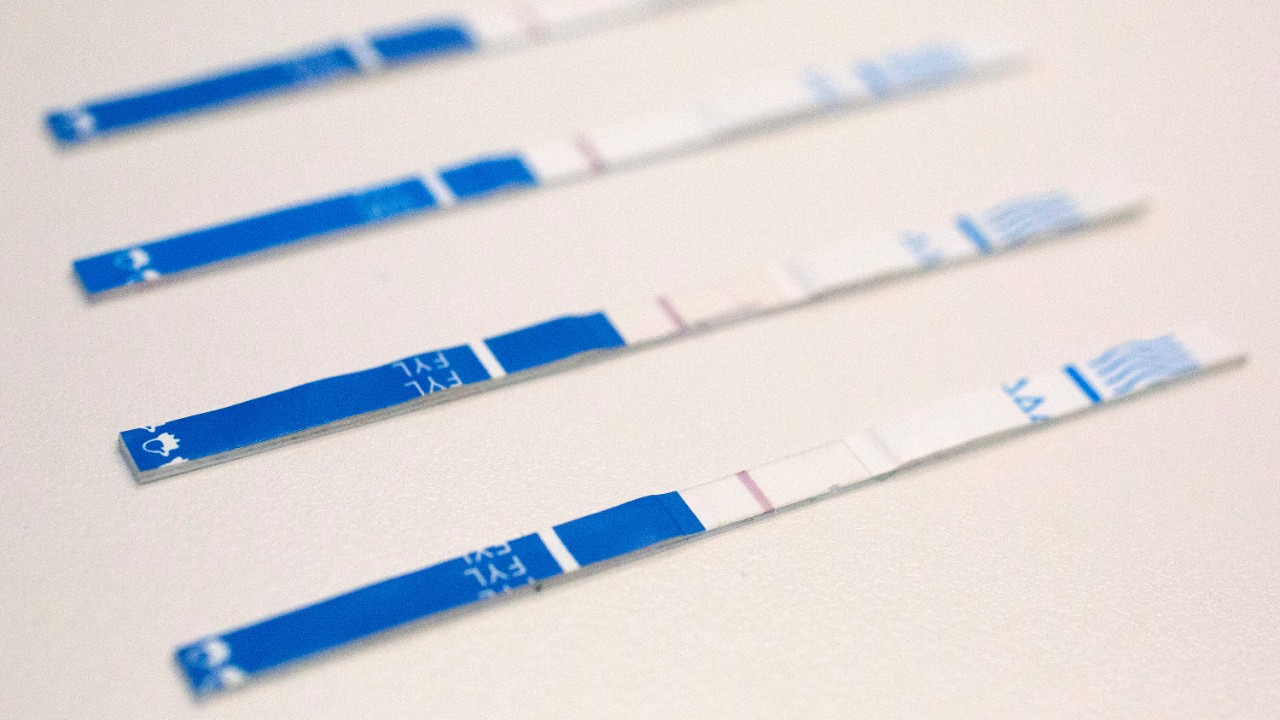
Lead photo of fentanyl test strips/Associated Press
Next Lives Here
The University of Cincinnati is classified as a Research 1 institution by the Carnegie Commission and is ranked in the National Science Foundation's Top-35 public research universities. UC's graduate students and faculty investigate problems and innovate solutions with real-world impact. Next Lives Here.
Related Stories
Sugar overload killing hearts
November 10, 2025
Two in five people will be told they have diabetes during their lifetime. And people who have diabetes are twice as likely to develop heart disease. One of the deadliest dangers? Diabetic cardiomyopathy. But groundbreaking University of Cincinnati research hopes to stop and even reverse the damage before it’s too late.
Is going nuclear the solution to Ohio’s energy costs?
November 10, 2025

The Ohio Capital Journal recently reported that as energy prices continue to climb, economists are weighing the benefits of going nuclear to curb costs. The publication dove into a Scioto Analysis survey of 18 economists to weigh the pros and cons of nuclear energy. One economist featured was Iryna Topolyan, PhD, professor of economics at the Carl H. Lindner College of Business.
App turns smartwatch into detector of structural heart disease
November 10, 2025

An app that uses an AI model to read a single-lead ECG from a smartwatch can detect structural heart disease, researchers reported at the 2025 Scientific Sessions of the American Heart Association. Although the technology requires further validation, researchers said it could help improve the identification of patients with heart failure, valvular conditions and left ventricular hypertrophy before they become symptomatic, which could improve the prognosis for people with these conditions.