National media highlight newest US World Heritage site
UC faculty member on team who worked for decades to honor Ohio’s physical and cultural ancestry

University of Cincinnati professor emeritus John Hancock has seen his life’s work come to fruition, with the inscription of Ohio’s Hopewell Ceremonial Earthworks as a UNESCO World Heritage site.

Mound City, Chillicothe, Ohio at sunrise. Photo/John Hancock
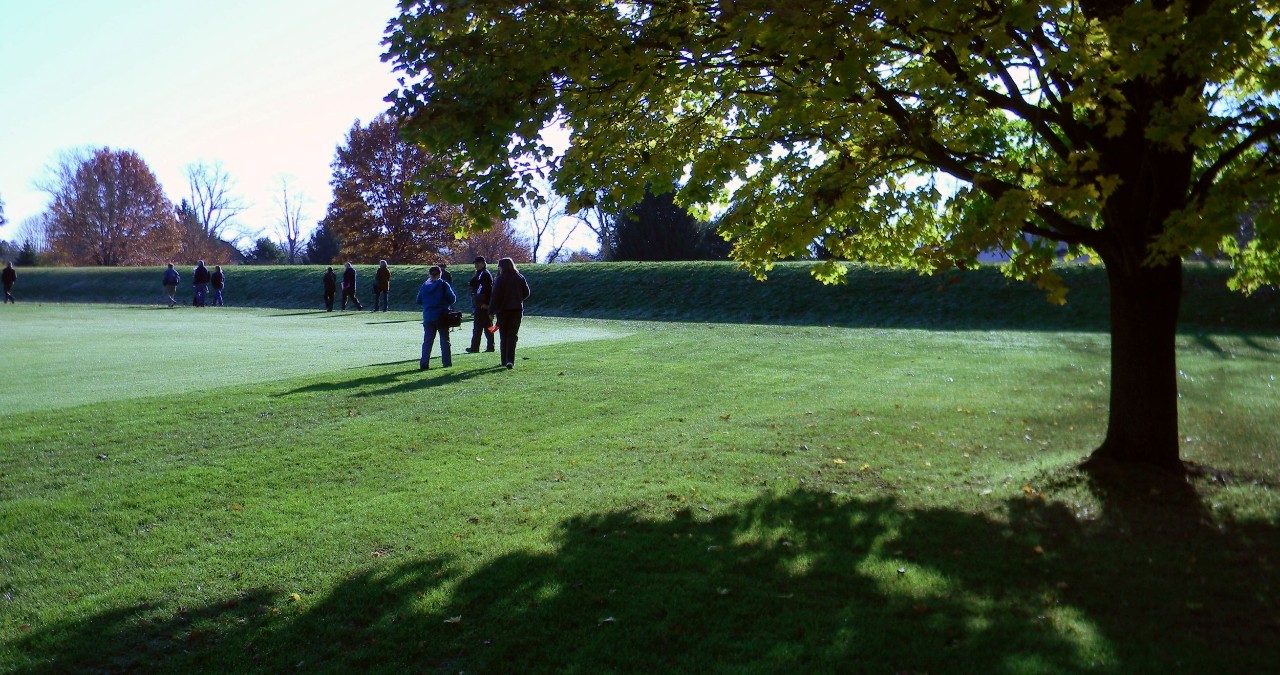
The designation pertains to eight sites in central and southern Ohio where vast earthen structures were built by American Indigenous people nearly 2,000 years ago. These earthworks — huge geometric and hilltop enclosures, lined with gateways and ponds — served as central ceremonial sites for festivals and religious gatherings, likely based around observations of moonrises.
In an article in National Geographic, one site alone is described as being “capable of holding four Roman Coliseums.”
“People have no idea about the brilliance of this culture and the ancient architectural monuments that are around here,” Hancock says of first learning about the earthworks himself in the late 1990s while teaching architectural history and theory at UC’s College of Design, Architecture, Art, and Planning. (DAAP).


Calling it a “moment of discovery,” Hancock went on to secure federal, state and UC grants to research the earthworks and their builders, to develop methods for making them more comprehensible to the public and to create an online guide to all of Ohio’s earthworks.
From there, for nearly two decades, Hancock helped lead the team of archaeologists, historians and Native American scholars, including staff at the National Park Service and Ohio History Connection, all of whom worked tirelessly to make the case for the earthworks to be recognized on par with other World Heritage sites such as the Great Wall of China and Stonehenge.
One difficulty, as Hancock describes in a Slate magazine feature, was that the sites had been damaged over many decades by settlement, farming and industry.
“If a Greek temple is in ruins, you can see it, and it’s still pretty interesting,” Hancock told the magazine. However, many of the Hopewell sites in the region, he stated, were flat, covered in forest or simply too large in scale to be comprehensible. “We had to come up with a way of describing the integrity of the sites through a combination of the architecture you can see and the archaeological evidence you can’t see.”
Now that the Ohio earthworks are designated as World Heritage sites, the team is working to update and upgrade visitor experience materials, interpretive signage and online resources for the expected increase in regional tourism.
Featured image at top of Mound City provided by Hancock.
Impact Lives Here
The University of Cincinnati is leading public urban universities into a new era of innovation and impact. Our faculty, staff and students are saving lives, changing outcomes and bending the future in our city's direction. Next Lives Here.
Related Stories
Sugar overload killing hearts
November 10, 2025
Two in five people will be told they have diabetes during their lifetime. And people who have diabetes are twice as likely to develop heart disease. One of the deadliest dangers? Diabetic cardiomyopathy. But groundbreaking University of Cincinnati research hopes to stop and even reverse the damage before it’s too late.
Is going nuclear the solution to Ohio’s energy costs?
November 10, 2025

The Ohio Capital Journal recently reported that as energy prices continue to climb, economists are weighing the benefits of going nuclear to curb costs. The publication dove into a Scioto Analysis survey of 18 economists to weigh the pros and cons of nuclear energy. One economist featured was Iryna Topolyan, PhD, professor of economics at the Carl H. Lindner College of Business.
App turns smartwatch into detector of structural heart disease
November 10, 2025

An app that uses an AI model to read a single-lead ECG from a smartwatch can detect structural heart disease, researchers reported at the 2025 Scientific Sessions of the American Heart Association. Although the technology requires further validation, researchers said it could help improve the identification of patients with heart failure, valvular conditions and left ventricular hypertrophy before they become symptomatic, which could improve the prognosis for people with these conditions.