Local 12: How to spot misinformation about the Israel-Hamas war
UC professor says outrage can be a tool of manipulation

Misinformation about the war between Israel and Hamas is abundant online, but there are ways to avoid falling for fake news, a University of Cincinnati professor told Local 12.
Many people have turned to social media for real-time updates about the conflict in Israel and Palestine. However, people should maintain some skepticism about what they're seeing online, said Jeffrey Blevins, PhD, a professor in UC's Department of Journalism and School of Public and International Affairs.
“If you see something and you are outraged by it, instead of just leaning into that outrage, you should be skeptical,” Blevins said. “Is someone trying to persuade me, manipulate me, to believe something that is not necessarily true?”
To avoid falling for misinformation, look to accredited news institutions for accurate information. Big news and horrific stories likely will be reported on by multiple outlets, so be wary of stories from a single source. Reverse image searches also can help determine if photos are legitimate.
Also, be wary of information that purports to come from a legitimate news organization but in reality is disinformation.
“So one of these videos for instance, it looks like it comes from BBC, which of course is reputable news outlet,” Blevins said. “But essentially they just took BBC’s logo and put it on this video which falsely suggests, I mean it looks like a news report, but it is suggesting that Ukraine had provided the weaponry to Hamas to help pull off this attack in Israel.”
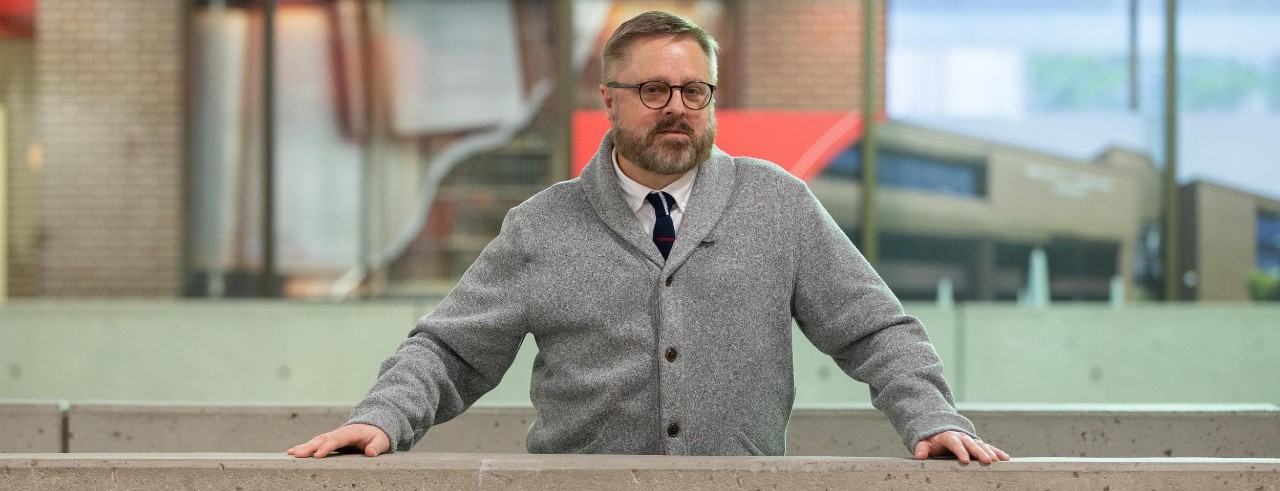
Featured image at top: Jeffrey Blevins, PhD, professor in UC's Department of Journalism and School of Public and International Affairs. Andrew Higley/UC Marketing + Brand
Impact Lives Here
The University of Cincinnati is leading public urban universities into a new era of innovation and impact. Our faculty, staff and students are saving lives, changing outcomes and bending the future in our city's direction. Next Lives Here.
Related Stories
Sugar overload killing hearts
November 10, 2025
Two in five people will be told they have diabetes during their lifetime. And people who have diabetes are twice as likely to develop heart disease. One of the deadliest dangers? Diabetic cardiomyopathy. But groundbreaking University of Cincinnati research hopes to stop and even reverse the damage before it’s too late.
Is going nuclear the solution to Ohio’s energy costs?
November 10, 2025

The Ohio Capital Journal recently reported that as energy prices continue to climb, economists are weighing the benefits of going nuclear to curb costs. The publication dove into a Scioto Analysis survey of 18 economists to weigh the pros and cons of nuclear energy. One economist featured was Iryna Topolyan, PhD, professor of economics at the Carl H. Lindner College of Business.
App turns smartwatch into detector of structural heart disease
November 10, 2025

An app that uses an AI model to read a single-lead ECG from a smartwatch can detect structural heart disease, researchers reported at the 2025 Scientific Sessions of the American Heart Association. Although the technology requires further validation, researchers said it could help improve the identification of patients with heart failure, valvular conditions and left ventricular hypertrophy before they become symptomatic, which could improve the prognosis for people with these conditions.