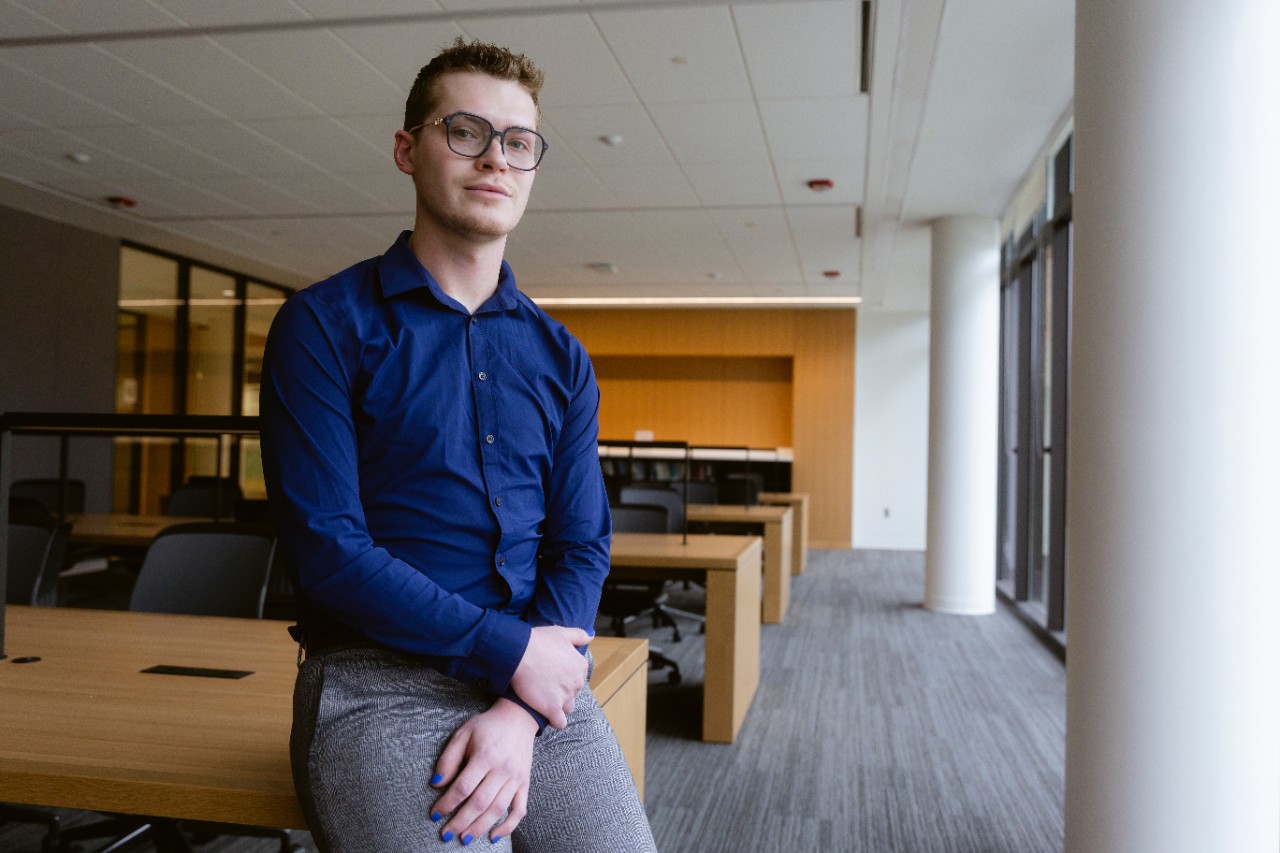
Brendan Mathews’ search for equitable outcomes

For the first two weeks of law school, Brendan Mathews (JD ‘23, PhD ‘25), divided his time between attending virtual classes at the University of Cincinnati College of Law and consulting with the Governor of Rhode Island to help overhaul the state's contact tracing efforts. From his makeshift office within the Rhode Island Health Department, Brendan adjusted to life as a law student during the COVID-19 pandemic.
“I had my little office in the health department where I would hop onto virtual class and then as soon as it was over, I would run around the health department having meetings with people, doing what I needed to do as an epidemiologist,” he recalled. “In the evenings I’d go to the gym, eat dinner, and read for classes the next day. Then get up early and do it all over again.”
Brought up in the rural town of Bardstown, Kentucky, Brendan said he always dreamed bigger than the life expected of him and his peers. His mom, who raised him solo, never let those big dreams seem too far out of reach.
“I always wanted to go on to do bigger, better things than the prescribed life,” he said. “Today, I do it all for my mom. She has been my support system and my reminder that I have the ability and the skillset to do this. So I'm gonna do it.”
Learn more about Brendan’s journey to a career in legal epidemiology, bridging his passion for public health and the law in his profile story “Bridging the Gap: Brendan Mathews' Search for Equitable Outcomes".
Photographer: Asa Featherstone
Tags
Related Stories
Sugar overload killing hearts
November 10, 2025
Two in five people will be told they have diabetes during their lifetime. And people who have diabetes are twice as likely to develop heart disease. One of the deadliest dangers? Diabetic cardiomyopathy. But groundbreaking University of Cincinnati research hopes to stop and even reverse the damage before it’s too late.
App turns smartwatch into detector of structural heart disease
November 10, 2025

An app that uses an AI model to read a single-lead ECG from a smartwatch can detect structural heart disease, researchers reported at the 2025 Scientific Sessions of the American Heart Association. Although the technology requires further validation, researchers said it could help improve the identification of patients with heart failure, valvular conditions and left ventricular hypertrophy before they become symptomatic, which could improve the prognosis for people with these conditions.
Why the need for public schools
November 10, 2025

UC Law professor Joseph Tomain argues for continued government support for public schools in the online publication, The Conversation.