Cincinnati Media: UC welcomes Bearcats living on campus for move-in day
Largest number of students in university housing ever

Rebecca Moore and her husband were able to park and load items into Calhoun Hall within 20 minutes. She was moving her youngest of three children into his residence hall this week at the University of Cincinnati
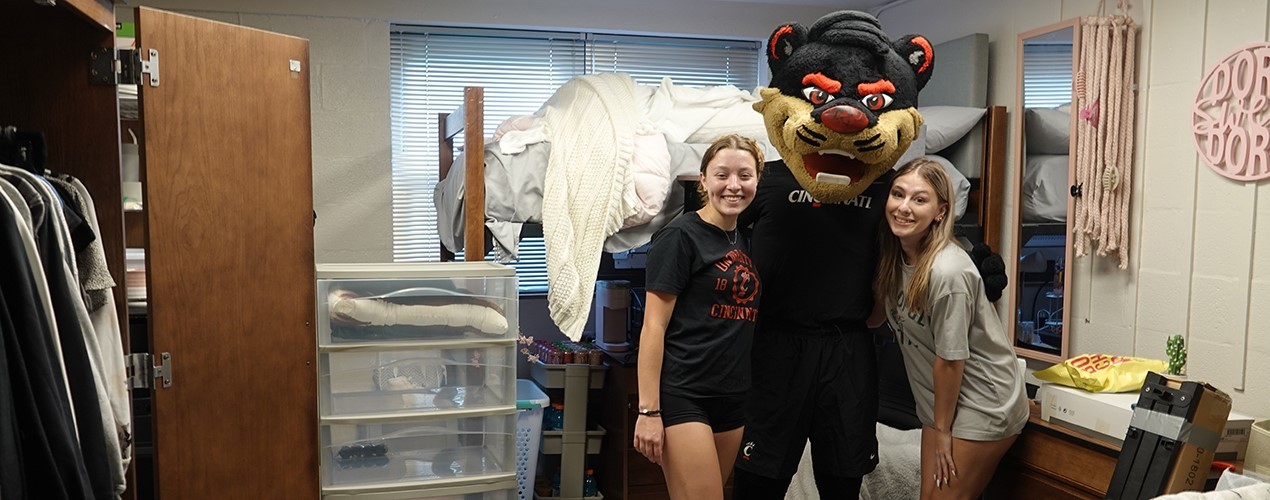
The day for the Moores went seamlessly as it did for many families visiting campus this week. UC’s first day of class is Monday, Aug. 21. Move-ins occurred at residential communities across campus during the week of Aug. 14. Parents took lots of pictures while the Bearcat sometimes joined in the fun.
“It’s really becoming an event,” says Jack Miner, vice provost for enrollment management. “It’s not just a move-in, it’s all the energy and excitement around it.”
Miner says university housing has found space for more than 8,000 students — the largest number of students ever.

Bearcat posses with one of our newest Bearcats in a university residence hall during move-in day. Photo submitted.
"Housing is always an opportunity to really think about how we are impacting the lives of the students,” explains Miner. “It is phenomenal for us and is a chance to think about how those students are getting a full set of wrap-around services in addition to a really great place to live.”
UC typically offers around 20 residential communities with varied amenities, price points and specialized living-learning opportunities designed to support students as they transition in and progress through their academic career.
Full-time staff are assigned in each residential community and 188 resident assistants are embedded across the communities on each floor.
For this academic year, UC has eight living-learning communities that provide students a dynamic educational experience in their residential environment with others who have similar academic interests.

The doors at Calhoun Hall say it all during move-in week at UC. Photo submitted.
Students in residence communities will have the opportunity to develop life skills including leadership, inclusion, community and learning. Students can become engaged citizens and experience-based learners.
“One of the things parents are often surprised by is this is a very different residence hall experience than what we had in college,” says Miner. “Students are moving into Calhoun Hall following an 18-month renovation and it is a chance to have Wi-Fi access, crucial support services, but this also has one of the most amazing views in the city.”
Neighboring Siddall Hall is currently under renovation and it will have amenities similar to Calhoun Hall and will be complete in August 2024.
Listen to coverage of move-in day from Cincinnati media:
Featured image at top/provided

Parents were all smiles with Bearcat and new Bearcats alike during move-in week at the Unviersity of Cincinnati. Photo submitted.
Related Stories
Sugar overload killing hearts
November 10, 2025
Two in five people will be told they have diabetes during their lifetime. And people who have diabetes are twice as likely to develop heart disease. One of the deadliest dangers? Diabetic cardiomyopathy. But groundbreaking University of Cincinnati research hopes to stop and even reverse the damage before it’s too late.
Is going nuclear the solution to Ohio’s energy costs?
November 10, 2025

The Ohio Capital Journal recently reported that as energy prices continue to climb, economists are weighing the benefits of going nuclear to curb costs. The publication dove into a Scioto Analysis survey of 18 economists to weigh the pros and cons of nuclear energy. One economist featured was Iryna Topolyan, PhD, professor of economics at the Carl H. Lindner College of Business.
App turns smartwatch into detector of structural heart disease
November 10, 2025

An app that uses an AI model to read a single-lead ECG from a smartwatch can detect structural heart disease, researchers reported at the 2025 Scientific Sessions of the American Heart Association. Although the technology requires further validation, researchers said it could help improve the identification of patients with heart failure, valvular conditions and left ventricular hypertrophy before they become symptomatic, which could improve the prognosis for people with these conditions.