Exploring express licensing through the University of Cincinnati
Streamlining innovation for faculty

In today's rapidly evolving landscape of startups, the process of licensing innovations can often be a complex and time-consuming endeavor.
However, for faculty or staff seeking to bring their ideas or technology to the market and for entrepreneurs eager to collaborate with these inventors, the University of Cincinnati developed an innovative solution — express licensing.
This initiative encourages faculty members to efficiently protect and commercialize their discoveries.
Geoffrey Pinski, UC assistant vice president for technology transfer, shares the benefits of express licensing for faculty inventors and its potential for collaboration between academia and industry in driving transformation.
“The primary purpose of developing the express license offered by UC is to streamline and simplify the licensing process for faculty creators. Looking to increase the pace at which startups were emerging, UC identified a need to expedite the path for faculty members to obtain licenses for their discoveries,” Pinski said.
Express licensing employs standardized license agreements with fixed terms to speed up the licensing process with predefined terms and conditions. By eliminating the need for negotiations that are common with customized agreements, express licenses are typically much quicker to execute — and usually require less complicated paperwork.
Looking to increase the pace at which startups were emerging, UC identified a need to expedite the path for faculty members to obtain licenses for their discoveries.
Geoffrey Pinski UC assistant vice president for technology transfer
“By eliminating unnecessary steps and reducing bureaucratic hurdles, we empowered inventors with a clearer understanding of what it takes to bring their intellectual property to the market through UC’s express licensing agreement," Pinski said. "There is a boundary at which the technology leaves the institution. We aim to help inventors accelerate the process to successfully commercialize their discovery under terms both parties feel is equitable."
Zalfa A. Abdel-Malek, PhD is one faculty member who has used the express license. A professor of dermatology at UC’s College of Medicine, Abdel-Malek developed a topical cream to protect against skin cancer, avoid wrinkles and trigger receptors in the skin to increase pigmentation — something available sunscreen options do not activate.
Through the tech transfer team, UC licensed the technology to Abdel-Malek’s startup company, MC1R Ventures. Her skin cream is on its way to being commercialized and available within the next few years.
Jason Heikenfeld, PhD, a professor in the UC College of Engineering and Applied Science, also has used the express license. One of his latest innovations is a wearable technology that provides clinicians and patients remote health monitoring through a body sensor for chronic disease indicators beyond glucose.
With over 40 issued patents and 300 U.S. applications already under his name, Heikenfeld works closely with the UC tech transfer team to protect and commercialize his discoveries while attracting investors. This partnership has resulted in seven startups with his most recent startup Kilele Health focused on commercializing his recent wearable technology.
“Faculty inventors who license their intellectual property through UC’s tech transfer office get an entire team behind them working hard to investigate, negotiate and facilitate collaborations with entrepreneurs and investors," Pinski said. "We want to help their invention live and be successful. Our team, working in close collaboration with UC’s Center for Entrepreneurship and Venture Lab is part of a machine that actively contributes to a larger goal of helping drive economic development through the launch of these startups. This leads to job opportunities fostering a more vibrant and thriving community.”
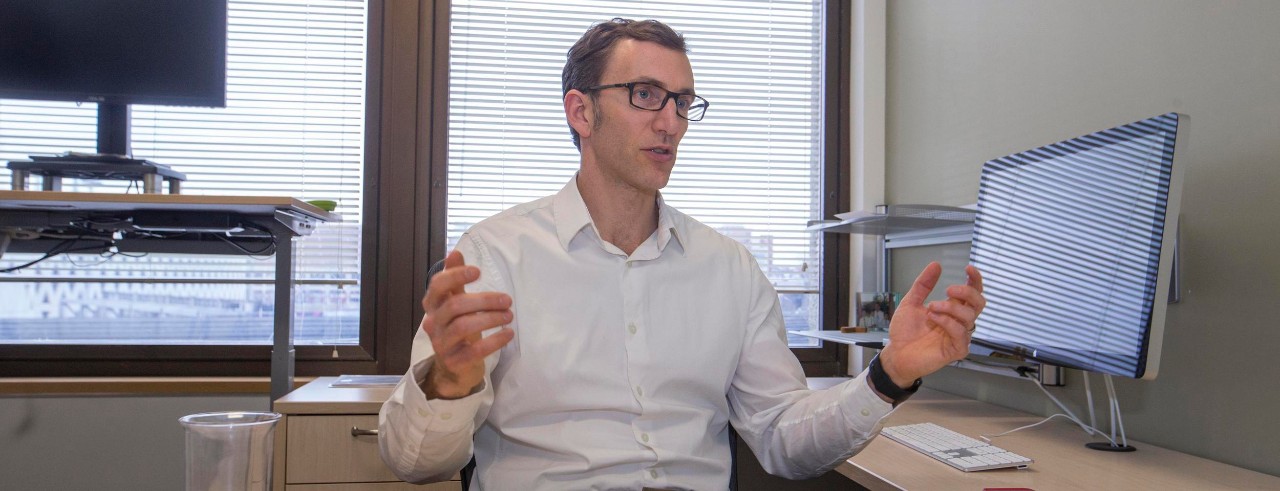
Featured image at top: Jason Heikenfeld, PhD, in his office. Joseph Fuqua II/UC Marketing + Brand
Innovation Lives Here
The University of Cincinnati is leading public urban universities into a new era of innovation and impact. Our faculty, staff and students are saving lives, changing outcomes and bending the future in our city's direction. Next Lives Here.
Related Stories
Sugar overload killing hearts
November 10, 2025
Two in five people will be told they have diabetes during their lifetime. And people who have diabetes are twice as likely to develop heart disease. One of the deadliest dangers? Diabetic cardiomyopathy. But groundbreaking University of Cincinnati research hopes to stop and even reverse the damage before it’s too late.
App turns smartwatch into detector of structural heart disease
November 10, 2025

An app that uses an AI model to read a single-lead ECG from a smartwatch can detect structural heart disease, researchers reported at the 2025 Scientific Sessions of the American Heart Association. Although the technology requires further validation, researchers said it could help improve the identification of patients with heart failure, valvular conditions and left ventricular hypertrophy before they become symptomatic, which could improve the prognosis for people with these conditions.
Combination immunotherapy helps overcome melanoma treatment resistance
November 10, 2025

MSN highlighted research led by the University of Cincinnati Cancer Center's Trisha Wise-Draper showing a combination of immunotherapy medications can activate a robust immune response and help overcome treatment resistance in patients with refractory melanoma.