Smithsonian: How conservation paleobiology helps restore ecosystems
UC geosciences professor talks about tracking ancient caribou migrations

Smithsonian magazine highlighted an ongoing research project led by a University of Cincinnati ecologist that is tracking ancient caribou across thousands of years and hundreds of miles of Arctic tundra.
Joshua Miller, an assistant professor of geosciences in UC's College of Arts and Sciences, has spent years exploring the wilderness of the Arctic National Wildlife Refuge to collect ancient antlers, some of which have sat on the tundra undisturbed for thousands of years.

Researchers traveled rivers by inflatable raft to survey the Coastal Plain for shed caribou antlers in Alaska's Arctic National Wildlife Refuge. Photo/Joshua Miller
He and his research partners explore river valleys using a rigid inflatable boat before a bush plane picks them up on the coast of the Beaufort Sea.
Miller discovered that caribou have been using the same calving grounds to give birth to their babies for more than 3,000 years.
Female caribou shed their antlers within days of giving birth, leaving behind a record of their annual travels across Alaska and Canada’s Yukon that persists on the cold tundra for hundreds or even thousands of years. Researchers recovered antlers that have sat undisturbed on the arctic tundra since the Bronze Age.
The antlers represent a time capsule of the animal's life, diet and travels across the landscape that Miller and his research partners are unlocking using isotopic analysis.
His research demonstrates how important this part of the refuge is to caribou and highlights the longstanding and historic reliance on the migration among native people who hunt caribou for subsistence.
“You really can walk on the landscape today and get some essence of what caribou were doing thousands of years ago,” Miller told Smithsonian.
But his research shows how generations of caribou dating back millennia in Alaska have relied on the same summer and spring calving grounds.
While the enormous Porcupine herd's summer range has remained stable over time, Miller found that the Central Arctic herd's summer range shifted inland when intense oil development began in the 1980s.
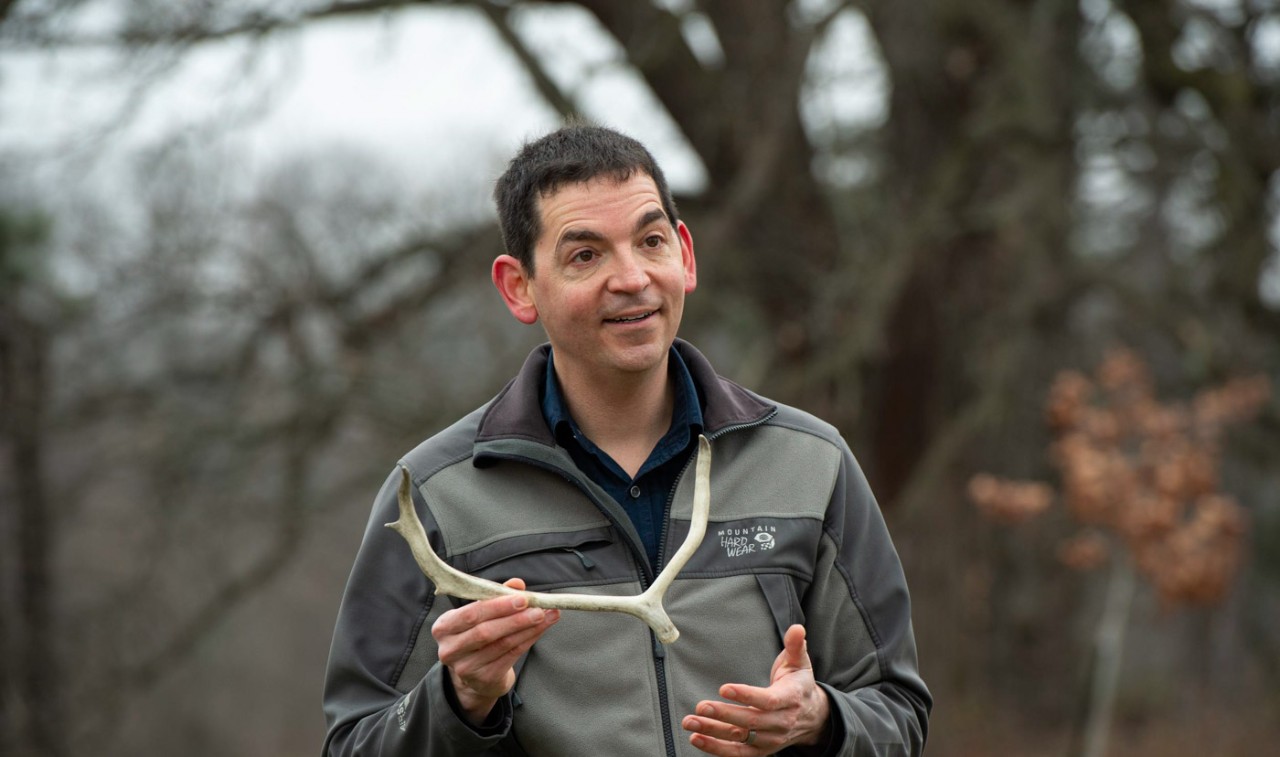
Featured image at top: UC Assistant Professor Joshua Miller holds up a caribou antler he collected in the Arctic National Wildlife Refuge. Photo/Colleen Kelley/UC

The Porcupine caribou herd has been using the same calving grounds for thousands of years, according to researchers from the University of Cincinnati. Photo/Lucian Provines
More UC Geosciences in the News

UC paleobiologist Joshua Miller studies a mastodon tusk. Photo/Andrew Higley/UC Marketing + Brand
- Yahoo! News: Eyeing the past to restore today's ecosystems
- Alaska Magazine: Search for ancient antlers
- Knowable Magazine: Conservation paleobiology
- Vigour Times: Using fossils to prepare for changing climate
- Billings Gazette: Old antlers help date caribou calving grounds to 3,000 years
Related Stories
Sugar overload killing hearts
November 10, 2025
Two in five people will be told they have diabetes during their lifetime. And people who have diabetes are twice as likely to develop heart disease. One of the deadliest dangers? Diabetic cardiomyopathy. But groundbreaking University of Cincinnati research hopes to stop and even reverse the damage before it’s too late.
Is going nuclear the solution to Ohio’s energy costs?
November 10, 2025

The Ohio Capital Journal recently reported that as energy prices continue to climb, economists are weighing the benefits of going nuclear to curb costs. The publication dove into a Scioto Analysis survey of 18 economists to weigh the pros and cons of nuclear energy. One economist featured was Iryna Topolyan, PhD, professor of economics at the Carl H. Lindner College of Business.
App turns smartwatch into detector of structural heart disease
November 10, 2025

An app that uses an AI model to read a single-lead ECG from a smartwatch can detect structural heart disease, researchers reported at the 2025 Scientific Sessions of the American Heart Association. Although the technology requires further validation, researchers said it could help improve the identification of patients with heart failure, valvular conditions and left ventricular hypertrophy before they become symptomatic, which could improve the prognosis for people with these conditions.