UC hosts exercise to prepare Ohio for potential cyberattacks
Cincinnati media report on state’s innovative approach that’s gaining worldwide attention

The Ohio Cyber Range Institute (OCRI) at the University of Cincinnati hosted a cybersecurity exercise that is preparing the state to respond to attacks and gaining attention from governments that want to emulate the approach, Cincinnati media reported.
Three teams from the Ohio Cyber Reserve, a volunteer force under the command of the state’s adjutant general, came to UC Digital Futures for the four-day exercise. They were evaluated based on their effectiveness, nimbleness and adherence to standard operating procedures.
“(There are) three teams from Cincinnati, Columbus and Cleveland," Craig Baker, program administrator for the Ohio Cyber Reserve, said to WCPO. "Everybody comes in on their own time, they’re not paid, they volunteer this time."

Craig Baker, program administrator for the Ohio Cyber Reserve, explains how members of the Ohio Cyber Reserve respond to cyberattacks.
The reservists were confronted with a simulated cyberattack against a fictional Ohio city.
"We can simulate the library system, we can simulate the offices that we'd have in a normal city," Bekah Michael, associate professor-educator in UC's School of Information Technology and executive staff director of the OCRI, said to WXVU. "And then also we're simulating the internet through gray space; we're simulating social media."
This was the second consecutive year that UC has hosted the cybersecurity exercise for the Ohio Cyber Reserve. The reservists hail from throughout Ohio and represent Cincinnati, Columbus and Cleveland units that can respond to cybersecurity incidents anywhere in the state.
"Unless you're constantly engaging and learning, you're a sitting duck," Scott Petersen, executive director of UC Digital Futures-Cyber Development, said to WLWT.
With growing dependence on the internet, now everyone is on the front line of cybersecurity, said Richard Harknett, director of the School of Public and International Affairs and co-director of the Ohio Cyber Range Institute.
“So, why are cyber criminals attacking the digital space? That’s where modern money is,” Harknett said to Local 12. “And money actually sits in data, our personal data.”

Leaders from the Ohio Cyber Range Institute at the University of Cincinnati take a photo with distinguished visitors at a cybersecurity exercise at UC Digital Futures.
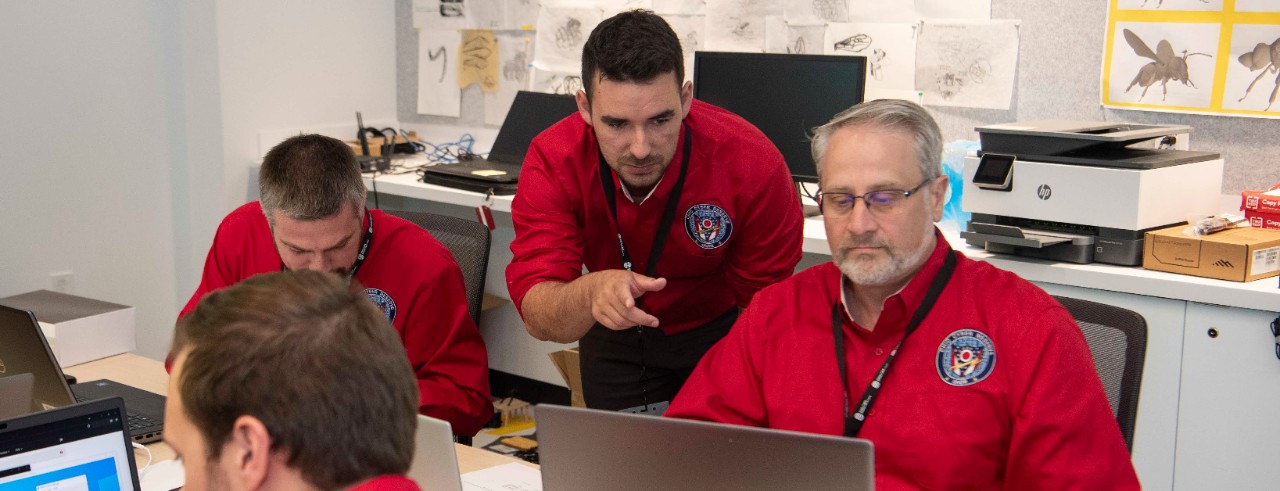
Featured image at top: Members of the Ohio Cyber Reserve respond to a simulated attack during a validation exercise at UC Digital Futures. All photos by Joseph Fuqua
Innovation Lives Here
The University of Cincinnati is leading public urban universities into a new era of innovation and impact. Our faculty, staff and students are saving lives, changing outcomes and bending the future in our city's direction. Next Lives Here.
Related Stories
Sugar overload killing hearts
November 10, 2025
Two in five people will be told they have diabetes during their lifetime. And people who have diabetes are twice as likely to develop heart disease. One of the deadliest dangers? Diabetic cardiomyopathy. But groundbreaking University of Cincinnati research hopes to stop and even reverse the damage before it’s too late.
Is going nuclear the solution to Ohio’s energy costs?
November 10, 2025

The Ohio Capital Journal recently reported that as energy prices continue to climb, economists are weighing the benefits of going nuclear to curb costs. The publication dove into a Scioto Analysis survey of 18 economists to weigh the pros and cons of nuclear energy. One economist featured was Iryna Topolyan, PhD, professor of economics at the Carl H. Lindner College of Business.
App turns smartwatch into detector of structural heart disease
November 10, 2025

An app that uses an AI model to read a single-lead ECG from a smartwatch can detect structural heart disease, researchers reported at the 2025 Scientific Sessions of the American Heart Association. Although the technology requires further validation, researchers said it could help improve the identification of patients with heart failure, valvular conditions and left ventricular hypertrophy before they become symptomatic, which could improve the prognosis for people with these conditions.