CNBC: Thales CEO recommends new approach to AI
Exec touts transparent, explainable AI created by UC graduate

Thales CEO Patrice Caine touted an artificial intelligence system created by a University of Cincinnati graduate as a responsible model for the future.
Caine spoke to CNBC about the need for companies to adopt responsible AI.
“AI can bring the best and the worst out,” Caine told CNBC. “That's why we developed this quite unique approach we call 'TRUE AI' for transparent, understandable and ethical AI.”
UC College of Engineering and Applied Science graduate Nick Ernest developed the system and is now working at Thales as chief architect in avionics.
“Transparent means you need to know how it works so it can't just be a black box,” Caine said.
“Understandable means at the end of the day to validate the idea proposed by the AI it needs to be understandable. You need to understand what it means when it says yes or no,” he said.
“And ethical values need to be taken into account. How? It's easy to say. More difficult to implement into our daily engineering job. But that's clearly the goal we set for ourselves.”
Thales, one of the world’s leading aerospace companies on national defense, space exploration and aeronautics, in March signed a five-year research agreement with UC to develop digital and aerospace technology.
Ernest and UC graduate Tim Arnett, senior AI researcher at Thales, gave a presentation on the novel artificial intelligence during this month’s North American Fuzzy Information Processing Society’s annual conference at UC’s Digital Futures building.
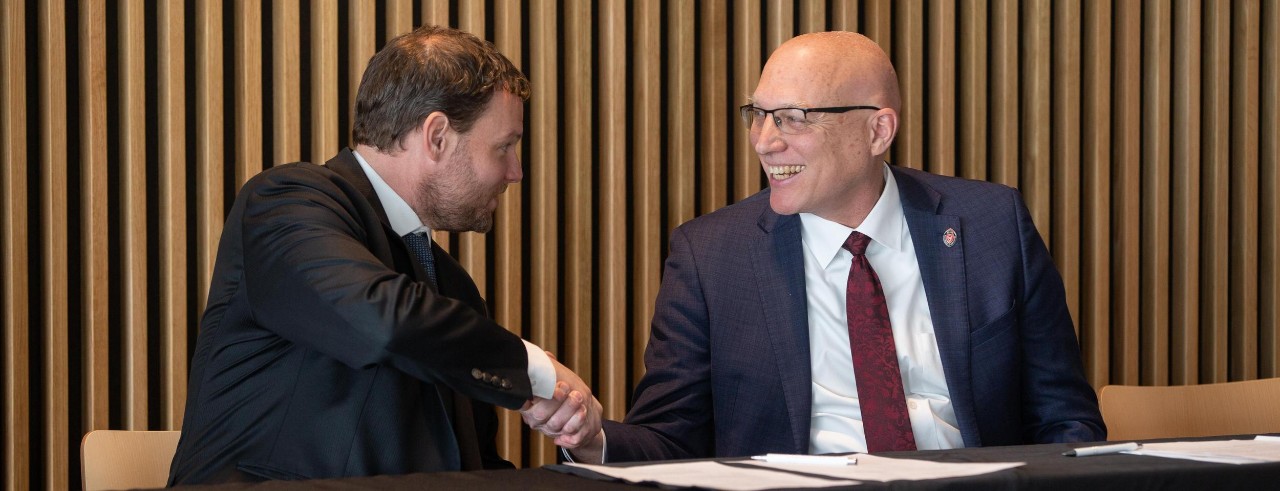
Featured image at top: Thales Vice President Yanik Doyon shakes hands with UC College of Engineering and Applied Science Dean John Weidner. Thales signed a five-year research agreement with UC to develop digital and aerospace technology. Photo/Andrew Higley/UC Marketing + Brand

Thales CEO Patrice Caine, right, and Renault CEO Luca de Meo talk to CNBC about incorporating AI technology into their businesses. Photo/CNBC
Related Stories
Sugar overload killing hearts
November 10, 2025
Two in five people will be told they have diabetes during their lifetime. And people who have diabetes are twice as likely to develop heart disease. One of the deadliest dangers? Diabetic cardiomyopathy. But groundbreaking University of Cincinnati research hopes to stop and even reverse the damage before it’s too late.
Is going nuclear the solution to Ohio’s energy costs?
November 10, 2025

The Ohio Capital Journal recently reported that as energy prices continue to climb, economists are weighing the benefits of going nuclear to curb costs. The publication dove into a Scioto Analysis survey of 18 economists to weigh the pros and cons of nuclear energy. One economist featured was Iryna Topolyan, PhD, professor of economics at the Carl H. Lindner College of Business.
App turns smartwatch into detector of structural heart disease
November 10, 2025

An app that uses an AI model to read a single-lead ECG from a smartwatch can detect structural heart disease, researchers reported at the 2025 Scientific Sessions of the American Heart Association. Although the technology requires further validation, researchers said it could help improve the identification of patients with heart failure, valvular conditions and left ventricular hypertrophy before they become symptomatic, which could improve the prognosis for people with these conditions.