NYT: Collective force increases odds of football concussions
UC biomedical engineer talks about latest study on chronic traumatic encephalopathy

The New York Times turned to a University of Cincinnati biomedical engineer to explain the significance of a new study linking the collective force of hits in football to concussions.
In his lab, UC College of Engineering and Applied Science Professor Eric Nauman studies ways to prevent concussions in contact sports, particularly football.
The Times reported on a study by Harvard Medical School published this month in Nature Communications that found that repeated small hits, not just a single devastating one, can lead to chronic traumatic encephalopathy. The study also found that the intensity of hits is a better predictor of concussion than counting the number of hits.
“Yes, all these hits matter. They all add up,” Nauman told the Times.

UC student Christopher Boles uses a modal hammer to strike a helmet. Photo/Andrew Higley/UC Marketing + Brand
Nauman said the findings also demonstrate the need for better safety equipment and policies such as no-contact practices that could reduce the risk of injury.
He co-authored a study this year in the Journal of Biomedical Engineering with his former students at Purdue University that tested how well helmets made by four leading manufacturers minimized the impact of hits to the head.
“None of the helmets was uniformly good or uniformly bad, except on the back of the helmet where they were all uniformly bad,” Nauman said.
“The helmets are generally designed to withstand the maximum possible impact. But that’s a 99th percentile type of hit. If you can design a helmet to protect players from the smaller, more typical hits, that would be ideal.”
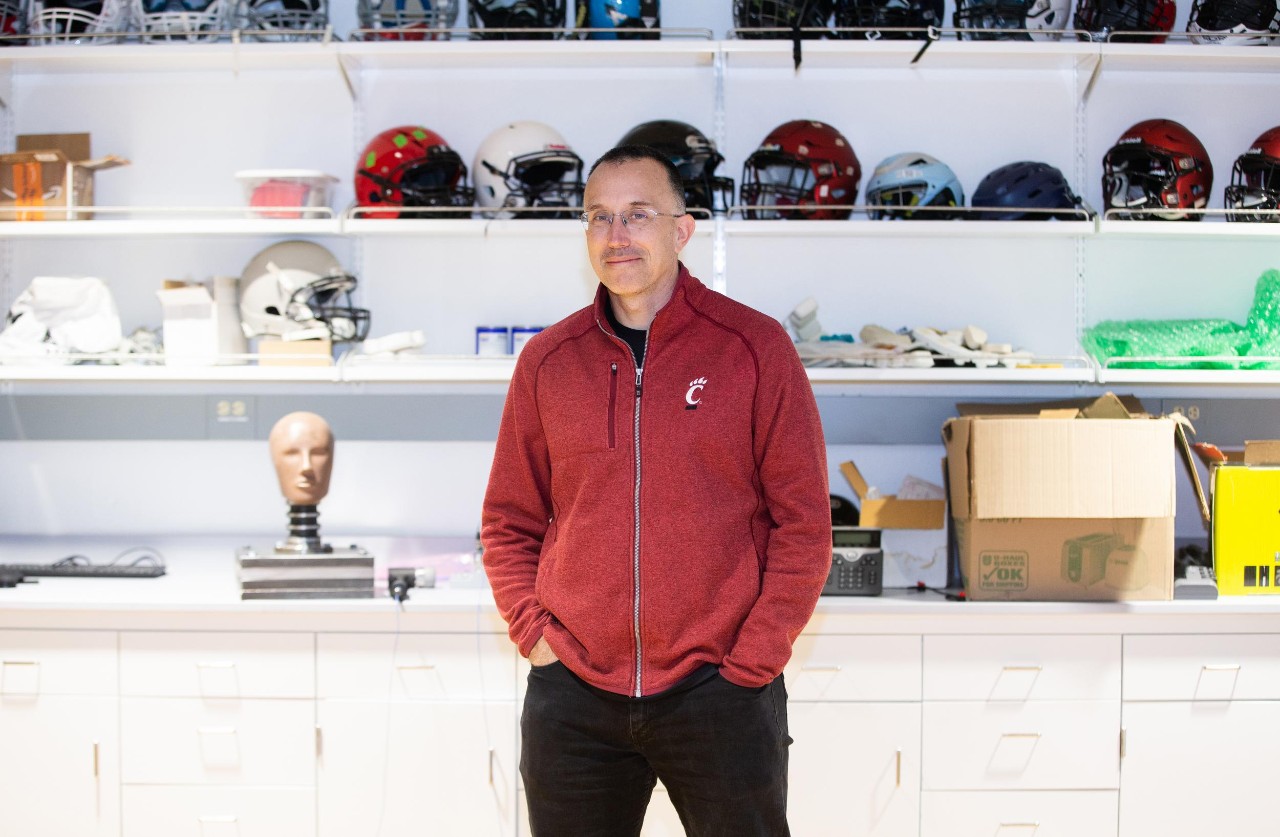
Featured image at top: UC College of Engineering and Applied Science Professor Eric Nauman studies ways to prevent concussions from contact sports in his biomedical engineering lab. Photo/Andrew Higley/UC Marketing + Brand
Related Stories
Sugar overload killing hearts
November 10, 2025
Two in five people will be told they have diabetes during their lifetime. And people who have diabetes are twice as likely to develop heart disease. One of the deadliest dangers? Diabetic cardiomyopathy. But groundbreaking University of Cincinnati research hopes to stop and even reverse the damage before it’s too late.
Is going nuclear the solution to Ohio’s energy costs?
November 10, 2025

The Ohio Capital Journal recently reported that as energy prices continue to climb, economists are weighing the benefits of going nuclear to curb costs. The publication dove into a Scioto Analysis survey of 18 economists to weigh the pros and cons of nuclear energy. One economist featured was Iryna Topolyan, PhD, professor of economics at the Carl H. Lindner College of Business.
App turns smartwatch into detector of structural heart disease
November 10, 2025

An app that uses an AI model to read a single-lead ECG from a smartwatch can detect structural heart disease, researchers reported at the 2025 Scientific Sessions of the American Heart Association. Although the technology requires further validation, researchers said it could help improve the identification of patients with heart failure, valvular conditions and left ventricular hypertrophy before they become symptomatic, which could improve the prognosis for people with these conditions.