UC biologist unlocks secret of metal-munching bacteria
NSF awards molecular biologist early-career grant to pursue research

A University of Cincinnati molecular biologist is pioneering research into organisms that feed on metals that has broad implications for green energy and environmentally friendly electronics.
UC College of Arts and Sciences Assistant Professor Annette Rowe is studying the power of microbes that can use minerals to store an electrical charge and then recover that energy when needed — like an organic battery.

Annette Rowe studies electromicrobiology in her lab. Photo/Andrew Higley/UC Marketing + Brand
“I wish we had been doing this research 30 years ago,” Rowe said. “There’s a lot of potential here to help mitigate and solve problems we’re facing today.”
Rowe is a recipient of a prestigious National Science Foundation Faculty Early Career Development Program grant, which recognizes the promising work of 500 researchers nationwide each year. The grants support faculty who have the potential to serve as role models in research and education and to lead advances in their specialty.
Rowe studies the metabolism of microbes — what they consume and how they do it.
“Most organisms would prefer to eat carbon: sugars or proteins or juicy polymers of reduced carbon substrates like fats,” she said. “That’s a really easy source of energy to use. We use it as building blocks to make more of ourselves.”

UC Assistant Professor Annette Rowe and postdoctoral researcher Sharanya Sriram examine a microscopic sample in Rowe's lab. Photo/Andrew Higley/UC Marketing + Brand
But some bacteria and other organisms are able to live off inorganic minerals. They produce energy through chemical reactions with metals such as iron or sulfur using compounds such as carbon dioxide to build more of themselves.
“A lot of minerals oxidize naturally. But is it the microbe doing it or the environment?” Rowe said. “The work we’ve been doing is decoupling some of that.”
Rowe said there is growing interest in understanding these processes to harness energy and create better technology.
“One potential benefit is replacing catalysts on electrodes. Usually these are made from rare earth elements like platinum or palladium. They are expensive to mine,” Rowe said. “But biology can catalyze the same process and allow us to replace these rare earth elements with microbes that can do the same thing.”

In Assistant Professor Annette Rowe's lab, researchers use an anaerobic chamber to study bacteria. Photo/Andrew Higley/UC Marketing + Brand
Likewise, the research could help improve technologies that generate methane such as natural gas from sewage treatment. Most sewage treatment plants only efficiently generate 60 to 80% of methane through anaerobic digestion.
“We tend to just burn it off so it becomes another waste product,” she said. “Coming up with technologies that can take that 80% methane conversion to a 95% threshold would be very valuable.”
Rowe comes from a science family. Her parents are physicians. She considered studying virology but she became fascinated with the way our cells make energy.
Her research draws on chemistry, engineering and biology. She earned a doctorate in microbiology while working in an environmental engineering lab.
“I wish I had paid more attention in physics,” she joked. “As a researcher, you’re going to have to learn things outside of your training.”
Rowe’s research also has implications for space exploration and the ongoing search for extraterrestrial life. If life exists outside Earth, it likely will be driven by geology or energy derived from heat rather than light, she said.
“It’s definitely never boring,” she said. “There’s a steep learning curve. And some frustration in being on the cutting edge. Nobody has done any of this before, so getting it to work will be a challenge.”
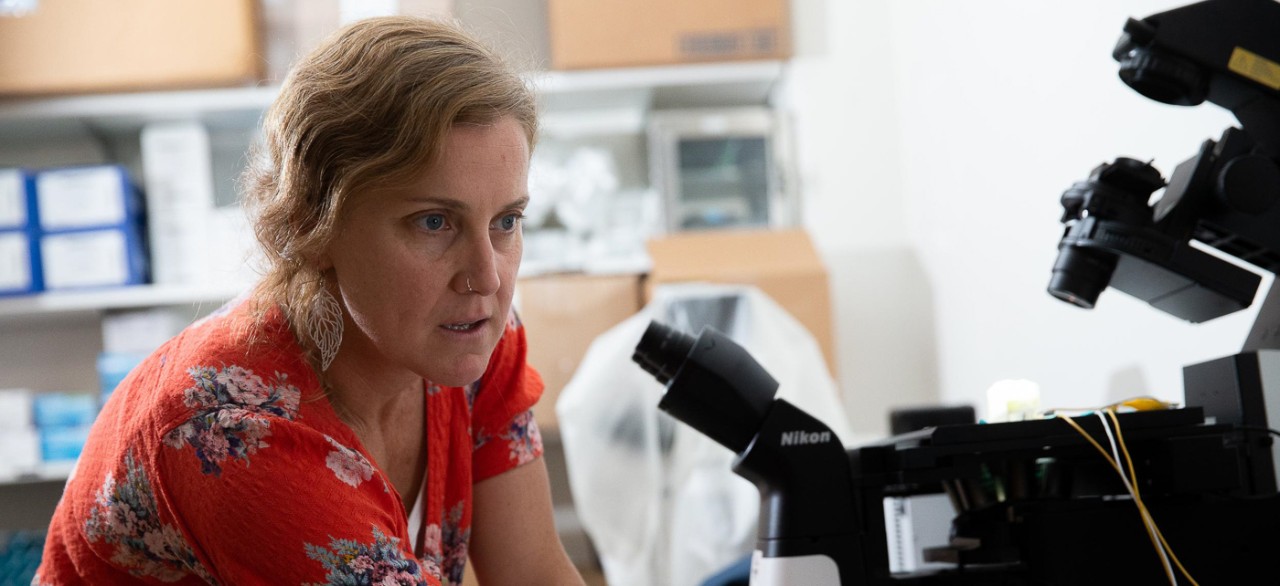
Featured image at top: UC College of Arts and Sciences Assistant Professor Annette Rowe is a 2023 recipient of an Early Career Grant from the National Science Foundation that will support her electromicrobiology research. Photo/Andrew Higley/UC Marketing + Brand

NSF early career grant recipient Annette Rowe and her students explore electromicrobiology in her lab in UC's College of Arts and Sciences. Photo/Andrew Higley/UC Marketing + Brand
Next Lives Here
The University of Cincinnati is leading public urban universities into a new era of innovation and impact. Our faculty, staff and students are saving lives, changing outcomes and bending the future in our city's direction. Next Lives Here.
Related Stories
Sugar overload killing hearts
November 10, 2025
Two in five people will be told they have diabetes during their lifetime. And people who have diabetes are twice as likely to develop heart disease. One of the deadliest dangers? Diabetic cardiomyopathy. But groundbreaking University of Cincinnati research hopes to stop and even reverse the damage before it’s too late.
App turns smartwatch into detector of structural heart disease
November 10, 2025

An app that uses an AI model to read a single-lead ECG from a smartwatch can detect structural heart disease, researchers reported at the 2025 Scientific Sessions of the American Heart Association. Although the technology requires further validation, researchers said it could help improve the identification of patients with heart failure, valvular conditions and left ventricular hypertrophy before they become symptomatic, which could improve the prognosis for people with these conditions.
Combination immunotherapy helps overcome melanoma treatment resistance
November 10, 2025

MSN highlighted research led by the University of Cincinnati Cancer Center's Trisha Wise-Draper showing a combination of immunotherapy medications can activate a robust immune response and help overcome treatment resistance in patients with refractory melanoma.