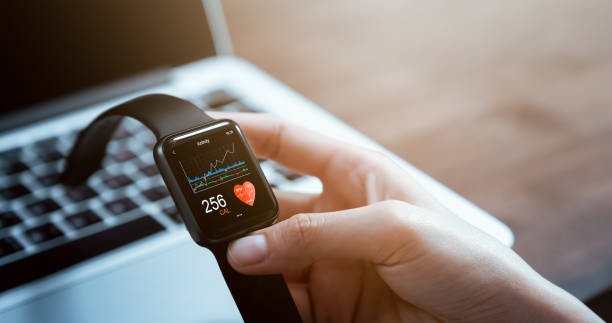
Local 12: Apple Watch saves local woman's life from deadly blood clot
UC cardiologist sees wearables as part of the health technology of the future

A Cincinnati woman is thanking her smartwatch for alerting her to a dangerous medical condition.
Kimmie Watkins, 29, wasn't feeling well one day, so she decided to sleep it off. Her Apple Watch woke her up because her heart rate had spiked to 178 beats per minute.
The notification wasn't a new text message or an incoming phone call, it was an alert that something was wrong with Watkins. Earlier in the day, Watkins felt lightheaded, winded and dizzy. Watkins said she assumed it was due to not eating much, and because she didn't have a history of heart problems.
"I was asleep for about an hour and a half before my watch woke me up with this alarm that said that my heart rate had been too high for too long," she told Local 12. "So for over 10 minutes, it was too high."
Doctors told Watkins she had a saddle pulmonary embolism.

Richard Becker, MD, professor of medicine in the Division of Cardiovascular Health and Disease at the UC College of Medicine/Photo/Colleen Kelley/UC Marketing + Brand
Local 12 interviewed Richard Becker, MD, professor in the Division of Cardiovascular Health who said people who have one of those types of embolisms have a 50% chance of survival.
Having a heart rate of 178 beats per minute is comparable to that of an athlete at peak performance.
"A saddle pulmonary embolism is the most severe and life-threatening of all, because it's a blood clot that saddles both the blood vessel to the right lung and to the left lung," Becker said.
Becker said consumer heart rate monitors parallel those used in the hospital. They use a photo sensor to detect the person's electrical current.
"Part of me sees wearables as part of that movement of health," Becker said.
Becker is also part of a national study researching smartwatches as a way to detect atrial fibrillation. That's also known as AFIB, which is an irregular and often rapid heart rate that can cause poor blood flow.
Becker said people often don't know they have it, so it goes untreated.
Next Lives Here
The University of Cincinnati is classified as a Research 1 institution by the Carnegie Commission and is ranked in the National Science Foundation's Top-35 public research universities. UC's graduate students and faculty investigate problems and innovate solutions with real-world impact. Next Lives Here.
Related Stories
Sugar overload killing hearts
November 10, 2025
Two in five people will be told they have diabetes during their lifetime. And people who have diabetes are twice as likely to develop heart disease. One of the deadliest dangers? Diabetic cardiomyopathy. But groundbreaking University of Cincinnati research hopes to stop and even reverse the damage before it’s too late.
Is going nuclear the solution to Ohio’s energy costs?
November 10, 2025

The Ohio Capital Journal recently reported that as energy prices continue to climb, economists are weighing the benefits of going nuclear to curb costs. The publication dove into a Scioto Analysis survey of 18 economists to weigh the pros and cons of nuclear energy. One economist featured was Iryna Topolyan, PhD, professor of economics at the Carl H. Lindner College of Business.
App turns smartwatch into detector of structural heart disease
November 10, 2025

An app that uses an AI model to read a single-lead ECG from a smartwatch can detect structural heart disease, researchers reported at the 2025 Scientific Sessions of the American Heart Association. Although the technology requires further validation, researchers said it could help improve the identification of patients with heart failure, valvular conditions and left ventricular hypertrophy before they become symptomatic, which could improve the prognosis for people with these conditions.