Scientific American: Parrots are taking over the world
UC researcher explains why parrots are so adaptable

Scientific American turned to a University of Cincinnati researcher to explain what makes parrots so adaptable, particularly in cities they share with people.
According to the magazine, at least 60 of the world's 380 parrot species have breeding populations outside their historic geographic range. These transplants are thriving in new places where they have learned to adapt.
“They're animals that are really social. They live in cognitively complex social environments,” Grace Smith-Vidaurre, a postdoctoral fellow at the University of Cincinnati, told Scientific American. “They're like humans in a lot of ways.”
Smith-Vidaurre studies birds in UC Assistant Professor Elizabeth Hobson's lab.
Monk parakeets, in particular, have adapted to city life in places like Chicago, New Jersey, and Brooklyn, New York. They were introduced to the United States from South America through the pet trade.
So far, concerns that monk parakeets would become an agricultural pest in the United States have not come true. Instead, they seem to enjoy city life.
Now Smith-Vidaurre is comparing the vocalizations of the U.S. birds to those found in their native South America. She found that the calls made by birds living in this noisy city soundscape are less complex than those found in South America.
“Something about their environment might be constraining their ability to produce or perceive these vocal signatures,” she says.
Read the Scientific American story.
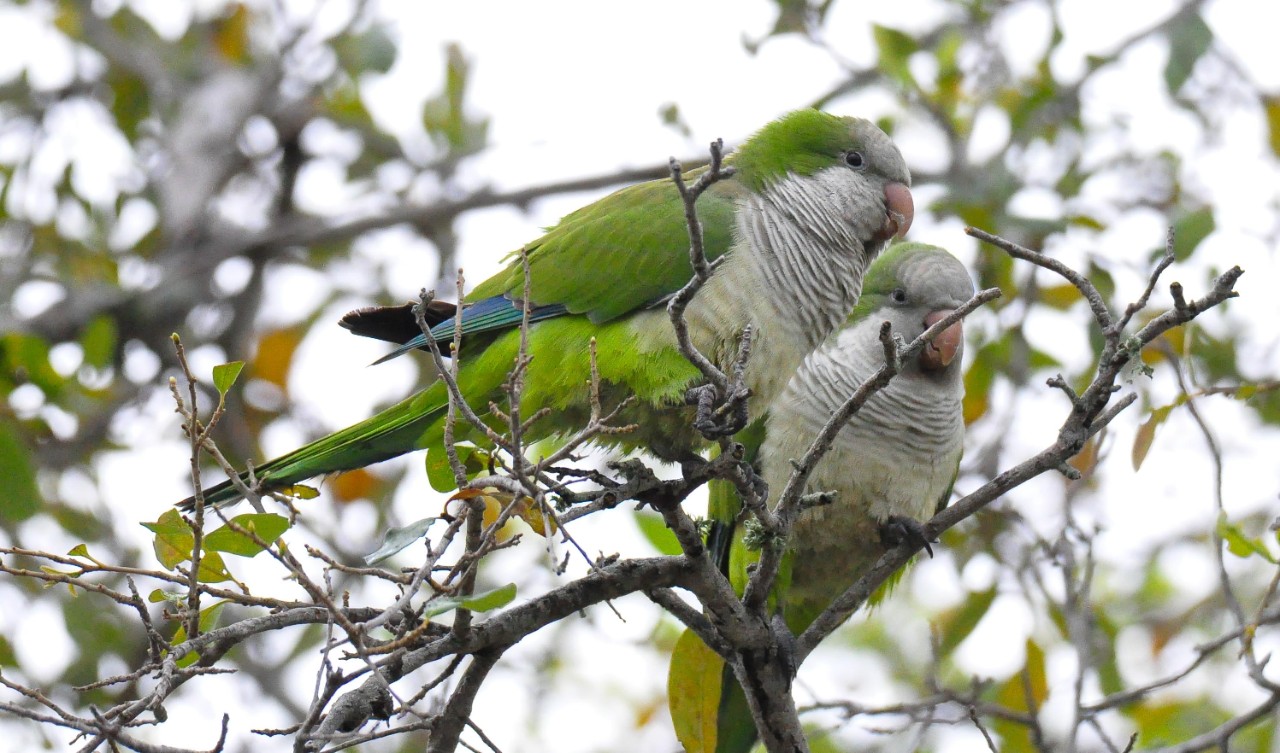
Featured image at top: Monk parakeets perch in a tree in Cape Coral, Florida. These nonnative, invasive species are thriving in many cities across the United States. Photo/Michael Miller
More UC biology in the news

UC Assistant Professor Elizabeth Hobson works with a parakeet in a flight cage in Florida. Photo/Provided
Related Stories
Sugar overload killing hearts
November 10, 2025
Two in five people will be told they have diabetes during their lifetime. And people who have diabetes are twice as likely to develop heart disease. One of the deadliest dangers? Diabetic cardiomyopathy. But groundbreaking University of Cincinnati research hopes to stop and even reverse the damage before it’s too late.
Is going nuclear the solution to Ohio’s energy costs?
November 10, 2025

The Ohio Capital Journal recently reported that as energy prices continue to climb, economists are weighing the benefits of going nuclear to curb costs. The publication dove into a Scioto Analysis survey of 18 economists to weigh the pros and cons of nuclear energy. One economist featured was Iryna Topolyan, PhD, professor of economics at the Carl H. Lindner College of Business.
App turns smartwatch into detector of structural heart disease
November 10, 2025

An app that uses an AI model to read a single-lead ECG from a smartwatch can detect structural heart disease, researchers reported at the 2025 Scientific Sessions of the American Heart Association. Although the technology requires further validation, researchers said it could help improve the identification of patients with heart failure, valvular conditions and left ventricular hypertrophy before they become symptomatic, which could improve the prognosis for people with these conditions.