UC study examines role of metabolites in disease treatment
Findings could result in first-of-its-kind treatments for an aortic aneurysm

Each year, about 200,000 people in the United States are diagnosed with a bulge in the lower part of the aorta, the main artery in the body, called an abdominal aortic aneurysm (AAA).
New research from the University of Cincinnati examines the role a particular metabolite plays in the development of AAA and could lead to the first treatment of the condition.
The research was published in the journal Circulation.
“We started the study by examining whether AAA patients themselves had an increase in trimethylamine N-oxide (TMAO). We examined an American and Swedish cohort with 354 human samples, and we compared those AAA patients to 1,775 control subjects,” says Phillip Owens, PhD, co-first author of the study along with Tyler Benson, PhD, both of the Division of Cardiovascular Health and Disease in the UC College of Medicine. “We started going into animal models after that, looking at what happens when we feed a high choline diet which leads to higher production of TMAO.”
Choline, found in a variety of foods with the richest sources being meat, fish, poultry, dairy and eggs, is processed into the organic compound TMAO when meat is digested by the bacteria in the gut.
The research found that in humans, TMAO levels were increased in AAA patients, but that doesn’t mean it is causing the disease state, according to Owens. To see if TMAO had an actual effect, researchers tried to replicate it in an animal model to manipulate the levels of TMAO and then block those in the subject to see whether TMAO increases were exacerbating the disease.

Kelsey Conrad/Photo/Provided
“We found that a high choline diet produces increased levels of AAA, and increased aneurysm rupture as well,” says Owens. “When we take that same model and inhibit the levels of TMAO using gut microbial inhibitors, inhibiting the conversion of the choline to the trimethylamine to the TMAO, we were able to reduce the levels of choline-induced AAA. It was in fact not the choline, but the choline-induced TMAO that led to an increase in aneurysm.”
Owens says the research came about as the result of interest expressed in the topic by former UC College of Medicine student Kelsey Conrad, PhD, who is a co-first author on the paper.
“It’s always one of my goals to try to get a project that interests the student, not just have them do something in my lab that I need to get done,” says Owens. “We created this project for that student then we filed a grant and found the funds. It’s not usually the way it goes.”
Conrad says she’s grateful to have worked with a mentor in Owens who supported her growth in a way that considered her past experiences and aligned with her professional goals.
“The potential for this work to radically change clinical care and improve patient outcomes in AAA is very exciting,” says Conrad who is now a faculty member at Smith College in Massachusetts. “Selectively targeting the gut microbes to prevent the progression of disease for this population would be a novel therapy for these patients who currently lack any pharmacological treatment options.”
Where I’m excited is if these inhibitors do make it to market, it’s potentially something in our arsenal that we can have for AAA where right now we have nothing.
Phillip Owens, PhD
There are an estimated 1 million men and women with AAAs in the United States and Owens says when you extrapolate that to the world population of 7 billion, that means potentially 20 to 30 million people worldwide have an AAA.
“We’ve gotten it to work in animal models which doesn’t necessarily mean it’s going to work in humans,” says Owens. “I think if the data has shown us one thing, it’s that TMAO is markedly increased in several cardiovascular diseases and if you inhibit it, at least in animal models, you do impact inflammation and overall mortality. Where I’m excited is if these inhibitors do make it to market, it’s potentially something in our arsenal that we can have for AAA where right now we have nothing.”
That may be a possibility sooner than later, Owens adds. Stanley Hazen at the Cleveland Clinic and co-author on the study, developed the drug fluoromethyl choline used in the studies and is constantly working on refining these inhibitors, which are currently being evaluated for their efficacy to inhibit TMAO in humans.
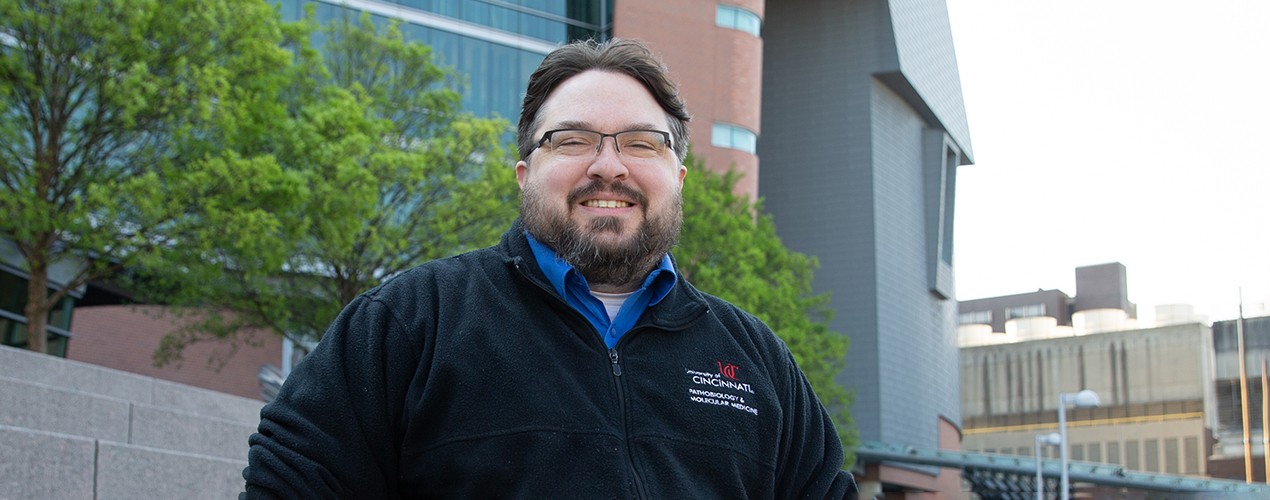
Lead photo at top of Phillip Owens/Andrew Higley/UC Marketing + Brand
Next Lives Here
The University of Cincinnati is classified as a Research 1 institution by the Carnegie Commission and is ranked in the National Science Foundation's Top-35 public research universities. UC's graduate students and faculty investigate problems and innovate solutions with real-world impact. Next Lives Here.
Related Stories
Sugar overload killing hearts
November 10, 2025
Two in five people will be told they have diabetes during their lifetime. And people who have diabetes are twice as likely to develop heart disease. One of the deadliest dangers? Diabetic cardiomyopathy. But groundbreaking University of Cincinnati research hopes to stop and even reverse the damage before it’s too late.
App turns smartwatch into detector of structural heart disease
November 10, 2025

An app that uses an AI model to read a single-lead ECG from a smartwatch can detect structural heart disease, researchers reported at the 2025 Scientific Sessions of the American Heart Association. Although the technology requires further validation, researchers said it could help improve the identification of patients with heart failure, valvular conditions and left ventricular hypertrophy before they become symptomatic, which could improve the prognosis for people with these conditions.
Combination immunotherapy helps overcome melanoma treatment resistance
November 10, 2025

MSN highlighted research led by the University of Cincinnati Cancer Center's Trisha Wise-Draper showing a combination of immunotherapy medications can activate a robust immune response and help overcome treatment resistance in patients with refractory melanoma.