WVXU: Researchers look to variations of psychedelic drugs as the future of mental health treatment
UC expert says research shows promise for improving treatment for mental health disorders

University of Cincinnati researchers are collaborating with researchers at Miami University to explore ways that psychedelic drugs could be used as treatments for a variety of mental illnesses. Andrew Jones, assistant professor of chemical, paper and biomedical engineering at Miami University, has successfully manufactured psilocybin in the lab. He is sharing those compounds with Eric Wohleb, PhD, of the Department of Pharmacology and Systems Physiology at the UC College of Medicine the compounds to test in Wholeb's lab.
WVXU produced a story on the research in which Wohleb will soon expand his research to study new compounds in lab-manufactured magic mushroomsto test their effectiveness in treating mental illness in animal models.

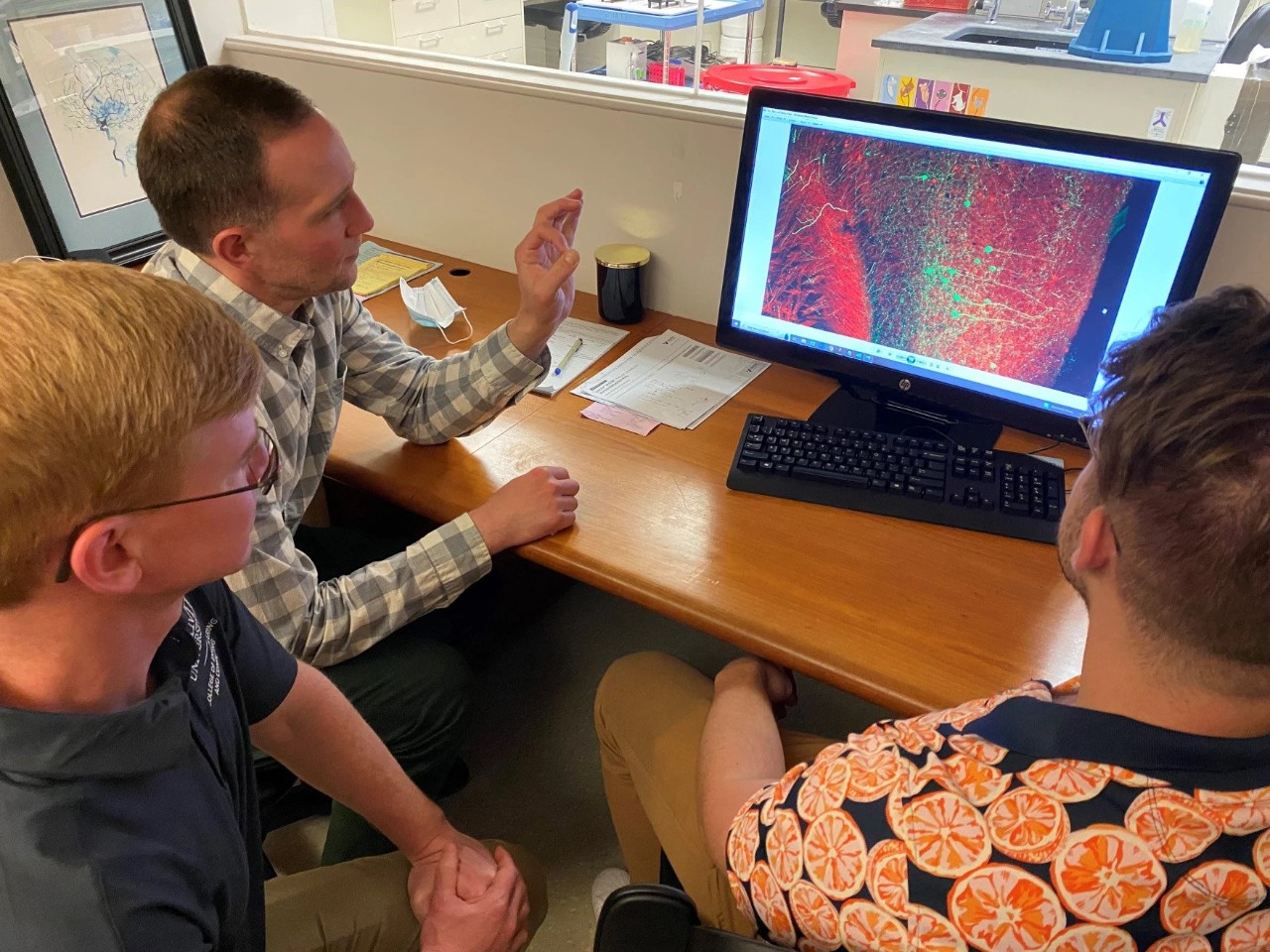
Eric Wohleb, PhD, and Christina Singh, research fellow/Photo/Colleen Kelley/UC Marketing + Brand
“That would kind of be the first pass at whether we see any beneficial effects of some of the compounds,” Wohleb said. “There are a few hurdles to jump through as far as DEA regulations and those types of things that we’re going to have to take care of but it’s a nice way because we’re relatively close and we have the capacity to collaborate.”
WVXU reported that one in four people in the U.S. are affected by mental disorders. Psychedelics could potentially help treat depression, anxiety, PTSD, obsessive-compulsive disorder, addiction, anorexia, bulimia, and more, according to Wohleb.
“An individual suffering from PTSD might also have a lot of depressive symptoms or anxiety symptoms and so finding these compounds that can change or alleviate symptoms across multiple disorders I think is really profound.”
Wohleb says there has been a fundamental shift in how psychiatry operates and it’s exciting to be working in this space.
Lead photo of Eric Wohleb, Andrew Jones and UC graduate student Alex Kuhn/Ann Thompson/WVXU
Next Lives Here
The University of Cincinnati is classified as a Research 1 institution by the Carnegie Commission and is ranked in the National Science Foundation's Top-35 public research universities. UC's graduate students and faculty investigate problems and innovate solutions with real-world impact. Next Lives Here.
Related Stories
Sugar overload killing hearts
November 10, 2025
Two in five people will be told they have diabetes during their lifetime. And people who have diabetes are twice as likely to develop heart disease. One of the deadliest dangers? Diabetic cardiomyopathy. But groundbreaking University of Cincinnati research hopes to stop and even reverse the damage before it’s too late.
Is going nuclear the solution to Ohio’s energy costs?
November 10, 2025

The Ohio Capital Journal recently reported that as energy prices continue to climb, economists are weighing the benefits of going nuclear to curb costs. The publication dove into a Scioto Analysis survey of 18 economists to weigh the pros and cons of nuclear energy. One economist featured was Iryna Topolyan, PhD, professor of economics at the Carl H. Lindner College of Business.
App turns smartwatch into detector of structural heart disease
November 10, 2025

An app that uses an AI model to read a single-lead ECG from a smartwatch can detect structural heart disease, researchers reported at the 2025 Scientific Sessions of the American Heart Association. Although the technology requires further validation, researchers said it could help improve the identification of patients with heart failure, valvular conditions and left ventricular hypertrophy before they become symptomatic, which could improve the prognosis for people with these conditions.