Fox19: UC hosts international aerospace conference on AI
UC aerospace professor talks about why we need trustworthy systems

Fox19 highlighted an international conference taking place at the University of Cincinnati that is exploring the future of artificial intelligence.
UC is playing host to the North American Fuzzy Information Processing Society's conference, which has drawn experts from around the world to UC's new Digital Futures building to examine innovations in artificial intelligence or AI.

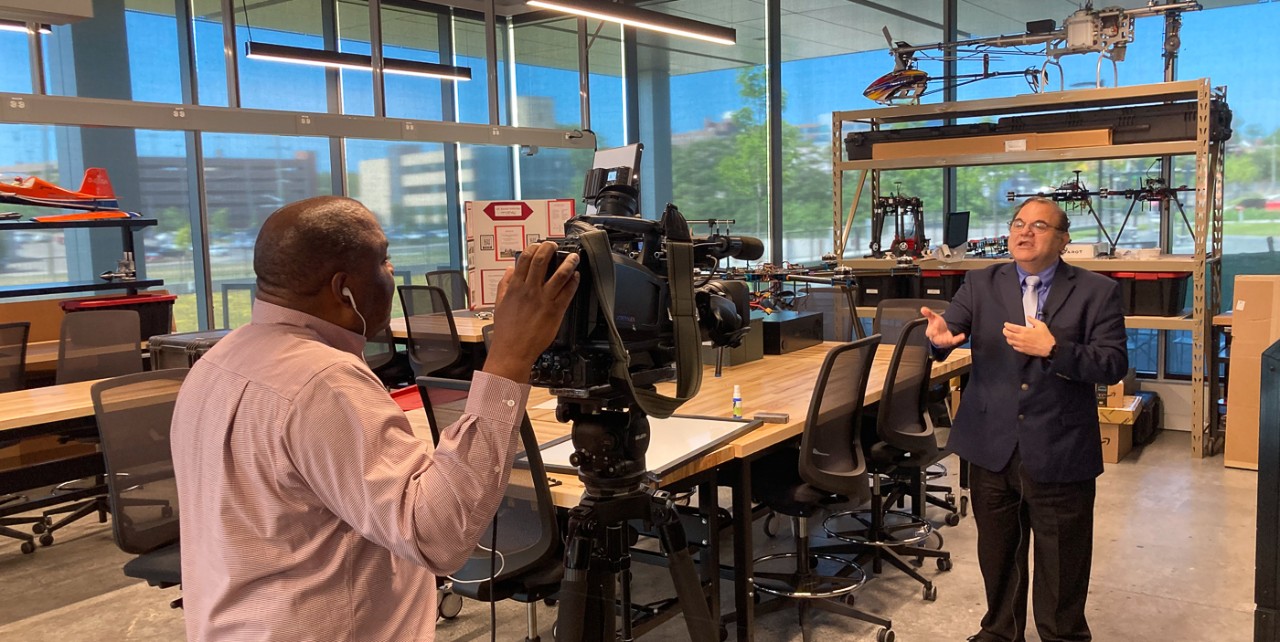
UC Aerospace Engineering Professor Kelly Cohen talks to Fox19 about artificial intelligence.
Fox19 spoke to UC College of Engineering and Applied Science Professor Kelly Cohen, who explained why AI applications are becoming more ubiquitous in our lives.
“We have a society is based on trust. Can I trust AI? Can I expect it to do exactly what I want it to do — no more, no less?” Cohen said. “We look into trust and verifiability. And that's what we're having panel discussions on.”
AI applications are becoming more common with innovations such as self-driving cars or computer programs that can write papers or songs or create artwork.
“Some people believe there's a danger to humanity. AI will take over. I don't think it will take over,” Vladik Kreinovich, a computer science professor at the University of Texas-El Paso, an expert in AI systems who is attending the conference.
“We have great tools like ChatGPT and we will use them. But these tools need explainability.”
Researchers are exploring the benefits of a type of artificial intelligence known as fuzzy logic that relies on degrees of truth rather than a binary true-false dichotomy. As a result, this artificial intelligence is both explainable and transparent.

In Ou Ma's lab, students are working on autonomous robots that can locate a wall outlet and plug themselves in for recharging and satellites that can fix other satellites in space. Photo/Andrew Higley/UC Marketing + Brand
Fox19 also highlighted robotics research in UC Professor Ou Ma's lab, where he, his students and his postdoctoral researchers are developing autonomous satellites that can refuel or repair other satellites in space.
In his lab, Ma is studying the complicated problem of approaching a malfunctioning or inoperable satellite that might be tumbling on its three axes in orbit and the challenge of reacting to that object's yaw, pitch and roll to safely capture it for repairs.
Featured image at top: UC Aerospace Engineering Professor Kelly Cohen talks to Fox19's Jason Maxwell about the international conference on artificial intelligence taking place at UC's Digital Futures building. Photo/Michael Miller
Related Stories
Sugar overload killing hearts
November 10, 2025
Two in five people will be told they have diabetes during their lifetime. And people who have diabetes are twice as likely to develop heart disease. One of the deadliest dangers? Diabetic cardiomyopathy. But groundbreaking University of Cincinnati research hopes to stop and even reverse the damage before it’s too late.
Is going nuclear the solution to Ohio’s energy costs?
November 10, 2025

The Ohio Capital Journal recently reported that as energy prices continue to climb, economists are weighing the benefits of going nuclear to curb costs. The publication dove into a Scioto Analysis survey of 18 economists to weigh the pros and cons of nuclear energy. One economist featured was Iryna Topolyan, PhD, professor of economics at the Carl H. Lindner College of Business.
App turns smartwatch into detector of structural heart disease
November 10, 2025

An app that uses an AI model to read a single-lead ECG from a smartwatch can detect structural heart disease, researchers reported at the 2025 Scientific Sessions of the American Heart Association. Although the technology requires further validation, researchers said it could help improve the identification of patients with heart failure, valvular conditions and left ventricular hypertrophy before they become symptomatic, which could improve the prognosis for people with these conditions.