New trial tests chemotherapy regimen following pancreatic cancer surgery
UC’s Ahmad leads SWOG national clinical trial

A new clinical trial is testing the effectiveness of chemotherapy treatment following surgery for a subset of pancreatic cancer patients.
The University of Cincinnati’s Syed Ahmad, MD, is the national principal investigator for the phase 2 Southwest Oncology Group (SWOG) 2104 trial.
Ahmad said he began work on this project several years ago in collaboration with Heloisa Soares, MD, PhD, of the University of Utah, through their collaboration as members of the cooperative SWOG Cancer Research Network.
The trial focuses on patients with pancreatic neuroendocrine tumors. The current standard of care for these patients is surgery only, followed by observation, but a subset of patients are at high risk for their cancer to return, Ahmad said.

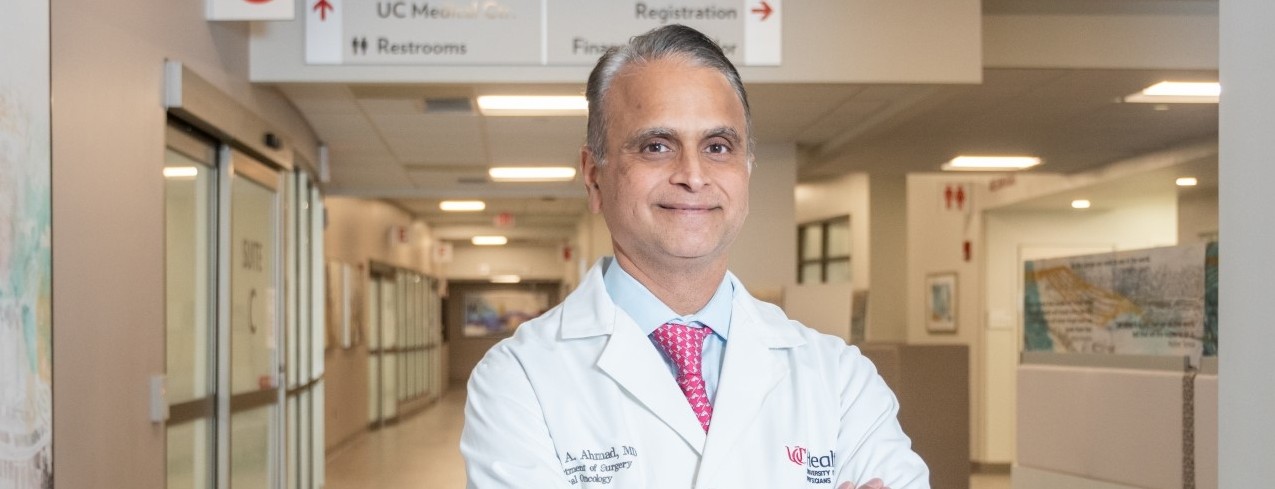
Dr. Ahmad is the principal investigator of the SWOG 2104 clinical trial. Photo/UC Health.
“In the past, we would just watch and wait as no studies had proven beneficial to prevent recurrence," said Ahmad, University of Cincinnati Cancer Center co-director and professor of surgery in UC’s College of Medicine. “However, there was a recent study in patients with advanced cancer showing the efficacy of chemotherapy drugs capecitabine and temozolomide. So we proposed and opened this combination of drugs in patients who have had surgery but are at high risk of recurrence.”
In the trial, patients who have had pancreatic neuroendocrine tumors surgically removed will be randomized to two study arms. Select patients will either receive the two chemotherapy drugs or a placebo.
“The primary endpoint is to see if we can prevent recurrence of the cancer,” Ahmad said. If the treatment regimen proves successful, it could lead to improved survival rates for these patients, he said.
The study has just opened at UC and aims to enroll 150 patients at sites throughout the country. Ahmad said being part of the SWOG Cancer Research Network helps advance research and patient care.
“It allows us to open studies at hundreds of sites to help with trial enrollment,” he said. “It allows us to open novel studies from other institutions so that our local patients have access to cutting edge therapy.”
Next Lives Here
The University of Cincinnati is classified as a Research 1 institution by the Carnegie Commission and is ranked in the National Science Foundation's Top-35 public research universities. UC's medical, graduate and undergraduate students and faculty investigate problems and innovate solutions with real-world impact. Next Lives Here.
Featured photo at top of Dr. Ahmad. Photo/University of Cincinnati Cancer Center.
Related Stories
Sugar overload killing hearts
November 10, 2025
Two in five people will be told they have diabetes during their lifetime. And people who have diabetes are twice as likely to develop heart disease. One of the deadliest dangers? Diabetic cardiomyopathy. But groundbreaking University of Cincinnati research hopes to stop and even reverse the damage before it’s too late.
Is going nuclear the solution to Ohio’s energy costs?
November 10, 2025

The Ohio Capital Journal recently reported that as energy prices continue to climb, economists are weighing the benefits of going nuclear to curb costs. The publication dove into a Scioto Analysis survey of 18 economists to weigh the pros and cons of nuclear energy. One economist featured was Iryna Topolyan, PhD, professor of economics at the Carl H. Lindner College of Business.
App turns smartwatch into detector of structural heart disease
November 10, 2025

An app that uses an AI model to read a single-lead ECG from a smartwatch can detect structural heart disease, researchers reported at the 2025 Scientific Sessions of the American Heart Association. Although the technology requires further validation, researchers said it could help improve the identification of patients with heart failure, valvular conditions and left ventricular hypertrophy before they become symptomatic, which could improve the prognosis for people with these conditions.