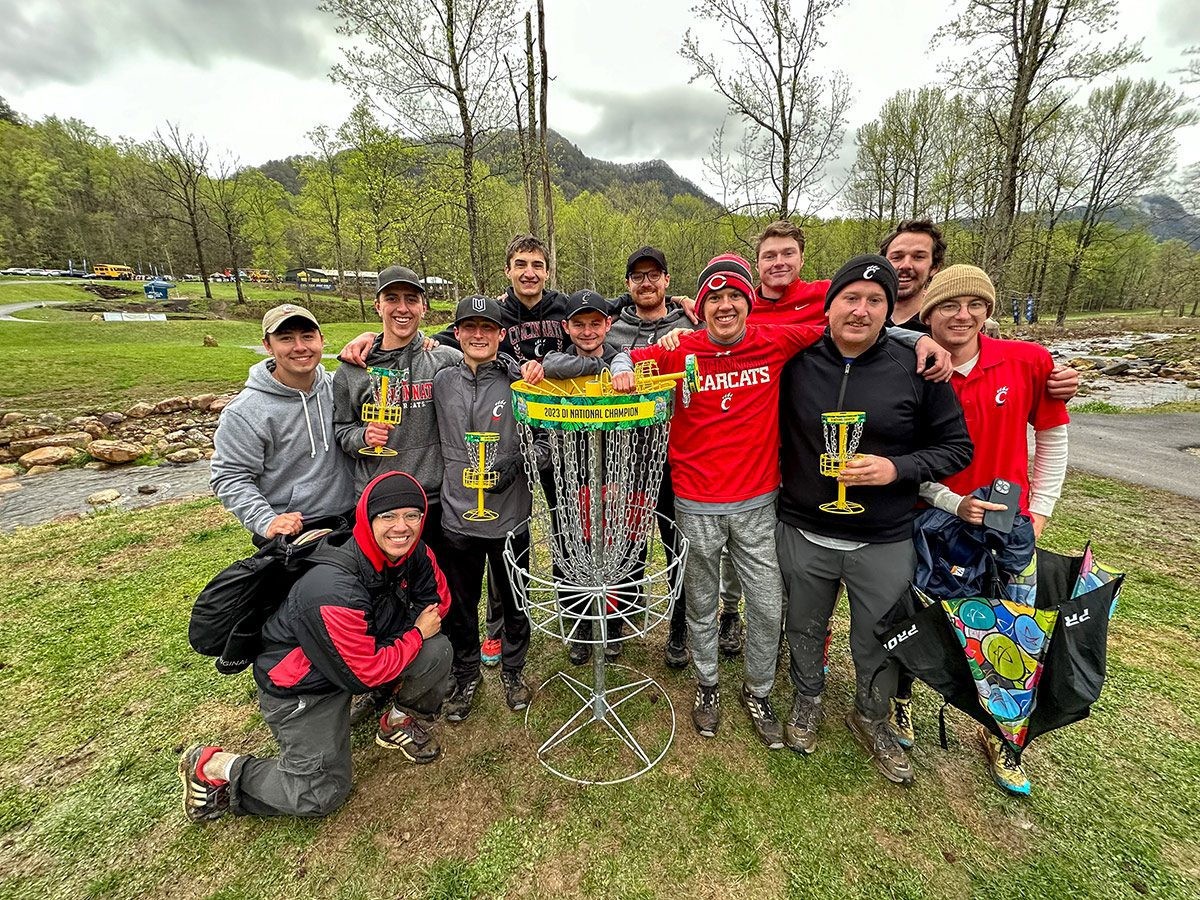
WCPO: UC's club disc golf team wins national championship
'Discats' take first place in singles and team competition

WCPO highlighted the University of Cincinnati's victory in the College Disc Golf national championship tournament last month in Marion, North Carolina.
UC's 'Discats' beat out 80 other college teams in the tournament to take home the Division I national championship. The winning foursome was made up of students Kyle Taylor and Tanner Young and brothers Calvin and Bradley Caldwell.
UC's Young also took home top honors in singles competition.
Twelve players from UC competed. More than 700 players from 80 schools took part in the competition across three divisions.
“We have a ton of seniors graduating this year, so if anyone would like to take the next steps and join the club, they are more than welcome to give it a shot,” Young said. “They can play for the defending national champions!”
Related Stories
Sugar overload killing hearts
November 10, 2025
Two in five people will be told they have diabetes during their lifetime. And people who have diabetes are twice as likely to develop heart disease. One of the deadliest dangers? Diabetic cardiomyopathy. But groundbreaking University of Cincinnati research hopes to stop and even reverse the damage before it’s too late.
Is going nuclear the solution to Ohio’s energy costs?
November 10, 2025

The Ohio Capital Journal recently reported that as energy prices continue to climb, economists are weighing the benefits of going nuclear to curb costs. The publication dove into a Scioto Analysis survey of 18 economists to weigh the pros and cons of nuclear energy. One economist featured was Iryna Topolyan, PhD, professor of economics at the Carl H. Lindner College of Business.
App turns smartwatch into detector of structural heart disease
November 10, 2025

An app that uses an AI model to read a single-lead ECG from a smartwatch can detect structural heart disease, researchers reported at the 2025 Scientific Sessions of the American Heart Association. Although the technology requires further validation, researchers said it could help improve the identification of patients with heart failure, valvular conditions and left ventricular hypertrophy before they become symptomatic, which could improve the prognosis for people with these conditions.