WVXU: Invasive plants are on rise in Cincinnati
UC professor is studying spread of invasive species across city

WVXU turned to a University of Cincinnati botanist to explain how some exotic plants sold at nurseries can escape into the wild where they outcompete native species.
Denis Conover, a professor of biology in UC's College of Arts and Sciences, told WVXU that nonnative, invasive species causes millions of dollars in damage each year, particularly to agriculture. But invasive species such as Amur honeysuckle, English ivy and wintercreeper also crowds out native species in forests in the the Tristate, putting some native flowers and plants at greater risk of extinction.
"One of the things that is most striking now, there are many more non-native invasive plant species here," Conover told WVXU. "It's very bad because the non-native plants can take over and outcompete the native plants. And the native wildlife depends on the native vegetation."
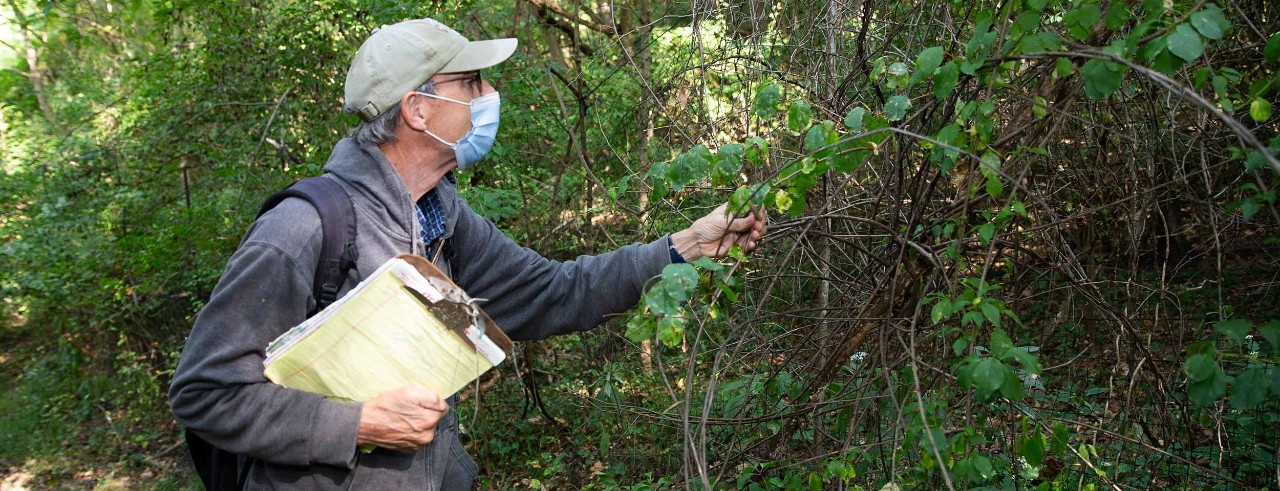
Conover is conducting a botanical survey to compare with similar surveys conducted over the last 200 years to learn how the city's flora has changed over the last two centuries of development and industrialization.
He took WVXU reporter Ann Thompson on a botanical tour of the woods surrounding Spring Grove Cemetery and Arboretum, where they found native plants such as wild ginger and bloodroot. But the woods are also home to invasive species from other continents such as Higan cherry.
Ohio has taken steps to curb the spread of invasive species by outlawing the sale of particularly prolific species such as Callery pear trees. Experts said one thing residents can do to help is to plant only native species in their gardens and flowerbeds.

English ivy is a nonnative, invasive ground cover that is often found growing up tree trunks and the sides of buildings in the United States. Photo/Lisa Ventre/UC
Related Stories
Sugar overload killing hearts
November 10, 2025
Two in five people will be told they have diabetes during their lifetime. And people who have diabetes are twice as likely to develop heart disease. One of the deadliest dangers? Diabetic cardiomyopathy. But groundbreaking University of Cincinnati research hopes to stop and even reverse the damage before it’s too late.
Is going nuclear the solution to Ohio’s energy costs?
November 10, 2025

The Ohio Capital Journal recently reported that as energy prices continue to climb, economists are weighing the benefits of going nuclear to curb costs. The publication dove into a Scioto Analysis survey of 18 economists to weigh the pros and cons of nuclear energy. One economist featured was Iryna Topolyan, PhD, professor of economics at the Carl H. Lindner College of Business.
App turns smartwatch into detector of structural heart disease
November 10, 2025

An app that uses an AI model to read a single-lead ECG from a smartwatch can detect structural heart disease, researchers reported at the 2025 Scientific Sessions of the American Heart Association. Although the technology requires further validation, researchers said it could help improve the identification of patients with heart failure, valvular conditions and left ventricular hypertrophy before they become symptomatic, which could improve the prognosis for people with these conditions.