Spectrum News: UC biologist discusses water pollution
Aquatic toxicologist explains threats to Ohio's waterways

Spectrum News turned to a University of Cincinnati aquatic toxicologist to explain the pollution threats to Ohio's waterways.
Latonya Jackson, an assistant professor of biology in UC's College of Arts and Sciences, told Spectrum News that everyday contaminants can have harmful effects on aquatic wildlife.
“Fish are being affected by everything that we are putting in the water,” she said.

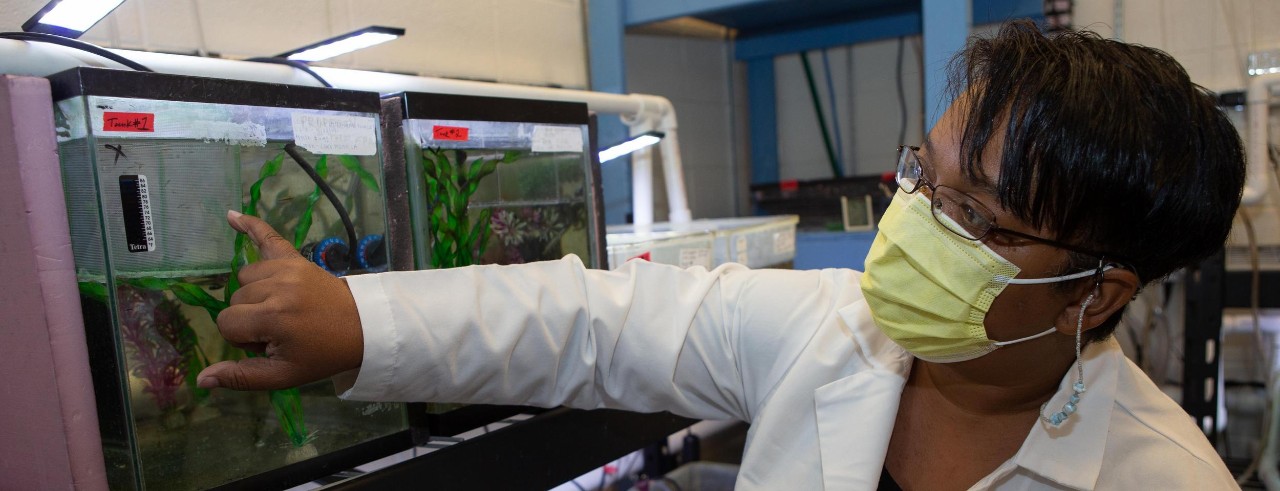
UC Assistant Professor Latonya Jackson studies live-bearing fish in her biology lab. Photo/Andrew Higley/UC Marketing + Brand
This was put in stark relief earlier this year when a train derailment in East Palestine spilled toxic chemicals into the Ohio River, killing fish and prompting treatment plants that rely on the river for drinking water to shut down temporarily.
Jackson joined Spectrum's In Focus host Mike Kallmeyer to discuss how pollution affects rivers, lakes and streams on Earth Day.
“As an aquatic toxicologist, I look at how different contaminants and pollution affect organisms and even humans — anything that comes in contact with the water,” she said.
In her lab, Jackson studies live-bearing fish to see how toxins in the water can harm not only adults but their babies as well.
Jackson said scientists today are studying contaminants of emerging concern, including personal-care products, microplastics, tire rubber and medicines that end up in waterways.
“Just about everything that we put down our drains is having a huge negative impact on fish,” she said.
Jackson said she has been following the environmental impacts from the train derailment. While contaminant levels quickly dissipate in the river, the chemicals can have a profound impact on generations of wildlife and the food chain, she said.
“We don't know how it will affect fish and other aquatic animals in the long term,” she said.
Watch the Spectrum News interview.
Featured image at top: UC Assistant Professor Latonya Jackson studies the long-term effects of chemicals on aquatic life. Photo/Andrew Higley/UC Marketing + Brand

UC College of Arts and Sciences Assistant Professor Latonya Jackson is an expert in aquatic toxicology. She studies how chemicals affect fish and other wildlife. Photo/Andrew Higley/UC Marketing + Brand
Related Stories
Sugar overload killing hearts
November 10, 2025
Two in five people will be told they have diabetes during their lifetime. And people who have diabetes are twice as likely to develop heart disease. One of the deadliest dangers? Diabetic cardiomyopathy. But groundbreaking University of Cincinnati research hopes to stop and even reverse the damage before it’s too late.
Is going nuclear the solution to Ohio’s energy costs?
November 10, 2025

The Ohio Capital Journal recently reported that as energy prices continue to climb, economists are weighing the benefits of going nuclear to curb costs. The publication dove into a Scioto Analysis survey of 18 economists to weigh the pros and cons of nuclear energy. One economist featured was Iryna Topolyan, PhD, professor of economics at the Carl H. Lindner College of Business.
App turns smartwatch into detector of structural heart disease
November 10, 2025

An app that uses an AI model to read a single-lead ECG from a smartwatch can detect structural heart disease, researchers reported at the 2025 Scientific Sessions of the American Heart Association. Although the technology requires further validation, researchers said it could help improve the identification of patients with heart failure, valvular conditions and left ventricular hypertrophy before they become symptomatic, which could improve the prognosis for people with these conditions.