Drug Discovery News: Silence in healthy cells makes FOXR2 a potential cancer target

Drug Discovery News recently highlighted research coauthored by the University of Cincinnati's Timothy Phoenix, PhD, focused on a gene called FOXR2.
FOXR2 is usually not expressed in most healthy cells, but the research team found it is abnormally expressed in more than 70% of 10,000 different adult and pediatric cancer types the team analyzed
The research team also found that FOXR2 bound to the DNA sequences that normally associate with E26 transformation-specific (ETS) transcription factors (ETS TFs), which control the expression of genes with a variety of cellular functions.
“FOXR2 and ETS TFs can interact on DNA and actually turn genes on and off, which can cause cancer,” said Phoenix, assistant professor in UC’s James L. Winkle College of Pharmacy Division of Pharmaceutical Sciences and a University of Cincinnati Cancer Center researcher.
Moving forward, the team aims to learn more about exactly how FOXR2 functions and the proteins it interacts with, with long-term goals of developing targets for new treatments.
Read the Drug Discovery News story.
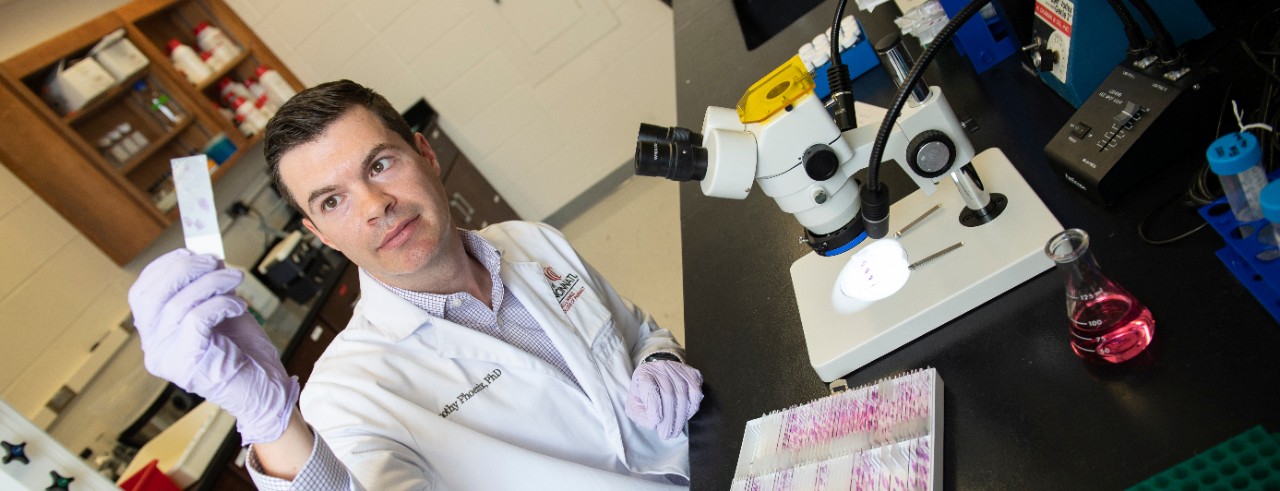
Featured photo at top of Phoenix in his lab. Photo/Colleen Kelley/UC Marketing + Brand
Related Stories
Sugar overload killing hearts
November 10, 2025
Two in five people will be told they have diabetes during their lifetime. And people who have diabetes are twice as likely to develop heart disease. One of the deadliest dangers? Diabetic cardiomyopathy. But groundbreaking University of Cincinnati research hopes to stop and even reverse the damage before it’s too late.
Is going nuclear the solution to Ohio’s energy costs?
November 10, 2025

The Ohio Capital Journal recently reported that as energy prices continue to climb, economists are weighing the benefits of going nuclear to curb costs. The publication dove into a Scioto Analysis survey of 18 economists to weigh the pros and cons of nuclear energy. One economist featured was Iryna Topolyan, PhD, professor of economics at the Carl H. Lindner College of Business.
App turns smartwatch into detector of structural heart disease
November 10, 2025

An app that uses an AI model to read a single-lead ECG from a smartwatch can detect structural heart disease, researchers reported at the 2025 Scientific Sessions of the American Heart Association. Although the technology requires further validation, researchers said it could help improve the identification of patients with heart failure, valvular conditions and left ventricular hypertrophy before they become symptomatic, which could improve the prognosis for people with these conditions.