UC research aims to prevent skin cancer while getting a tan
WJXT highlights work of Venture Lab-backed startup

Research from the University of Cincinnati could allow people to get a healthy tan, avoid wrinkles and protect themselves from skin cancer, WJXT in Jacksonville, Florida, reported.
Zalfa A. Abdel-Malek, PhD, a professor of dermatology in the UC College of Medicine, is leading a team that's developing a topically applied cream that would start a sunless tanning process.
“What you’re doing with our peptides is you’re activating your skin’s natural ability to increase pigmentation,” Abdel-Malek said in a story that was distributed nationally by Ivanhoe Broadcast News. “So, when you go out in the sun, you’re not going to have the drastic and dangerous effects of sun exposure.”
Abdel-Malek's cream would work better than commercially available spray tans, she said. Current options color the skin but don’t activate the receptors that reduce DNA damage.
The cream could be commercially available in the next few years, Abdel-Malek said. With the help of the UC Venture Lab within the 1819 Innovation Hub, she’s created a startup, MC1R Ventures, to develop the product.
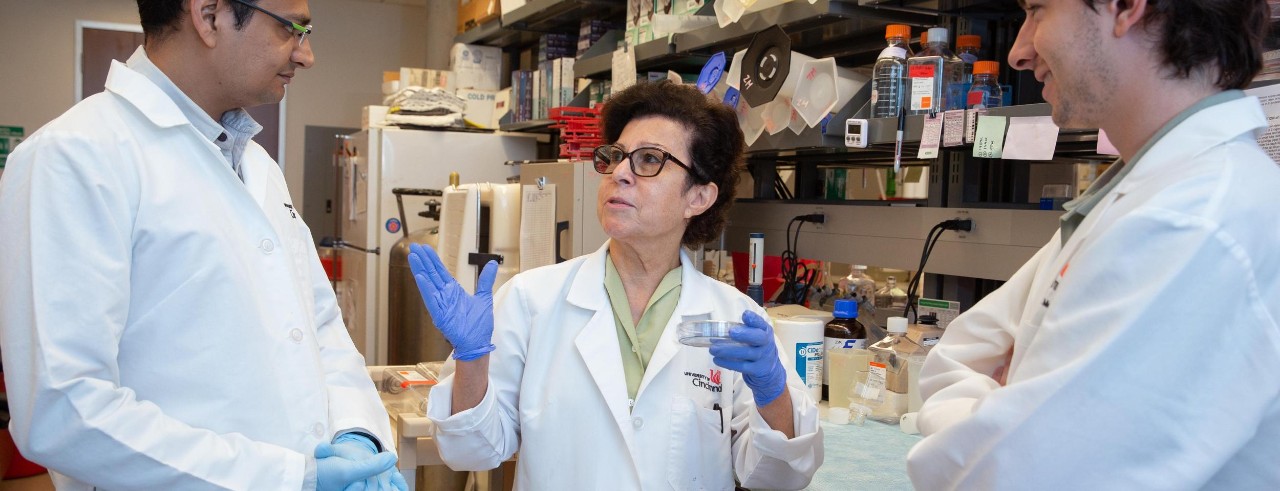
Featured image at top: Zalfa A. Abdel-Malek, center, is developing a topically applied product to initiate sunless tanning, which could have medical and cosmetic applications. Photo/Andrew Higley/UC Marketing + Brand
About UC Venture Lab
A leading model for urban-centered universities, the UC Venture Lab activates a high density of rapidly curated startup opportunities that attract outside entrepreneurial talent and investors. We connect university students, faculty, staff, and alumni to talent and funding to help launch new companies. Our team includes Office of Innovation staff as well as Entrepreneurs-in-Residence (EIRs), coaches, curated service providers, and subject matter experts.
Related Stories
Sugar overload killing hearts
November 10, 2025
Two in five people will be told they have diabetes during their lifetime. And people who have diabetes are twice as likely to develop heart disease. One of the deadliest dangers? Diabetic cardiomyopathy. But groundbreaking University of Cincinnati research hopes to stop and even reverse the damage before it’s too late.
Is going nuclear the solution to Ohio’s energy costs?
November 10, 2025

The Ohio Capital Journal recently reported that as energy prices continue to climb, economists are weighing the benefits of going nuclear to curb costs. The publication dove into a Scioto Analysis survey of 18 economists to weigh the pros and cons of nuclear energy. One economist featured was Iryna Topolyan, PhD, professor of economics at the Carl H. Lindner College of Business.
App turns smartwatch into detector of structural heart disease
November 10, 2025

An app that uses an AI model to read a single-lead ECG from a smartwatch can detect structural heart disease, researchers reported at the 2025 Scientific Sessions of the American Heart Association. Although the technology requires further validation, researchers said it could help improve the identification of patients with heart failure, valvular conditions and left ventricular hypertrophy before they become symptomatic, which could improve the prognosis for people with these conditions.