CNN: Meet TikTok's new favorite pet
UC biologist discusses people's love for jumping spiders

CNN turned to a University of Cincinnati biologist to explain the adoration people express for jumping spiders on social media.
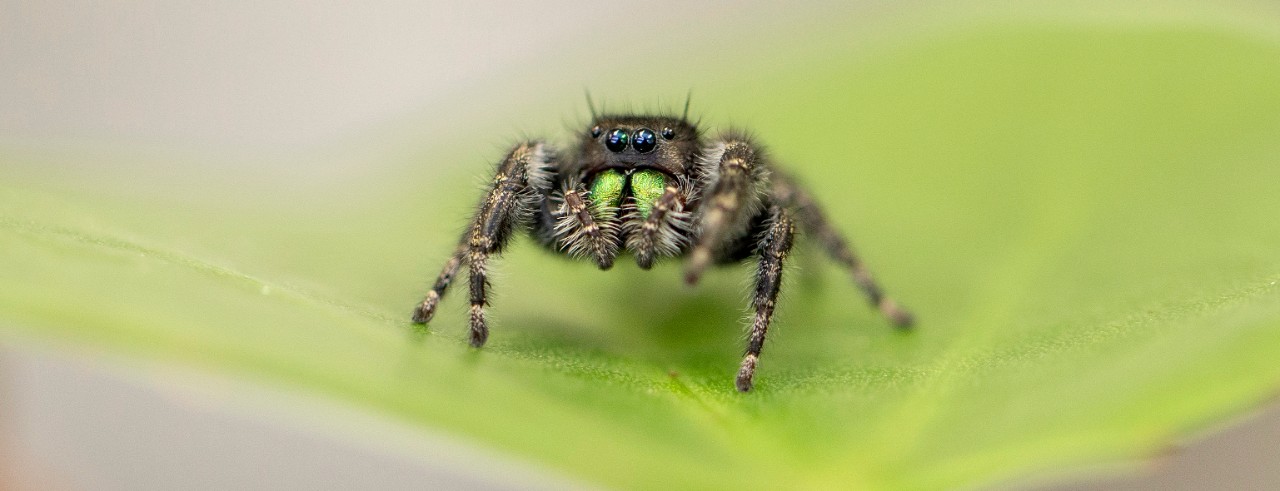
Jumping spiders are little darlings on TikTok, where their attentive behavior and big eyes have endeared them to many fans. And some people have turned the little eight-legged predators into beloved pets.
“Maybe it’s because they’re these tiny sentient little creatures existing in this huge world around us, and we don’t even take the time to notice them or how smart they are,” TikTok user Heather Bruen told CNN. “But caring for them has changed my entire life.”
UC College of Arts and Sciences visual ecologist and Associate Professor Nathan Morehouse told CNN that they are objectively cute with oversized eyes like Grogu from Disney's “The Mandalorian.”
“We're suckers for that,” Morehouse said. “There's a cute babyish-ness.”
Morehouse has traveled the world studying the extraordinary vision of jumping spiders. Their color vision, in particular, far surpasses our own.
“When animals can see farther away from their bodies, and they can act right away, that offers the capacity for planning,” Morehouse said. “Lots of animals can only see and sense the world in their immediate surroundings – a lot of what they do is knee-jerk reactions to things.”
Morehouse said spiders deserve good PR. They provide many hidden benefits to people such as pest control.
“Spiders are essential members of the world that we move through,” he said.
Featured image at top: Jumping spiders have become social media stars. Photo/Joseph Fuqua II/UC

UC Associate Professor Nathan Morehouse studies jumping spiders in his lab. He is director of UC's Institute for Research in Sensing. Photo/Jay Yocis/UC
Related Stories
Sugar overload killing hearts
November 10, 2025
Two in five people will be told they have diabetes during their lifetime. And people who have diabetes are twice as likely to develop heart disease. One of the deadliest dangers? Diabetic cardiomyopathy. But groundbreaking University of Cincinnati research hopes to stop and even reverse the damage before it’s too late.
Is going nuclear the solution to Ohio’s energy costs?
November 10, 2025

The Ohio Capital Journal recently reported that as energy prices continue to climb, economists are weighing the benefits of going nuclear to curb costs. The publication dove into a Scioto Analysis survey of 18 economists to weigh the pros and cons of nuclear energy. One economist featured was Iryna Topolyan, PhD, professor of economics at the Carl H. Lindner College of Business.
App turns smartwatch into detector of structural heart disease
November 10, 2025

An app that uses an AI model to read a single-lead ECG from a smartwatch can detect structural heart disease, researchers reported at the 2025 Scientific Sessions of the American Heart Association. Although the technology requires further validation, researchers said it could help improve the identification of patients with heart failure, valvular conditions and left ventricular hypertrophy before they become symptomatic, which could improve the prognosis for people with these conditions.