AP: Communities await first US limits on ‘forever chemicals’
UC expert says the scientific community 'missed the boat' early on about PFAs

Restrictions on harmful "forever chemicals" in drinking water are expected to be proposed by the Environmental Protection Agency after finding they are dangerous in amounts so small as to be undetectable. However, experts say removing them will be very expensive, which most small communities with limited resources won't be able to cover.
In a story posted by the Associated Press, Susan Pinney, PhD, of the Department of Environmental and Public Health Sciences at the UC College of Medicine said per-and polyfluoroalkyl substances or PFAs should have been better regulated and dealt with once they were first identified.

Susan Pinney, PhD, of the Department of Environmental and Public Health Sciences/Photo/Colleen Kelley/UC Marketing + Brand
“We as a community of scientists and policymakers and regulators really missed the boat early on,” said Pinney, also director of the Center for Environmental Genetics at UC.
PFOA and PFOS are part of the family of PFAS, that are widespread, don’t degrade in the environment and have been around for decades. They’ve been used in nonstick pans, food packaging and firefighting foam. Their use is now mostly phased out in the U.S., but some still remain, the AP reported.
Pienney has testified to members of the U.S. Congress that PFAS chemicals have been linked to health problems including cancer, kidney damage, thyroid difficulties and changes in reproductive hormones that disrupt puberty for girls.
“With any public health problem, the first step is assessment, and we really don’t have an assessment of the extent of exposure to PFAS in drinking water,” Pinney says. “That’s why the approval of the [federal legislation] is so important, because it would require a more universal assessment throughout the United States.”
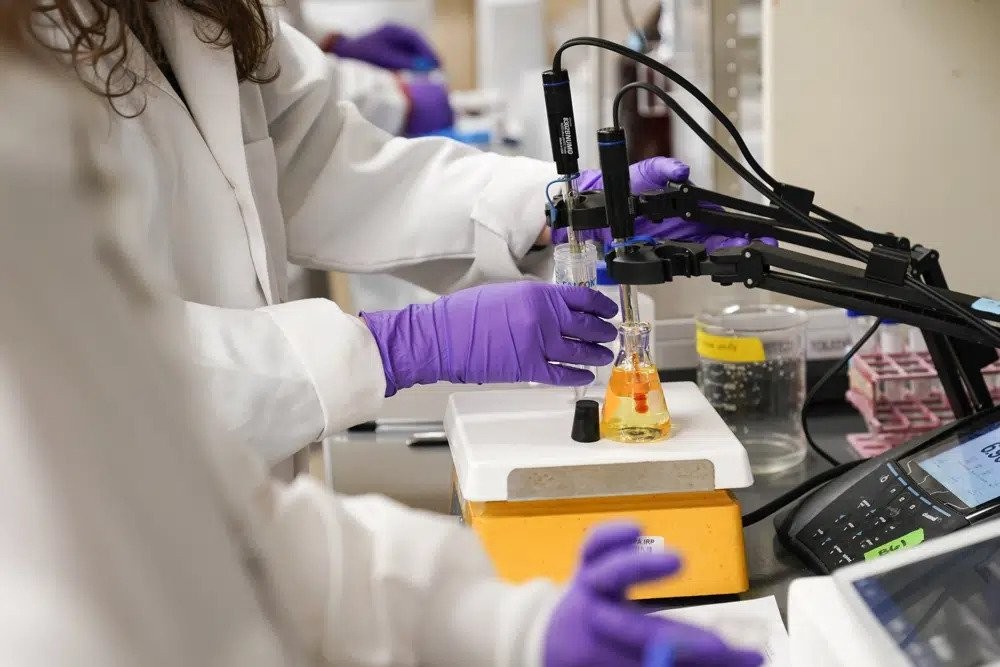
Lead photo of EPA scientists in Cincinnati testing for PFAs/Joshua Bickel/AP
Next Lives Here
The University of Cincinnati is classified as a Research 1 institution by the Carnegie Commission and is ranked in the National Science Foundation's Top-35 public research universities. UC's graduate students and faculty investigate problems and innovate solutions with real-world impact. Next Lives Here.
Related Stories
Sugar overload killing hearts
November 10, 2025
Two in five people will be told they have diabetes during their lifetime. And people who have diabetes are twice as likely to develop heart disease. One of the deadliest dangers? Diabetic cardiomyopathy. But groundbreaking University of Cincinnati research hopes to stop and even reverse the damage before it’s too late.
Is going nuclear the solution to Ohio’s energy costs?
November 10, 2025

The Ohio Capital Journal recently reported that as energy prices continue to climb, economists are weighing the benefits of going nuclear to curb costs. The publication dove into a Scioto Analysis survey of 18 economists to weigh the pros and cons of nuclear energy. One economist featured was Iryna Topolyan, PhD, professor of economics at the Carl H. Lindner College of Business.
App turns smartwatch into detector of structural heart disease
November 10, 2025

An app that uses an AI model to read a single-lead ECG from a smartwatch can detect structural heart disease, researchers reported at the 2025 Scientific Sessions of the American Heart Association. Although the technology requires further validation, researchers said it could help improve the identification of patients with heart failure, valvular conditions and left ventricular hypertrophy before they become symptomatic, which could improve the prognosis for people with these conditions.