Forbes: When did mammoths go extinct?
Environmental DNA can be misleading, UC paleontologist says

Forbes talked to a University of Cincinnati paleontologist about why environmental DNA is not the best barometer for dating extinctions.
UC College of Arts and Sciences assistant professor Joshua Miller was lead author of a paper published in Nature titled “When did mammoths go extinct?” that refuted a previous study suggesting mammoths went extinct much more recently than believed.
“We can radiocarbon date all kinds of things: bones, teeth, charcoal, leaves. That’s very powerful. But currently, we can’t independently date DNA found in sediments,” Miller told Forbes.
Miller said environmental DNA can persist for thousands of years in arctic climates, making it unreliable for dating extinctions.
Miller said mammoths probably went extinct between 10,000 and 13,000 years ago. Some island populations survived longer.
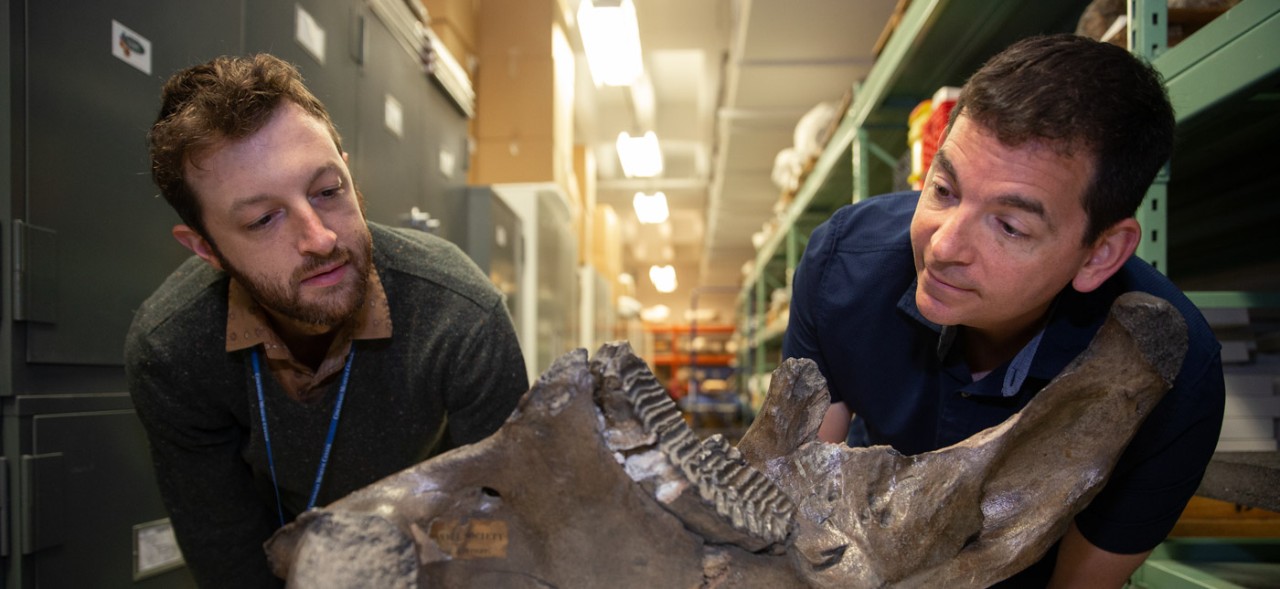
Featured image at top: Cameron Schwalbach, paleontology collections manager for the Cincinnati Museum Center’s Geier Collections and Research Center, and UC assistant professor Joshua Miller examine a mammoth skull. Photo/Andrew Higley/UC Marketing + Brand

UC assistant professor Joshua Miller poses with a bronze mammoth outside the Cincinnati Museum Center's Geier Collections and Research Center. Photo/Andrew Higley/UC Marketing + Brand
UC Geosciences in the News

UC associate professor Joshua Miller examines a mammoth tusk at the Cincinnati Museum Center's Geier Collections and Research Center. Photo/Andrew Higley/UC Marketing + Brand
- Spectrum News: Paleontologist disputes date when mammoths went extinct
- European Times: New study refutes timeline of mammoth extinction
- Science Times: When did mammoth extinction take place?
Related Stories
Sugar overload killing hearts
November 10, 2025
Two in five people will be told they have diabetes during their lifetime. And people who have diabetes are twice as likely to develop heart disease. One of the deadliest dangers? Diabetic cardiomyopathy. But groundbreaking University of Cincinnati research hopes to stop and even reverse the damage before it’s too late.
Is going nuclear the solution to Ohio’s energy costs?
November 10, 2025

The Ohio Capital Journal recently reported that as energy prices continue to climb, economists are weighing the benefits of going nuclear to curb costs. The publication dove into a Scioto Analysis survey of 18 economists to weigh the pros and cons of nuclear energy. One economist featured was Iryna Topolyan, PhD, professor of economics at the Carl H. Lindner College of Business.
App turns smartwatch into detector of structural heart disease
November 10, 2025

An app that uses an AI model to read a single-lead ECG from a smartwatch can detect structural heart disease, researchers reported at the 2025 Scientific Sessions of the American Heart Association. Although the technology requires further validation, researchers said it could help improve the identification of patients with heart failure, valvular conditions and left ventricular hypertrophy before they become symptomatic, which could improve the prognosis for people with these conditions.