WLWT: UC works with art museums to identify fakes and forgeries
Project uses latest science tools to study art in a new way

WLWT highlighted a novel collaboration between art museums and geologists, chemists and art historians at the University of Cincinnati to examine precious artworks using the latest scientific tools.
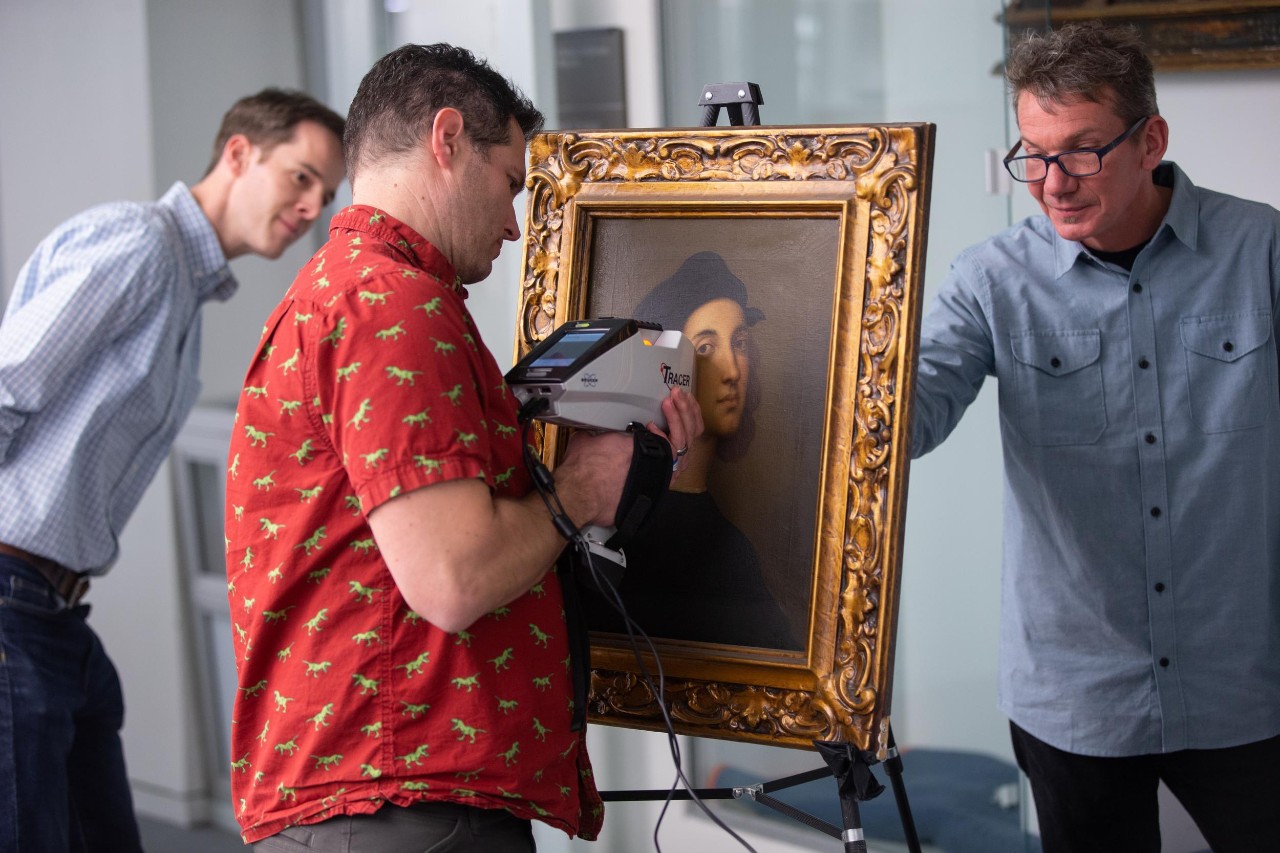
UC worked with the Taft Museum of Art to use tools such as Xray fluorescence spectroscopy to study the pigments in two paintings in the hopes of learning more about the masterpieces.
Art historian Christopher Platts in UC's College of Design, Architecture, Art, and Planning, and UC College of Arts and Sciences geologist Daniel Sturmer and chemists Pietro Strobbia and Lyndsay Kissell examined "Panel with the Crucifixion" and "Landscape with Canal" in Taft's collection.
The first was a painting on a wood panel in the style of Italian Renaissance artist Bernardo Daddi. UC's chemical analysis revealed more modern pigments in the painting.
UC's experts hoped to shed light on the landscape painting's suspicious signature. The painting was signed John Constable, but experts long have suspected the work was created by contemporary Frederick Waters Watts. UC's analysis was inconclusive.
UC researchers say these tools can help historians pin down the dates the artworks were created and potentially identify a fake or fraud. The Taft Museum of Art included the paintings in an exhibit titled Fakes, Forgeries and Followers in the Taft Collection that runs through Feb. 5.

UC geologist Daniel Sturmer uses XRF spectroscopy to study a painting in the style of Italian Renaissance master Bernardo Daddi in the conservation lab of the Taft Museum of Art. Photo/Andrew Higley/UC Marketing + Brand
Related Stories
Sugar overload killing hearts
November 10, 2025
Two in five people will be told they have diabetes during their lifetime. And people who have diabetes are twice as likely to develop heart disease. One of the deadliest dangers? Diabetic cardiomyopathy. But groundbreaking University of Cincinnati research hopes to stop and even reverse the damage before it’s too late.
Is going nuclear the solution to Ohio’s energy costs?
November 10, 2025

The Ohio Capital Journal recently reported that as energy prices continue to climb, economists are weighing the benefits of going nuclear to curb costs. The publication dove into a Scioto Analysis survey of 18 economists to weigh the pros and cons of nuclear energy. One economist featured was Iryna Topolyan, PhD, professor of economics at the Carl H. Lindner College of Business.
App turns smartwatch into detector of structural heart disease
November 10, 2025

An app that uses an AI model to read a single-lead ECG from a smartwatch can detect structural heart disease, researchers reported at the 2025 Scientific Sessions of the American Heart Association. Although the technology requires further validation, researchers said it could help improve the identification of patients with heart failure, valvular conditions and left ventricular hypertrophy before they become symptomatic, which could improve the prognosis for people with these conditions.