SIAM News: How the albatross optimizes long-range flight
UC aerospace experts explain physics behind effortless flight

How do albatrosses soar for days over the ocean while expending almost no energy?
An aerospace engineering student and his professor at the University of Cincinnati say they harness the wind by executing a series of deft aerial maneuvers that save them energy as they travel the vast ocean.

UC aerospace student Sameer Pokhrel. Photo/Provided
UC College of Engineering and Applied Science graduate student Sameer Pokhrel and Sameh Eisa, an assistant professor of aerospace engineering, broke down the complicated physics behind the bird's graceful flight for SIAM News, the science magazine for the Society for Industrial and Applied Mathematics.
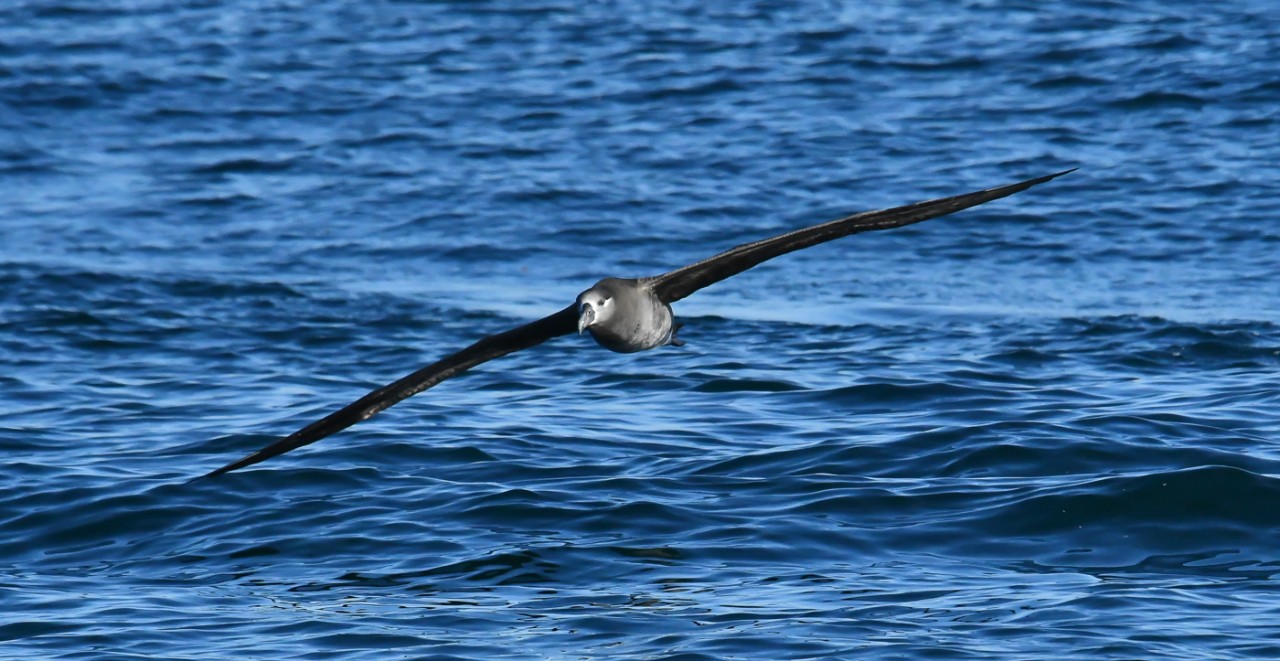
Albatrosses have enormous wings. The wandering albatross has the largest wingspan of any living bird at 12 feet. They use these long wings to get lift on the ocean breeze.
According to Pokhrel and Eisa, albatrosses fly into the wind, gaining elevation through wind shear, or the increase in wind speed typically observed at higher elevations. They trade kinetic energy for potential energy during the climb.
When the bird's air speed slows, they execute a deft high-altitude turn and descend with a tail wind that propels them. During the descent, they trade the gained potential energy with kinetic energy to increase speed and momentum.

UC assistant professor Sameh Eisa. Photo/Provided
At the bottom of their decent, near the ocean's surface, the birds make another graceful turn into the wind to repeat the complex series of maneuvers.
Pokhrel and Eisa say albatrosses minimize the energy they need to expend by optimizing this soaring pattern, which they described as an extremum seeking control system. In Eisa's Modeling, Dynamics and Control Lab, the researchers created a computer model that replicates the optimized soaring patterns that come so naturally to albatrosses.
The researchers said the lessons we learn about dynamic soaring from albatrosses can help optimize long-distance flights with drones and other aircraft.
Pohkrel presented his analysis to the Society for Industrial and Applied Mathematics Conference on the Life Sciences in July.
Featured image at top: A black-footed albatross glides over the Pacific Ocean. Photo/Michael Miller
Related Stories
Sugar overload killing hearts
November 10, 2025
Two in five people will be told they have diabetes during their lifetime. And people who have diabetes are twice as likely to develop heart disease. One of the deadliest dangers? Diabetic cardiomyopathy. But groundbreaking University of Cincinnati research hopes to stop and even reverse the damage before it’s too late.
Is going nuclear the solution to Ohio’s energy costs?
November 10, 2025

The Ohio Capital Journal recently reported that as energy prices continue to climb, economists are weighing the benefits of going nuclear to curb costs. The publication dove into a Scioto Analysis survey of 18 economists to weigh the pros and cons of nuclear energy. One economist featured was Iryna Topolyan, PhD, professor of economics at the Carl H. Lindner College of Business.
App turns smartwatch into detector of structural heart disease
November 10, 2025

An app that uses an AI model to read a single-lead ECG from a smartwatch can detect structural heart disease, researchers reported at the 2025 Scientific Sessions of the American Heart Association. Although the technology requires further validation, researchers said it could help improve the identification of patients with heart failure, valvular conditions and left ventricular hypertrophy before they become symptomatic, which could improve the prognosis for people with these conditions.