Fox 19 highlights Lung Cancer Awareness Month
UC's Starnes discusses screening, treatment

The University of Cincinnati's Sandra L. Starnes, MD, joined the Fox 19 morning show to discuss Lung Cancer Awareness Month.
Lung cancer is the leading cause of cancer death in the United States and the third most common cancer overall.
Starnes said smoking remains the main risk factor for lung cancer, but a proportion of patients will develop lung cancer even if they never smoked. Screening techniques have led to progress in detecting and treating cancer in earlier stages, she said.
"Lung cancer screening has now been around for about a dozen years, and it’s really exciting because the study that originally showed that it was beneficial was the first time that showed something that could impact the mortality for lung cancer," said Starnes, professor, division chief and Dr. John B. Flege, Jr. Chair in the UC College of Medicine's Division of Cardiothoracic Surgery in the Department of Surgery and a UC Health physician. "But still less than 10% of people who are eligible to be screened get screened."
Individuals between 50-80 years old who haven’t quit smoking within the last 15 years and have at least a 20 “pack year” history should be screened for lung cancer. A pack year is calculated by multiplying the number of packs of cigarettes smoked per day by the number of years they have smoked, with one pack year equivalent to smoking one pack of cigarettes per day for one year or two packs per day for six months. A 20 pack year history would mean smoking one pack a day for 20 years.
Starnes said advanced treatments including targeted therapy have been developed to treat lung cancer in place of traditional treatments like chemotherapy and radiation.
"I think there’s a lot of fear around lung cancer, but it can be very treatable as well," Starnes said.
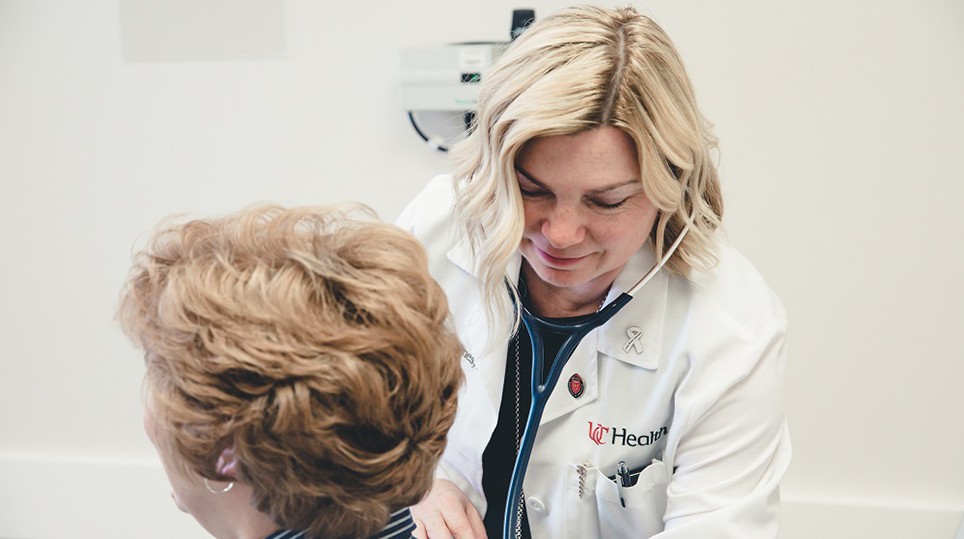
Featured photo at top of Dr. Starnes with a patient. Photo/University of Cincinnati.
Related Stories
Sugar overload killing hearts
November 10, 2025
Two in five people will be told they have diabetes during their lifetime. And people who have diabetes are twice as likely to develop heart disease. One of the deadliest dangers? Diabetic cardiomyopathy. But groundbreaking University of Cincinnati research hopes to stop and even reverse the damage before it’s too late.
Is going nuclear the solution to Ohio’s energy costs?
November 10, 2025

The Ohio Capital Journal recently reported that as energy prices continue to climb, economists are weighing the benefits of going nuclear to curb costs. The publication dove into a Scioto Analysis survey of 18 economists to weigh the pros and cons of nuclear energy. One economist featured was Iryna Topolyan, PhD, professor of economics at the Carl H. Lindner College of Business.
App turns smartwatch into detector of structural heart disease
November 10, 2025

An app that uses an AI model to read a single-lead ECG from a smartwatch can detect structural heart disease, researchers reported at the 2025 Scientific Sessions of the American Heart Association. Although the technology requires further validation, researchers said it could help improve the identification of patients with heart failure, valvular conditions and left ventricular hypertrophy before they become symptomatic, which could improve the prognosis for people with these conditions.