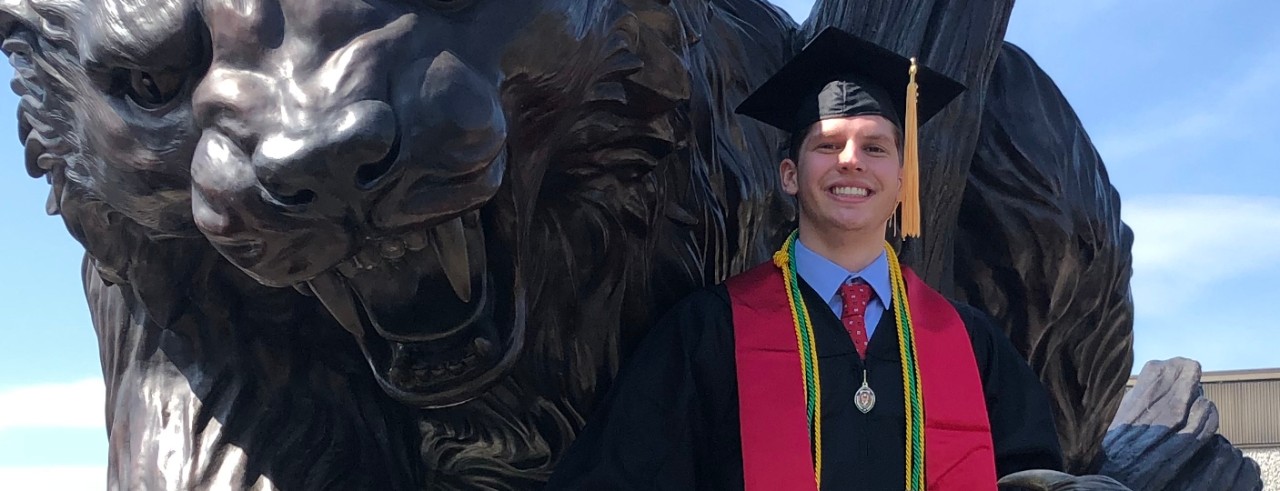
Spectrum News: Pediatric stroke survivor provides care at Cincinnati Children's Hospital
UC College of Nursing graduate shares story of pediatric stroke and rare genetic disorder

One morning in Dec. 2017, David Moskowitz, a 17-year-old senior at Sycamore High School, woke up to feel his lips tingling, and throughout the day that feeling spread up the right side of his face, but he thought nothing of it at the time.
But after lacrosse practice, when the feeling continued, he consulted family, who immediately took him to Cincinnati Children's Hospital. In a profile produced by Spectrum News, they reported that MRI testing revealed Moskowitz suffered a stroke, had an inoperable brain malformation, or AVM, and was diagnosed with a rare genetic disorder called HHT.
Moskowitz spent nearly a month in the ICU receiving treatments, including radiation, but had trouble speaking, moving and lost some of his vision. Several months later, under the supervision of Sudahakar Vadivelu, DO, his surgeon, Moskowitz was on the road to recovery.
His health battle would lead to an outpouring of support at his team's lacrosse matches and on social media with the hashtag, #DAVIDSTRONG.
Moskowitz told Spectrum News it took him a full year to get back to normal, but over the next four years, with a healthy mind, body and spirit, he earned a bachelor’s degree from the UC College of Nursing.
After a Co-op at Cincinnati Children's pediatric intensive care unit, his story would come full circle by being hired at Children's and, at times, working with Vadivelu.
“It's cool to see a role model for me in the ICU and a guy who took care of me in my darkest days. And now he's with me in my better days and we get to work together," said Moskowitz. "So it's an awesome experience."
Moskowitz said he will continue to increase pediatric stroke awareness in the future through community events, and he says he wouldn't be where he is today without a close support team.
“I was a cocky 17-year-old, and I learned very quickly that I would have never made it through that experience without the support systems that I had, my family, my friends, and the community being by my side," he said. "I love patients that I can connect with and just go through a shift and know that I created a bond with someone and made their day a little better when they're facing those dark times."
Read more about his story and time at UC here.
Photo/David Moskowitz
Next Lives Here
The University of Cincinnati is classified as a Research 1 institution by the Carnegie Commission and is ranked in the National Science Foundation's Top-35 public research universities. UC's medical, graduate and undergraduate students and faculty investigate problems and innovate solutions with real-world impact. Next Lives Here.
Related Stories
Sugar overload killing hearts
November 10, 2025
Two in five people will be told they have diabetes during their lifetime. And people who have diabetes are twice as likely to develop heart disease. One of the deadliest dangers? Diabetic cardiomyopathy. But groundbreaking University of Cincinnati research hopes to stop and even reverse the damage before it’s too late.
Is going nuclear the solution to Ohio’s energy costs?
November 10, 2025

The Ohio Capital Journal recently reported that as energy prices continue to climb, economists are weighing the benefits of going nuclear to curb costs. The publication dove into a Scioto Analysis survey of 18 economists to weigh the pros and cons of nuclear energy. One economist featured was Iryna Topolyan, PhD, professor of economics at the Carl H. Lindner College of Business.
App turns smartwatch into detector of structural heart disease
November 10, 2025

An app that uses an AI model to read a single-lead ECG from a smartwatch can detect structural heart disease, researchers reported at the 2025 Scientific Sessions of the American Heart Association. Although the technology requires further validation, researchers said it could help improve the identification of patients with heart failure, valvular conditions and left ventricular hypertrophy before they become symptomatic, which could improve the prognosis for people with these conditions.