55KRC: UC leads way in implementing new stroke treatment regionally

A new treatment for acute ischemic stroke is now available to patients across Greater Cincinnati thanks to the stroke experts at the University of Cincinnati Gardner Neuroscience Institute (UCGNI).
Tenecteplase (TNK) is a powerful blood thinner that can break up blood clots in patients experiencing an acute ischemic stroke, which is caused by a blood clot or sudden blockage of an artery that supplies blood to the brain. Unlike current treatments for ischemic stroke, TNK is administered in a single injection that takes just seconds.
“Large clinical studies in ischemic stroke patients have repeatedly shown that giving a medication such as TNK can increase the chances of a return to pre-stroke activities and reduce disability. Since almost 2 million brain cells die every minute in stroke, the faster we give this medication, the better chances we have of it working,” said Stacie Demel, DO, PhD, associate professor of clinical neurology and rehabilitation medicine at UC's College of Medicine, vascular neurologist at UCGNI and co-director of the UC Stroke Team.
TNK is specifically designed to target fibrin, which is the major component of a blood clot. This type of medication, called a fibrinolytic, has been used for almost 30 years in stroke therapy. Compared to previous medications in this class of drugs, however, TNK may be better at breaking up blood clots in the arteries that feed the brain and be safer for patients.
Importantly, there are time-based criteria that must be followed to receive TNK. That is why it’s imperative to call 911 immediately at the first sign of a stroke. An ambulance will transport the patient to the closest emergency room, where members of the UC Stroke Team will assist the local emergency room physician in deciding if TNK administration is the best course of treatment.
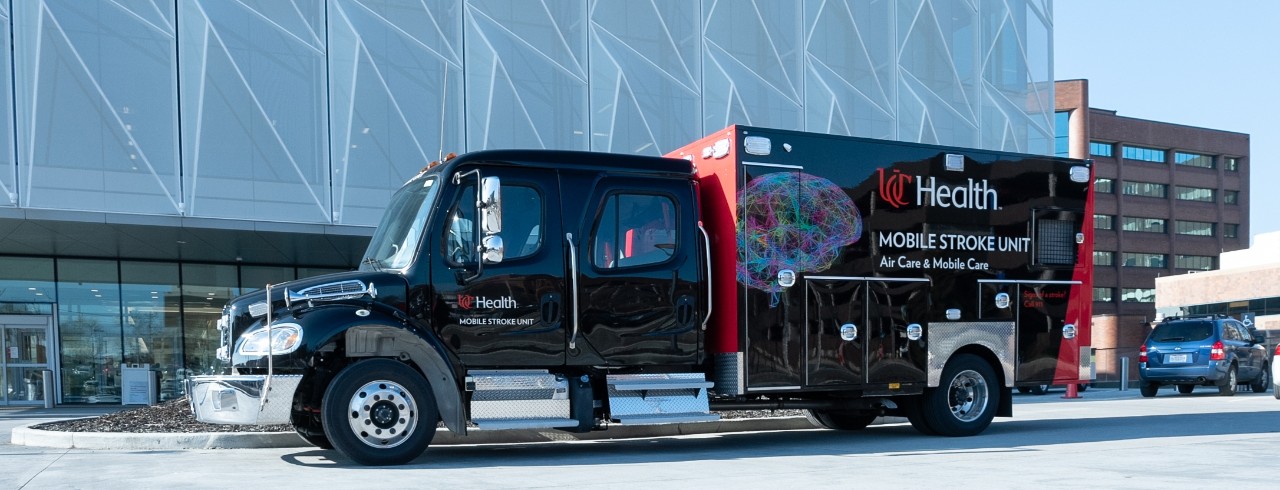
TNK is now available to patients at UC Health hospitals and via the UC Health Mobile Stroke Unit. UC Medical Center and West Chester hospitals were the first hospitals in Greater Cincinnati to implement TNK in mid-August. UC Health has also led the regional implementation of the treatment, providing virtual and in-person training and education to several community hospitals who now offer TNK as well.
“The University of Cincinnati Stroke Team provides rapid decision-making for all strokes presenting to any emergency department in the Greater Cincinnati/Northern Kentucky region,” Demel said. “We have supported the transition from alteplase (tPA) to tenecteplase at most of our community partners already, with the few remaining hospitals planning to switch to tenecteplase in the near future.”
The UC Stroke Team has been Greater Cincinnati’s leader in stroke care for more than 30 years. The team is responsible for the acute care of stroke in almost 30 different hospitals across Greater Cincinnati, available 24 hours a day, 7 days a week, 365 days a year.
A national leader in stroke research, UCGNI is also the national coordinating center for the National Institutes of Health’s StrokeNet research network.
Demel recently joined 55KRC's Simply Medicine radio show and podcast to discuss TNK.
Listen to the podcast segment here. (Note: Segment begins around 10 minute mark.)
Featured photo at top of UC Health's mobile stroke unit courtesy of UC Health.
Related Stories
Sugar overload killing hearts
November 10, 2025
Two in five people will be told they have diabetes during their lifetime. And people who have diabetes are twice as likely to develop heart disease. One of the deadliest dangers? Diabetic cardiomyopathy. But groundbreaking University of Cincinnati research hopes to stop and even reverse the damage before it’s too late.
Is going nuclear the solution to Ohio’s energy costs?
November 10, 2025

The Ohio Capital Journal recently reported that as energy prices continue to climb, economists are weighing the benefits of going nuclear to curb costs. The publication dove into a Scioto Analysis survey of 18 economists to weigh the pros and cons of nuclear energy. One economist featured was Iryna Topolyan, PhD, professor of economics at the Carl H. Lindner College of Business.
App turns smartwatch into detector of structural heart disease
November 10, 2025

An app that uses an AI model to read a single-lead ECG from a smartwatch can detect structural heart disease, researchers reported at the 2025 Scientific Sessions of the American Heart Association. Although the technology requires further validation, researchers said it could help improve the identification of patients with heart failure, valvular conditions and left ventricular hypertrophy before they become symptomatic, which could improve the prognosis for people with these conditions.