Discover: Ancient DNA suggests Griffin Warrior ruled his homeland
UC Classics' discoveries continue to shed light on ancient Greece

Discover magazine featured a DNA analysis by the University of Cincinnati and its international partners that found that a Bronze Age warrior was born in the area he one day would come to rule.
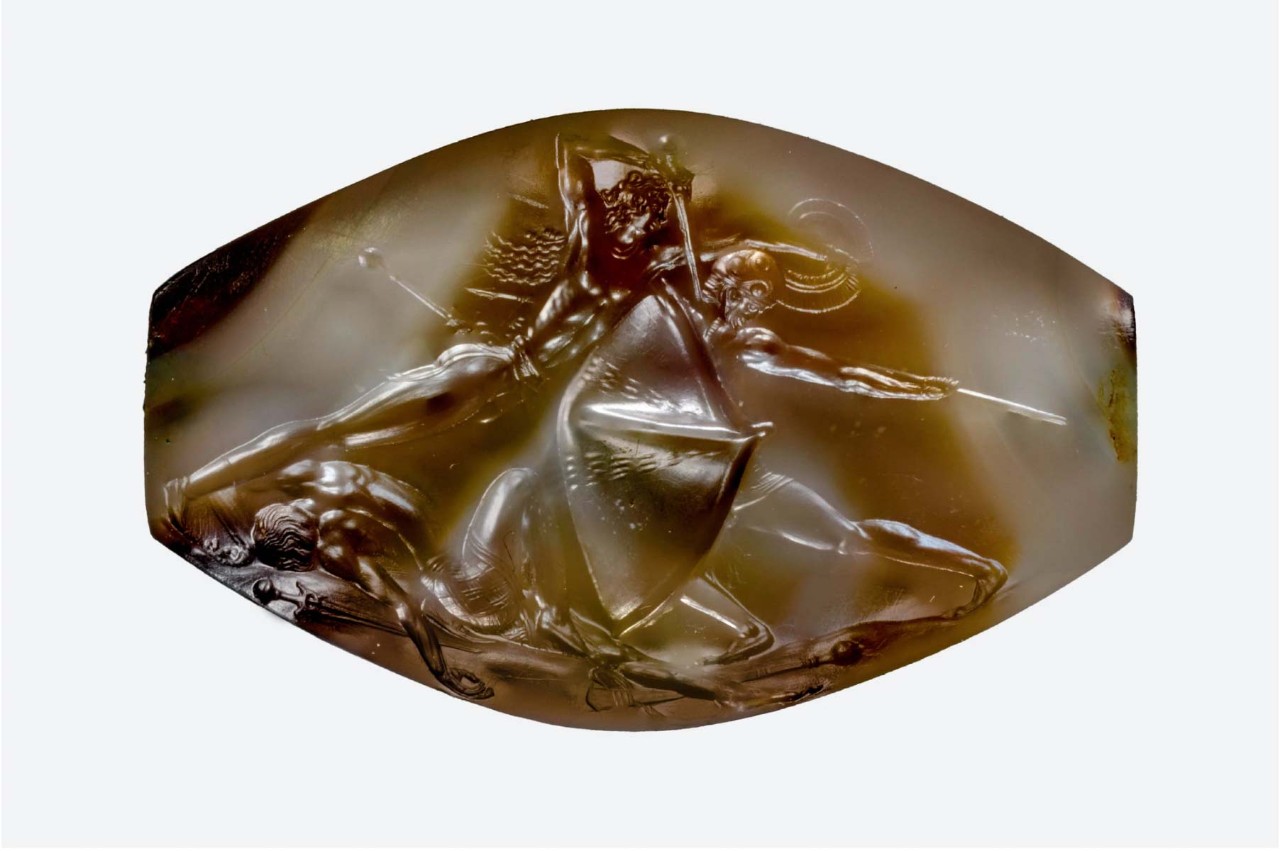
UC Classics professor Jack Davis and UC senior research associate Sharon Stocker in 2015 discovered the tomb of the Griffin Warrior near the Palace of Nestor in coastal Pylos, Greece. They named the warrior for the half-lion, half-eagle mythological figure emblazoned on his ivory plaque.

Discoveries by UC Classics Department Head Jack Davis and UC Senior Research Associate Sharon Stocker are changing the way we understand ancient Greece. Photo/UC Classics
UC researchers collaborated with archaeologists from around the world on an ambitious project to examine the ancient DNA from the remains of 727 people to study the origins and movements of people during the Bronze Age.
They found that between 5,000 and 7,000 years ago, people with ancestry from the Caucasus, a region between the Black and Caspian seas, moved west into Anatolia (now Turkey) and north into the steppe of Eastern Europe. Then around 5,000 years ago, people from Eastern Europe spread out across the European continent and into Western Asia and back to the Caucasus. They joined local populations, “creating a tapestry of diverse ancestry from which speakers of the Greek, Paleo-Balkan and Albanian languages arose.”
Three studies on the project were published this year in the journal Science.
“When we look at the rise of Mycenaean civilization, the ancient DNA supports the notion that it was a local phenomenon, not something imported from the outside,” said Davis, a study co-author and head of UC's Classics Department.
“The development of the state by the Mycenaean was indigenous to Greece,” Davis said.
Davis and Stocker hope to turn to ancient DNA again to examine any relationships between the Griffin Warrior and the people buried in gold-lined princely tombs they found nearby in 2017.
“What will be interesting to see is if we can establish a genetic relationship between the Griffin Warrior and the people buried in those tholos tombs at the same time,” Davis told Discover.
Related Stories
Sugar overload killing hearts
November 10, 2025
Two in five people will be told they have diabetes during their lifetime. And people who have diabetes are twice as likely to develop heart disease. One of the deadliest dangers? Diabetic cardiomyopathy. But groundbreaking University of Cincinnati research hopes to stop and even reverse the damage before it’s too late.
Is going nuclear the solution to Ohio’s energy costs?
November 10, 2025

The Ohio Capital Journal recently reported that as energy prices continue to climb, economists are weighing the benefits of going nuclear to curb costs. The publication dove into a Scioto Analysis survey of 18 economists to weigh the pros and cons of nuclear energy. One economist featured was Iryna Topolyan, PhD, professor of economics at the Carl H. Lindner College of Business.
App turns smartwatch into detector of structural heart disease
November 10, 2025

An app that uses an AI model to read a single-lead ECG from a smartwatch can detect structural heart disease, researchers reported at the 2025 Scientific Sessions of the American Heart Association. Although the technology requires further validation, researchers said it could help improve the identification of patients with heart failure, valvular conditions and left ventricular hypertrophy before they become symptomatic, which could improve the prognosis for people with these conditions.