UC joins historic U.S. academic outreach to Greece
Thirty U.S. universities will visit Greece to expand student opportunities

The University of Cincinnati will join a historic delegation of U.S. academic institutions on a visit to Greece in November to explore new opportunities for student scholarship in both countries.
UC has the longest relationship with Greece of any American university. Since the 1960s, UC has worked with the Aristotle University of Thessaloniki. More recently, students in UC Classics and philosophy have studied in Greece.
UC Provost Valerio Ferme will lead UC’s delegation to formalize new partnerships and expand existing ones by meeting with Greece’s public universities.
“We’d like to find strategic partners where multiple UC departments can conduct joint research, work with faculty, submit grants and offer students educational opportunities,” said Ferme, UC's vice president for academic affairs.

UC Classics professor Carl Blegen spent much of his career working in Greece, where he discovered the Palace of Nestor. Photo/UC Classics
UC will join 29 other U.S. universities in the academic delegation, the largest ever to conduct this kind of educational summit abroad, according to the Athens-Macedonian News Agency.
“It is a really historic visit. It will be the largest delegation of U.S. universities to another country,” U.S. Embassy cultural attache Shanna Dietz Surendra told the news service.
UC Classics has conducted archaeological work in Greece dating back to the 1920s. Years later, in 1939, Department Head Carl Blegen, a former fellow of the American School of Classical Studies at Athens, discovered the Palace of Nestor with Greek archaeologist Konstantinos Kourouniotis.
More recently, UC Classics Department Head Jack Davis and Senior Research Associate Sharon Stocker have been making astounding discoveries about ancient Greece such as the tomb of the Griffin Warrior shared around the world. Davis also served on the board of the National and Kapodistrian University of Athens for three years.
Students will inherit these challenges, so it’s important we show them the world beyond our doorstep.
Raj Mehta, UC Vice Provost
Davis said UC professor Peter Topping is credited with establishing UC’s academic relationship with Greece in the 1960s. Topping, who died in 2003, left his post as director at the Gennadius Library at the American School of Classical Studies in Athens to teach as a professor of history and later Greek studies.
“UC hired him to build a program in modern Greek studies,” Davis said. “He helped establish a special relationship between UC and the Aristotle University of Thessaloniki.”
Davis said he has collaborated with many Greek scholars and scientists over the years in his investigations of ancient Pylos. Many UC graduate students have come from Greece.
“A paleobotanist from the Aristotle University of Thessaloniki coordinates a group of students who are studying seeds from our excavations,” Davis said.
UC has similar academic partnerships with universities in many other countries.
Before the COVID-19 pandemic made international travel impossible, as many as 1,800 UC students took part in study abroad. Likewise, UC is home to students from countries on six continents. UC enrolled more than 4,500 students from other countries this year.
Vice Provost Raj Mehta, director of UC's Honors Program, said students who travel abroad often find they have a better understanding of how the world is connected.
“Many of the challenges we face are global, such as climate change, food insecurity, dwindling water resources and pandemics. We call them ‘wicked problems,’” Mehta said. “Students will inherit these challenges, so it’s important we show them the world beyond our doorstep.”
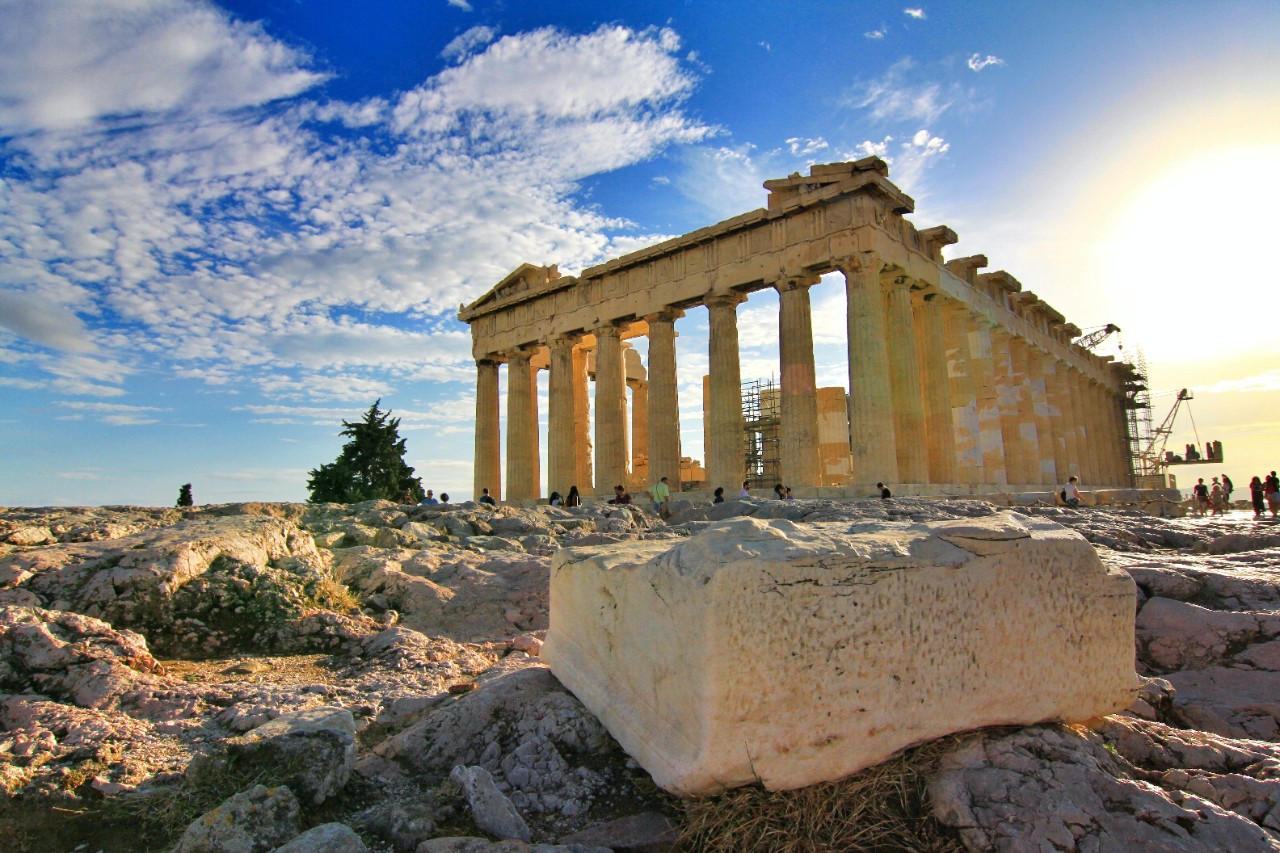
Featured image at top: Greece's Parthenon. UC will join a delegation of U.S. academic institutions to meet with Greek universities to expand opportunities for students in both countries. Photo/Patrick/Unsplash

UC Classics professor Jack Davis, left, and UC senior research associate Sharon Stocker have made startling discoveries about ancient Greece. Photo/Provided
Impact Lives Here
The University of Cincinnati is leading public urban universities into a new era of innovation and impact. Our faculty, staff and students are saving lives, changing outcomes and bending the future in our city's direction. Next Lives Here.
Related Stories
Sugar overload killing hearts
November 10, 2025
Two in five people will be told they have diabetes during their lifetime. And people who have diabetes are twice as likely to develop heart disease. One of the deadliest dangers? Diabetic cardiomyopathy. But groundbreaking University of Cincinnati research hopes to stop and even reverse the damage before it’s too late.
Is going nuclear the solution to Ohio’s energy costs?
November 10, 2025

The Ohio Capital Journal recently reported that as energy prices continue to climb, economists are weighing the benefits of going nuclear to curb costs. The publication dove into a Scioto Analysis survey of 18 economists to weigh the pros and cons of nuclear energy. One economist featured was Iryna Topolyan, PhD, professor of economics at the Carl H. Lindner College of Business.
App turns smartwatch into detector of structural heart disease
November 10, 2025

An app that uses an AI model to read a single-lead ECG from a smartwatch can detect structural heart disease, researchers reported at the 2025 Scientific Sessions of the American Heart Association. Although the technology requires further validation, researchers said it could help improve the identification of patients with heart failure, valvular conditions and left ventricular hypertrophy before they become symptomatic, which could improve the prognosis for people with these conditions.