Media highlight UC's FLASH radiotherapy trial

A new first-in-human trial led by University of Cincinnati researchers suggests a certain radiation treatment, which delivers therapeutic doses of radiation in a fraction of a second, may hold promise as a potential treatment for tough-to-kill tumors.
The technology, called FLASH radiation treatment (FLASH RT), delivers radiation at dose rates that are more than 300 times higher than those used in conventional radiation treatments. This induces a phenomenon known as the FLASH effect, which reduces the harm that may occur to normal tissue surrounding a tumor during conventional radiation therapy, while still killing the cancer cells at the tumor site.
In the trial of 10 patients with bone metastases, FLASH was shown to be safe and appeared to be as effective as conventional radiation without causing unexpected side effects.
Media outlets including Imaging Technology News, U.S. News and World Report and MedPage Today recently highlighted the research.
“Our study shows FLASH radiotherapy with protons is a practical modality to reduce pain,” said Emily C. Daugherty, MD, second author of the study and an assistant professor of clinical radiation oncology at the University of Cincinnati Cancer Center. “It deserves further exploration because of its potential to decrease the side effects associated with conventional radiation treatments.”
Read the U.S. News and World Report story.
Read the Aunt Minnie story. (Note: Subscription or account creation may be required to view full story.)
Watch Dr. Daugherty discuss the research on Oncology Tube.
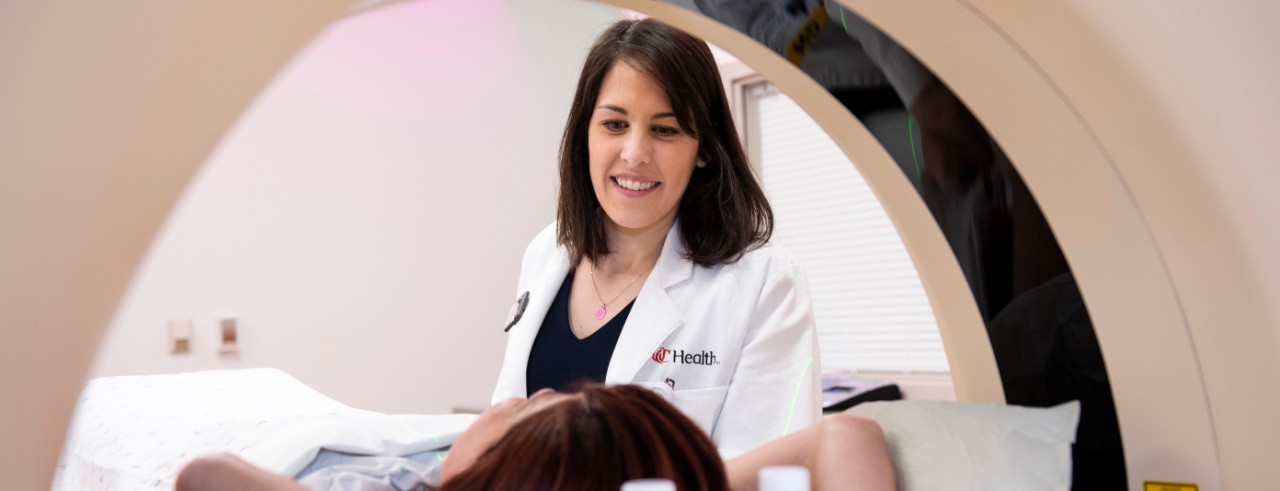
Featured photo at top of Dr. Daugherty with a patient. Photo/Colleen Kelley/UC Marketing + Brand.
Related Stories
Sugar overload killing hearts
November 10, 2025
Two in five people will be told they have diabetes during their lifetime. And people who have diabetes are twice as likely to develop heart disease. One of the deadliest dangers? Diabetic cardiomyopathy. But groundbreaking University of Cincinnati research hopes to stop and even reverse the damage before it’s too late.
Is going nuclear the solution to Ohio’s energy costs?
November 10, 2025

The Ohio Capital Journal recently reported that as energy prices continue to climb, economists are weighing the benefits of going nuclear to curb costs. The publication dove into a Scioto Analysis survey of 18 economists to weigh the pros and cons of nuclear energy. One economist featured was Iryna Topolyan, PhD, professor of economics at the Carl H. Lindner College of Business.
App turns smartwatch into detector of structural heart disease
November 10, 2025

An app that uses an AI model to read a single-lead ECG from a smartwatch can detect structural heart disease, researchers reported at the 2025 Scientific Sessions of the American Heart Association. Although the technology requires further validation, researchers said it could help improve the identification of patients with heart failure, valvular conditions and left ventricular hypertrophy before they become symptomatic, which could improve the prognosis for people with these conditions.