Student group brings global health competition to UC
Interdisciplinary team gains real-world experience, competes to advance nationally
A group of UC students is competing in the second Global Health Case Competition at the University of Cincinnati, with the hope of advancing to compete internationally.
As participants in the challenge, the students bring scholarship from multiple academic disciplines—among them political science, medical sciences, neuroscience, English, chemical and environmental engineering and more—to find innovative solutions to global health crises.
The competition first came to UC’s campus in 2021, led by Sanath Chandramouli, a fourth-year student in the College of Arts and Sciences double majoring in political science and neuroscience. Chandramouli was inspired to participate in the Global Health Competition founded at Atlanta’s Emory University.

UC political science and neuroscience double major Sanath Chandramouli. Photo/Provided
“Emory University’s Global Health Case Competition looked interesting, and I was frustrated that it wasn’t present at UC.” said Chandramouli, “so, I built a team, and we made it happen.”
Chandramouli explains benefits of the competition to students: “It gives students an opportunity to develop research, presentation and critical analysis skills in a low-stakes high-reward environment. Additionally, it provides exposure to the field of public policy, budgeting, and public health which virtually every major can benefit from experience in.”
The Case Competition involves multiple teams of about four to six students, the only requirement being that each team represents at least two colleges on campus. Each team is given the same case on a global health crisis, and they must form their own solution to the crisis. They then take their solution to compete against one another.
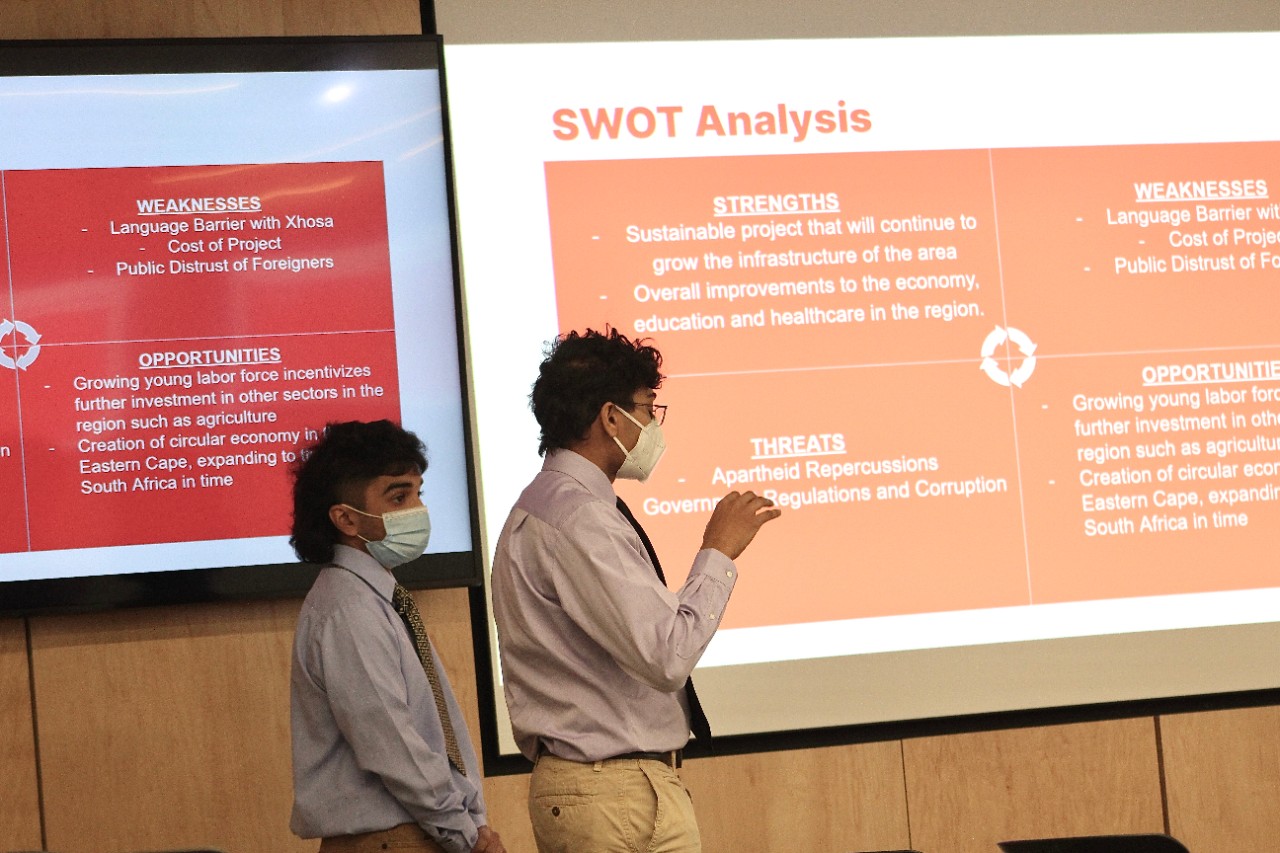
The global health crisis that the teams are given varies each year. Last year, the crisis revolved around the collapse of the emergency medical system in the Eastern Cape of South Africa. The global health crisis always aligns with the one also being used for the case competitions at Emory University.
What makes the program important
Chandramouli is co-president of the executive board they have created, serving with medical sciences major and economics minor Ashvin Babu. When Chandramouli knew he wanted to start this program at UC, he enlisted the help of peers: Saiprasad Naidu, medical sciences; Sharif Johnson, finance; and Lindsey Learned, marketing. Serving as the advisor is Russel Durst, professor emeritus in English for the College of Arts and Sciences.
“Three things, in my opinion, make this program crucial,” says board vice president Sharif Johnson. “Students get the chance to gain real-world experience, they work on projects that are practical, and they complete assignments that they can discuss in [future] interviews.”
Johnson feels that this program is going to continue having a positive impact on UC. Johnson states, “Hearing that UC not only has one of the top health programs, but also offers competition case studies to students in all majors sounds fascinating.”
Securing local support

UC students competing in the 2021 Global Health Case Competition. Photo/Provided
Upon first bringing the competition to UC, Chandramouli reached out to public health-care provider CareSource to seek sponsorship. CareSource was eager to sponsor, Chandramouli says, and has since been able to match Emory University in the awards they provide to the winning team. This year, CareSource will award a $3,000 scholarship to the winning team.
“We are attempting to organize an international round of the competition so that our winning team from UC can go compete at Emory University,” explains Chandramouli, “Our org hosts an intramural round and Emory hosts an international round.” The executive board hopes that they will be able to compete in the final round at Emory.
Participating students will be given five weeks to work on their solution, and then present it at the competition. This year, the competition takes place from October 10 through November 12.
Featured image at top: UC students compete at the 20201 Global Health Case Competition. Photo/Provided

By Hayley Garr
Student Journalist, Marketing and Communication, College of Arts and Sciences
artscinews@ucmail.uc.edu
Related Stories
How AI might help nonprofits
November 7, 2025
University of Cincinnati Professor Victoria LaPoe examined whether people respond differently to AI-created messaging in nonprofit advertising.
Shining like a disco ball: Rachel Hoermann’s story of finding passion and purpose at UC
November 6, 2025
Rachel Hoermann has dreamed of becoming a writer since childhood. But like many who grew up in Ohio’s rust belt, the idea of going to college felt out of reach. For years, she cycled through work that never quite satisfied her creative drive. That changed when she came across a box that once belonged to her father—a discovery that would alter the course of her life.
New hires reflect UC’s commitment to research, innovation and impact
November 6, 2025
With the 2025-26 school year in full swing, the College of Arts and Sciences has welcomed five faculty members to lead departments that span from chemistry to journalism. Dean James Mack said these new hires “reflect our unwavering commitment to ‘Discovery in Action,’ as we continue to enhance our academic and research excellence”. With these additions, the future of UC is in good hands, and students can look forward to new opportunities for learning, research, and innovation.