How a scholarship changed one medical student’s life

The phone call changed the trajectory of Justin Kenney’s life.
At the time, Justin was working as a Firefighter/EMT with the Cincinnati Fire Department. He was in his late twenties, living with his wife in a one-bedroom apartment in Batavia, and had been accepted into the College of Medicine. He had filled out an application for financial aid and was hoping for the best—perhaps a few thousand dollars a year—when Art Pancioli, MD, the Richard C. Levy Endowed Chair & Professor of Emergency Medicine, called to update him about his scholarship status.
“How would you like to go to medical school for free?” Pancioli asked.
Justin was speechless. “I bawled like a baby,” he says. “That someone would care that much about investing in this community—that some person, without even knowing me, would invest in my future— is overwhelming. I get choked up just thinking about it.”

Medical student Justin Kenney. Photo/provided.
Justin is one of the first group of 10 College of Medicine students to receive a four-year, full-tuition scholarship from the Webster-Gustin Medical Scholarship Fund. The fund was established in 2020 with an anonymous gift and will benefit a total of 40 students who went to high school or college in Ohio.
Justin and his wife, Chelsie, had pinched pennies and amassed enough funds that Justin felt could limit the debt he would incur attending medical school. Instead, he and Chelsie—who met in Sunday School when they were five years old—used the nest egg to purchase their first home, along with other necessities as they prepare for the birth of their first child in October.
The Webster-Gustin Scholarship, Justin says, has allowed him to live a life that differs from that of his medical school colleagues. “I was able to put my savings toward something that’s important for someone who’s 30 years old, as I am, like investing in my family, or buying a house, or being able to buy my kid’s crib, or even not having to worry about affording groceries. Anything that’s going on in my life right now is all seen in the light of an absence of a massive debt.”
Helping students chase their passions
Growing up in Cincinnati, Justin wanted to become a superhero. “I know it sounds cheesy,” he says, “but I really wanted to be a fireman and a doctor. I couldn’t explain it.”
After graduating from Vanderbilt University, Justin moved back to Cincinnati, acquired his EMS certification, and began working for the Cincinnati Fire Department. “I loved the job, loved the community, loved my co-workers, but I felt called to pursue a greater scope of practice, because you’re very limited in what you’re able to do in the pre-hospital setting,” he says. “To utilize my gifts to their fullest capacity, I felt called to go to medical school.”
Today, Justin is on track to become an emergency medicine physician. In addition to his regular coursework, he has created hands-on workshops to educate fellow students about the realities of emergency medical practice, conducted research in acute pain management after traumatic injury in the pre-hospital setting, and served as president of the Emergency Medicine Interest Group on campus. He’s scheduled to graduate in 2024.
If his future turns out as perfectly as his present, he will perform his emergency medicine residency at UC and then practice medicine in the Cincinnati community.
Justin also hopes to become the kind of superhero who funded his medical school scholarship.
“I’ve made it my life goal ever since to pay it forward. I want to pay back this gift, and I want to do this anonymously for some other random medical student someday, and many more if I can help it. My scholarship is the kind of life-changing event that makes you want to be a better person every time you think about it. It makes me want to get up and be a better doctor every day. It has influenced everything I will ever do, forever.”
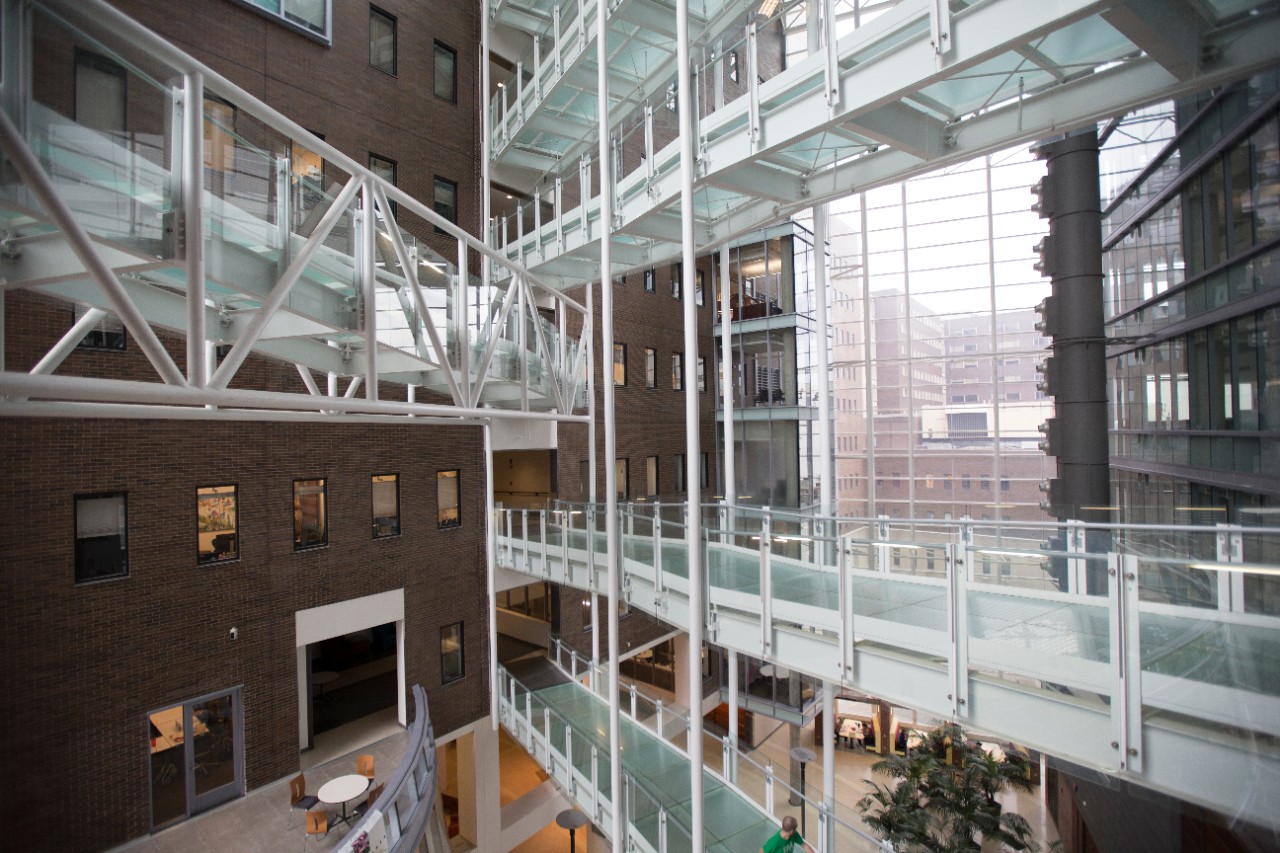
Featured image at top: Care Crawley building. Photo/provided.
To support Justin and other students like him, please visit the College of Medicine giving website.
Related Stories
Sugar overload killing hearts
November 10, 2025
Two in five people will be told they have diabetes during their lifetime. And people who have diabetes are twice as likely to develop heart disease. One of the deadliest dangers? Diabetic cardiomyopathy. But groundbreaking University of Cincinnati research hopes to stop and even reverse the damage before it’s too late.
App turns smartwatch into detector of structural heart disease
November 10, 2025

An app that uses an AI model to read a single-lead ECG from a smartwatch can detect structural heart disease, researchers reported at the 2025 Scientific Sessions of the American Heart Association. Although the technology requires further validation, researchers said it could help improve the identification of patients with heart failure, valvular conditions and left ventricular hypertrophy before they become symptomatic, which could improve the prognosis for people with these conditions.
Combination immunotherapy helps overcome melanoma treatment resistance
November 10, 2025

MSN highlighted research led by the University of Cincinnati Cancer Center's Trisha Wise-Draper showing a combination of immunotherapy medications can activate a robust immune response and help overcome treatment resistance in patients with refractory melanoma.