Discover: Did giant sea lizard rule oceans 66M years ago?
UC paleontologist Takuya Konishi explains significance of new mosasaur discovery

Discover turned to University of Cincinnati paleontologist Takuya Konishi to explain the significance of a new species of mosasaur described by the University of Bath.
Konishi, who was not part of the discovery, is an expert in mosasaurs and other marine reptiles that terrorized oceans during the Cretaceous Period more than 65 million years ago.

UC College of Arts and Sciences assistant professor Takuya Konishi studies mosasaurs and other ancient marine reptiles. Photo/Joseph Fuqua II/UC
Nicholas Longrich of the University of Bath led a study about a newly identified species of mosasaur they called Thalassotitan atrox (which means merciless sea giant) found in Morocco that had conical teeth like a killer whale. It was as big as an orca, too, at 30 feet.
Konishi told Discover that the specimen resembles another mosasaur called Prognathodon overtoni.
“The bulk of the features are basically found in this other species of mosasaur,” Konishi told Discover. “It’s just 10 million years older. The morphological consistency between the two mosasaurs likely implies just a continuation of that same kind of niche for Prognathodon.”
When it comes to the world's largest marine reptiles, location might not be as important a factor to identification, he said.
“They are large predators, and 10 million years would've given ample time for any large marine reptiles to achieve global distribution, keeping their original niche wherever they ended up,” he told Discover.
Konishi and UC graduate Alexander Willman and University of Alberta professor Michael Caldwell in 2021 identified an 18-foot-long mosasaur they called Ectenosaurus everhartorum after paleontologists Mike and Pamela Everhart. The mosasaur inhabited the Western Interior Seaway 80 million years ago in what is now western Kansas.
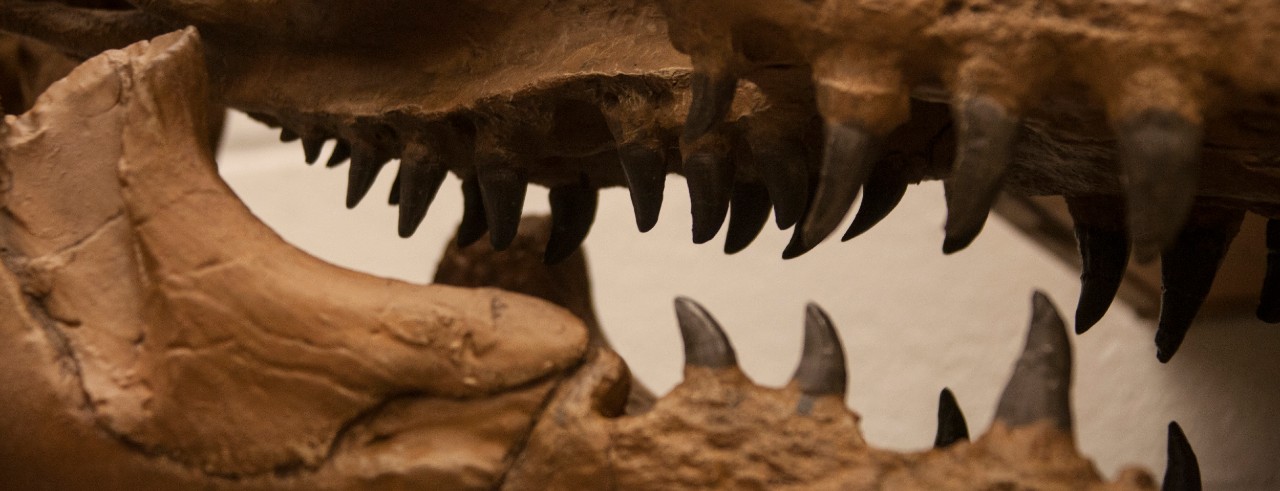
Featured image at top: The teeth of a mosasaur. Photo/Joseph Fuqua II/UC

UC College of Arts and Sciences assistant professor Takuya Konishi studies ancient marine reptiles such as mosasaurs. Photo/Joseph Fuqua II/UC
Related Stories
Sugar overload killing hearts
November 10, 2025
Two in five people will be told they have diabetes during their lifetime. And people who have diabetes are twice as likely to develop heart disease. One of the deadliest dangers? Diabetic cardiomyopathy. But groundbreaking University of Cincinnati research hopes to stop and even reverse the damage before it’s too late.
Is going nuclear the solution to Ohio’s energy costs?
November 10, 2025

The Ohio Capital Journal recently reported that as energy prices continue to climb, economists are weighing the benefits of going nuclear to curb costs. The publication dove into a Scioto Analysis survey of 18 economists to weigh the pros and cons of nuclear energy. One economist featured was Iryna Topolyan, PhD, professor of economics at the Carl H. Lindner College of Business.
App turns smartwatch into detector of structural heart disease
November 10, 2025

An app that uses an AI model to read a single-lead ECG from a smartwatch can detect structural heart disease, researchers reported at the 2025 Scientific Sessions of the American Heart Association. Although the technology requires further validation, researchers said it could help improve the identification of patients with heart failure, valvular conditions and left ventricular hypertrophy before they become symptomatic, which could improve the prognosis for people with these conditions.