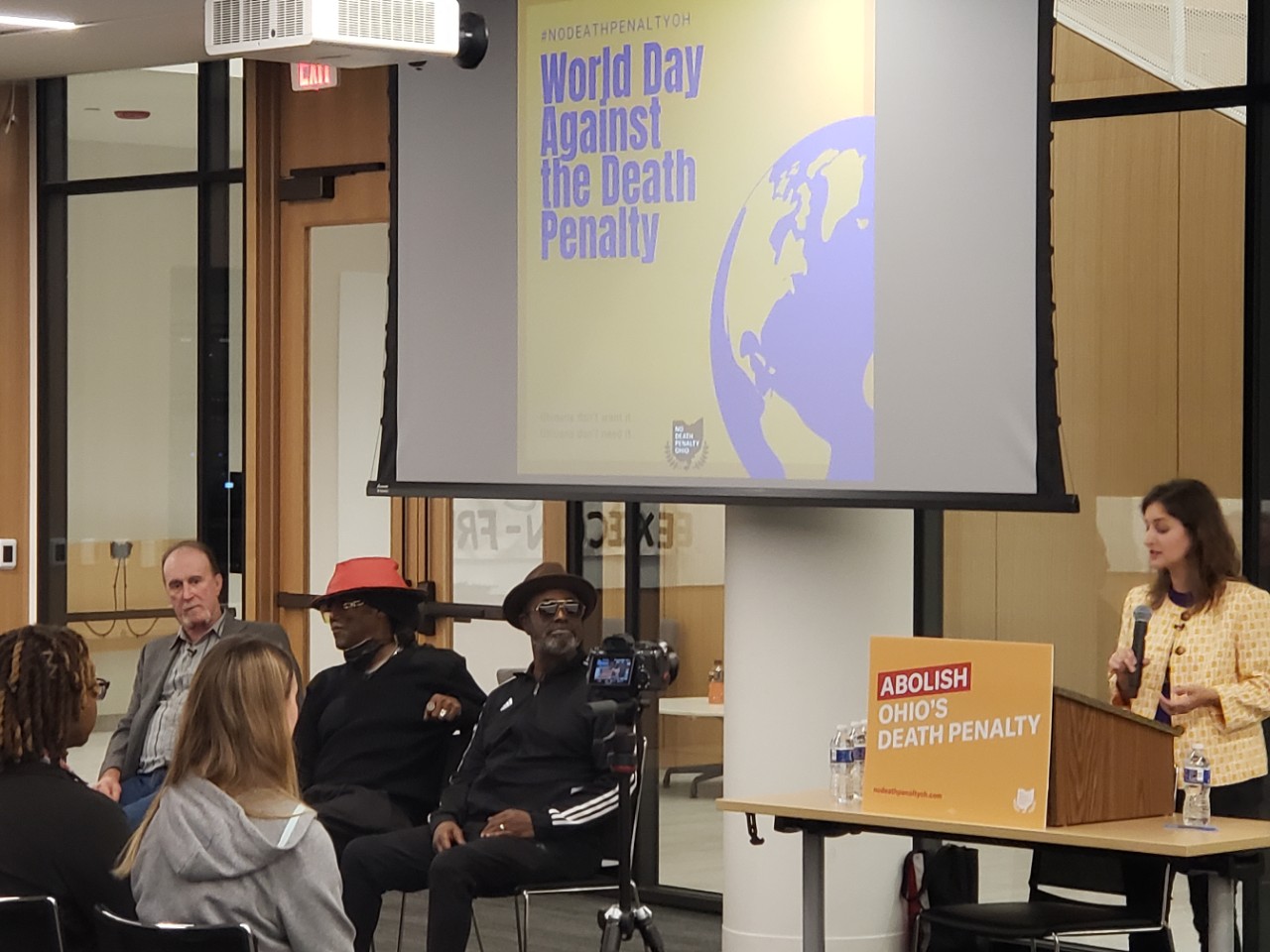
Ohio Innocence Tour visits UC Law to discuss abolition of the death penalty
Cincinnati's Local 12 News speaks with three death row exonerees

The Ohio Innocence Tour made a stop at the UC College of Law Monday, Oct. 10, to feature three Ohio Death Row exonerees — individuals wrongly convicted and sentenced to death but are now free — as part of an effort to end the death penalty in the state of Ohio. Kwame Ajamu, Derrick Jamison and Ray Krone were part of a panel discussion.
They were interviewed by Local 12 News for segments about abolition of the death penalty. Ajamu had his name cleared with the help of the Ohio Innocence Project at UC.
According to the Witness to Innocence website, Ajamu was a teenager in Cleveland, Ohio, when he was wrongfully convicted due to false eyewitness testimony and police misconduct. Ajamu spent 28 years for a crime he didn’t commit. The sole evidence against Ajamu, known as Ronnie Bridgeman at the time, and his co-defendants, brother Wiley Bridgeman and friend Ricky Jackson, was the false, coerced eyewitness testimony of a 13-year-old boy.
No physical or forensic evidence linked Ajamu, Bridgeman or Jackson to the 1975 murder-robbery of Harold Franks, none of them had any prior criminal record, and defense witnesses provided all three with credible alibis. Nevertheless, all three were sentenced to death just months after their arrest.
Jamison served 20 years in prison, survived six death warrants and once came within 90 minutes of execution, according to the Death Penalty Information Center. He was convicted and sentenced to death in 1985 for the murder of a Cincinnati bartender. His conviction hinged on the testimony of a co-defendant who avoided the death penalty by falsely implicating Jamison. Other evidence that would have contradicted that testimony was withheld during Jamison’s trial. In 2000, a federal district court judge overturned Jamison’s conviction and five years later charges against him were dismissed.
According to the Innocence Project website, Krone spent more than a decade in prison, some of it on death row, before DNA testing cleared his name. He was wrongfully convicted in the 1991 fatal stabbing of a 36-year-old woman found in the restroom of a Phoenix, Arizona bar. Investigators relied on bite marks on the victim’s breast and neck to make their case.
Upon hearing that the victim had told a friend that a regular customer named Ray Krone was to help her close up the bar the previous night, police asked Krone to make a Styrofoam impression of his teeth for comparison. Krone maintained his innocence saying he was asleep when the killing occurred. He was nevertheless convicted of murder and kidnapping. After five years behind bars, Krone won a new trial but again was convicted, mainly on the state’s expert bite-mark testimony. It wasn’t until 2002 that DNA testing concluded the saliva and blood found on the victim excluded Krone as the source and instead matched another incarcerated man.
Pierce Reed, director of policy and engagement for the Ohio Innocence Project at UC, says one of OIP’s main legislative goals is the abolition of the death penalty in Ohio.
“The best research estimates that between 3% and 5% of people on America’s death rows are innocent,” explains Reed. “In Ohio, we think that it is a higher rate than that. Ohio is home to 11 death row exonerees who collectively spent 216 years incarcerated for crimes they did not commit.”
For every five people Ohio has executed, one has been exonerated from death row, says Reed. More than half (56%) of those on Ohio’s death row are people of color, even though they make up a small fraction (15%) of Ohio’s population. When Ohio executions have taken place, 75% of the time the crime committed has involved a white victim.
Learn more about the Ohio Innocence Project at UC online.
Featured image of Ray Krone, Derrick Jamison and Kwame Ajamu at the Ohio Innocence Tour at UC Law. Photo provided.
Related Stories
Sugar overload killing hearts
November 10, 2025
Two in five people will be told they have diabetes during their lifetime. And people who have diabetes are twice as likely to develop heart disease. One of the deadliest dangers? Diabetic cardiomyopathy. But groundbreaking University of Cincinnati research hopes to stop and even reverse the damage before it’s too late.
Is going nuclear the solution to Ohio’s energy costs?
November 10, 2025

The Ohio Capital Journal recently reported that as energy prices continue to climb, economists are weighing the benefits of going nuclear to curb costs. The publication dove into a Scioto Analysis survey of 18 economists to weigh the pros and cons of nuclear energy. One economist featured was Iryna Topolyan, PhD, professor of economics at the Carl H. Lindner College of Business.
App turns smartwatch into detector of structural heart disease
November 10, 2025

An app that uses an AI model to read a single-lead ECG from a smartwatch can detect structural heart disease, researchers reported at the 2025 Scientific Sessions of the American Heart Association. Although the technology requires further validation, researchers said it could help improve the identification of patients with heart failure, valvular conditions and left ventricular hypertrophy before they become symptomatic, which could improve the prognosis for people with these conditions.