UC study: Immunotherapy drug did not increase surgery complications
Researchers publish findings in JAMA Otolaryngology

A University of Cincinnati study found administering an immunotherapy drug before surgery for oral cavity cancer did not lead to increased rates of complications during and after surgery.
The findings were published Aug. 25 in the journal JAMA Otolaryngology - Head & Neck Surgery.
Alice Tang, MD, first author on the study, said the research built upon previous findings led by UC’s Trisha Wise-Draper that found adding immunotherapy drug pembrolizumab to the standard of care increased survival rates for patients with head and neck cancer with intermediate risk features.
Pembrolizumab, sold under the brand name Keytruda, is an antibody used in cancer immunotherapy that treats a variety of cancers, including head and neck.
“Dr. Wise-Draper and her group previously demonstrated that pembrolizumab in some patients undergoing treatment for head and neck cancer have benefited their disease-free survival,” said Tang, assistant professor of clinical otolaryngology in UC’s College of Medicine, a UC Health physician and a University of Cincinnati Cancer Center member. “For patients undergoing surgery, we continue to want to understand how pembrolizumab given before surgery may affect wound healing and other factors in our patients as we increase the use of these novel agents.”
Researchers reviewed outcomes of 32 patients from Wise-Draper’s clinical trial who received pembrolizumab before head and neck cancer surgery and 32 control patients to see if the drug led to increased adverse events, including tissue swelling, wound infections, improper wound healing and failure of reconstruction, during and after surgery.
“What we found was that patients who received preoperative treatment with immunotherapy did not have an increase in morbidities around the time of surgery,” Tang said.

Alice Tang, MD. Photo/University of Cincinnati
Tang said the findings are encouraging as immunotherapy drugs continue to be researched as treatments for head and neck cancer.
“For patients who are treatment naïve, meaning that they have not previously received chemotherapy, radiation or surgery for their oral cavity cancer, we can feel reassured that their complication rate would not be different when receiving immunotherapy compared to those patients who did not receive immunotherapy,” Tang said.
Moving forward, future studies will seek to validate these findings while evaluating pembrolizumab’s effect on other subsites of head and neck cancer including the larynx and the middle part of the throat, Tang said.
“Immunotherapy demonstrates a lot of promise in treating many types of cancer including head and neck cancer,” Tang said. “With its increased use for a variety of cancers, it is important to understand the side effects and toxicities of using these novel agents in patients who undergo surgery.”
Study authors also include Thomas O’Neil, Sean McDermott, Siddhant Tripathi, Raisa Tikhtman, Jonathan R. Mark, Yash Patil, Meredith Tabangin, Mekibib Altaye, Trisha Wise-Draper and Chad Zender. Wise-Draper reported grants from Merck Sharp & Dohme Corp, Bristol Myers Squibb, Tesaro/GSK, Janssen and AstraZeneca, as well as personal fees from Shattuck Labs, Exicure, Caris Life Sciences and Rakuten outside the submitted work. No other disclosures were reported.
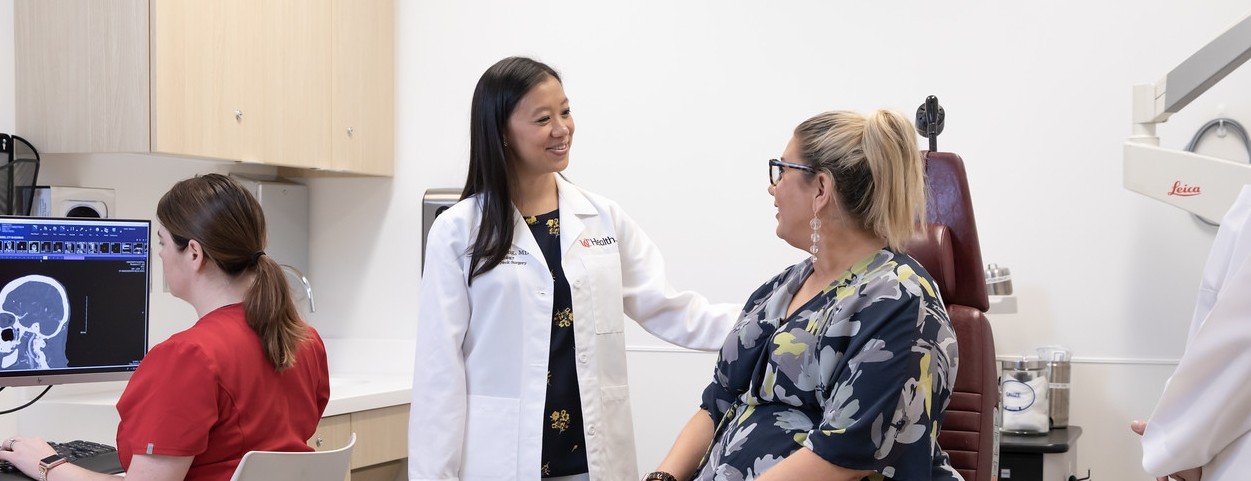
Featured photo at top of Alice Tang, MD, center, with patient. Photo provided by UC Health.
Related Stories
Sugar overload killing hearts
November 10, 2025
Two in five people will be told they have diabetes during their lifetime. And people who have diabetes are twice as likely to develop heart disease. One of the deadliest dangers? Diabetic cardiomyopathy. But groundbreaking University of Cincinnati research hopes to stop and even reverse the damage before it’s too late.
Is going nuclear the solution to Ohio’s energy costs?
November 10, 2025

The Ohio Capital Journal recently reported that as energy prices continue to climb, economists are weighing the benefits of going nuclear to curb costs. The publication dove into a Scioto Analysis survey of 18 economists to weigh the pros and cons of nuclear energy. One economist featured was Iryna Topolyan, PhD, professor of economics at the Carl H. Lindner College of Business.
App turns smartwatch into detector of structural heart disease
November 10, 2025

An app that uses an AI model to read a single-lead ECG from a smartwatch can detect structural heart disease, researchers reported at the 2025 Scientific Sessions of the American Heart Association. Although the technology requires further validation, researchers said it could help improve the identification of patients with heart failure, valvular conditions and left ventricular hypertrophy before they become symptomatic, which could improve the prognosis for people with these conditions.