UC creates next generation of internet security
Math professor’s algorithm will safeguard email, banking and other digital systems we use every day

An encryption tool co-created by a University of Cincinnati math professor will soon safeguard the telecommunications, online retail and banking and other digital systems we use every day.
The National Institute of Standards and Technology chose four new encryption tools designed to thwart the next generation of hackers or thieves. One of them, called CRYSTALS-Kyber, is co-created by UC College of Arts and Sciences math professor Jintai Ding.
“It’s not just for today but for tomorrow,” Ding said. “This is information that you don’t want people to know even 30 or 50 years from now.”

Jintai Ding
Ding’s algorithm was designed to withstand probing from quantum computers, which harness the power of quantum mechanics to speed calculations. The faster the calculations, the more quickly a security system can be breached.
“Given enough time, you can decrypt any system,” Ding said. “But if it takes 10,000 years, nobody cares.”
The institute, part of the U.S. Department of Commerce, selected CRYSTALS-Kyber among three other tools.
Symmetric encryption uses math to protect sensitive electronic information, from the texts we send to financial documents we share. Public-key systems help the sender and receiver to create a shared secret key, which is used to encrypt and decipher data to deter uninvited third parties.
“The implications are very profound,” Ding said. “Without a modern encryption system, we don’t have the internet. We don’t have secure communications. No online banking. No software updates. Our whole digital society relies on modern cryptography.”

UC math professor Jintai Ding created the algorithm that will be used to protect digital communications, banking and other online systems we use every day. Photo/Andrew Higley/UC Marketing + Brand
Among the advantages NIST cited for CRYSTALS-Kyber was its efficiency.
“It can’t be too slow,” Ding said. “You don’t want lag time. You want to read your message immediately.”
Likewise, you don’t want the encryption to take up valuable computer storage.
The federal agency also chose three algorithms to verify people’s identities during digital transactions.
“The sister of Kyber is called Dilithium, which is used for authentication. They’re used together sometimes and sometimes they’re used separately,” Ding said.
The implications are very profound. Without a modern encryption system, we don’t have the internet.
Jintai Ding, UC math professor
The names might ring familiar to fans of “Star Trek” and “Star Wars.” Kyber crystals power lightsabers while dilithium crystals power the warp drive of the USS Enterprise. Ding credited his collaborators for the colorful names.
“Encryption is not as easy to understand as ‘Star Wars,’” he joked.
The need for improved cybersecurity can’t be overstated, said Richard Harknett, chairman of UC’s Center for Cyber Strategy and Policy.
“Quantum technology has the potential to undermine the fundamentals of how we securely exchange digital data,” Harknett said. “Professor Jintai Ding has been a leader in this field for decades and has worked consistently to solve this looming threat. He and his team have provided NIST with a solution that will benefit global security.
“We are fortunate to have Dr. Ding, whose vision has driven cryptography to a new level. UC talks about next lives here. Dr. Ding has proven it does.”
The standards adopted by the United States often become the de facto standards around the world, Ding said. So the new cybersecurity could have far-reaching implications.
Ding took a circuitous route to studying cryptography. His expertise as a tenured professor of math at UC was in quantum algebra. But in 2001, he read about a quantum computer created by MIT physicist Isaac Chuang.
“I was amazed. I immediately realized that we have to replace all the existing key code systems protecting our data,” he said. “I gave up what I was doing and switched to cryptography. UC gave me a lot of support.”
Implementing the new security is expected to take years because it’s not as easy as installing a software patch. But its protections could last for a generation.
Even as encryption tools get more powerful, others are working on new attacks to crack them.
“This is a game we’ll keep playing,” Ding said. “We can never be complacent.”
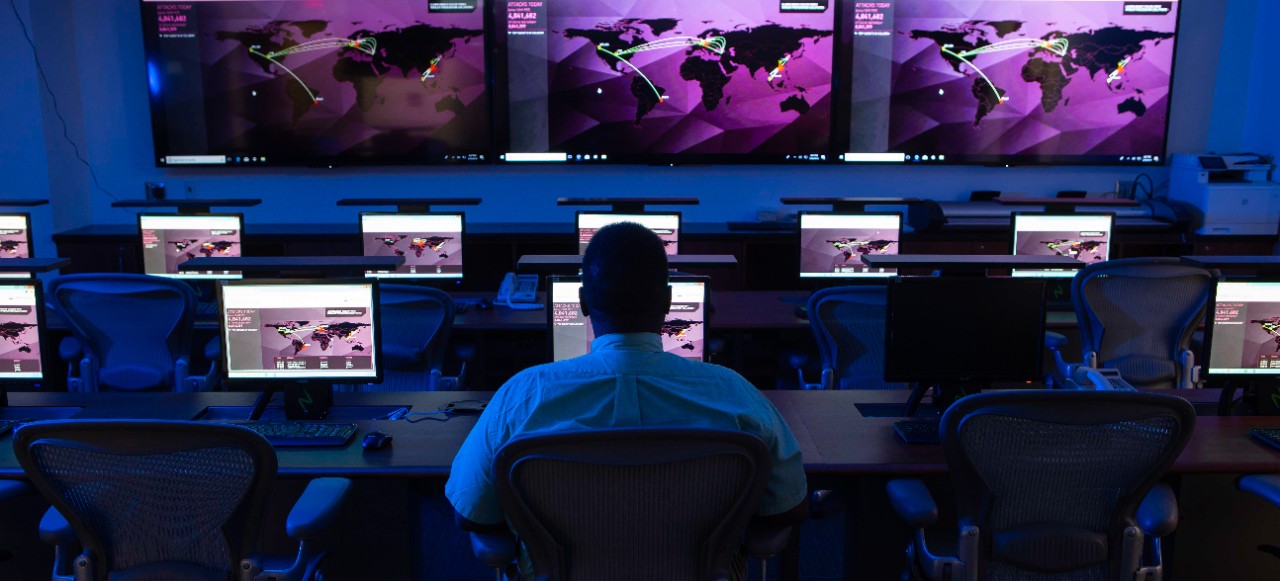
Featured image at top: UC professor Jintai Ding created a cybersecurity system designed to thwart quantum computers. Photo/Andrew Higley/UC Marketing + Brand

UC math professor Jintai Ding created the algorithm chosen by the National Institute for Standards and Technology to support the next generation of cybersecurity in the United States. Photo/Andrew Higley/UC Marketing + Brand
Next Lives Here
The University of Cincinnati is classified as a Research 1 institution by the Carnegie Commission and is ranked in the National Science Foundation's Top-35 public research universities. UC's graduate students and faculty investigate problems and innovate solutions with real-world impact. Next Lives Here.
Related Stories
Sugar overload killing hearts
November 10, 2025
Two in five people will be told they have diabetes during their lifetime. And people who have diabetes are twice as likely to develop heart disease. One of the deadliest dangers? Diabetic cardiomyopathy. But groundbreaking University of Cincinnati research hopes to stop and even reverse the damage before it’s too late.
App turns smartwatch into detector of structural heart disease
November 10, 2025

An app that uses an AI model to read a single-lead ECG from a smartwatch can detect structural heart disease, researchers reported at the 2025 Scientific Sessions of the American Heart Association. Although the technology requires further validation, researchers said it could help improve the identification of patients with heart failure, valvular conditions and left ventricular hypertrophy before they become symptomatic, which could improve the prognosis for people with these conditions.
Combination immunotherapy helps overcome melanoma treatment resistance
November 10, 2025

MSN highlighted research led by the University of Cincinnati Cancer Center's Trisha Wise-Draper showing a combination of immunotherapy medications can activate a robust immune response and help overcome treatment resistance in patients with refractory melanoma.