Medium highlights UC research of light as treatment for cancer

Medium recently highlighted University of Cincinnati research that shows early indications that light can be used as a treatment for certain diseases, including cancer.
Jiajie Diao, PhD, associate professor in the Department of Cancer Biology in UC’s College of Medicine and a University of Cincinnati Cancer Center member, and colleagues at the University of Illinois Urbana-Champaign and the University at Buffalo published the results of their study demonstrating light-activated proteins can help normalize dysfunction within cells in the journal Nature Communications July 25.
The researchers attached two separate proteins to mitochondria and lysosomes within stem cells. When stimulated by blue light, the proteins naturally bind to each other to form one new protein, which also brings the mitochondria and lysosome into contact. Once they are brought together, the lysosome can cut the mitochondria, achieving fission.
“We found that it can recover the mitochondrial function,” Diao said. “Some of the cells can even go back to normal. This proves that by just using some simple light stimulation we can at least partially recover the mitochondrial function of the cell.”
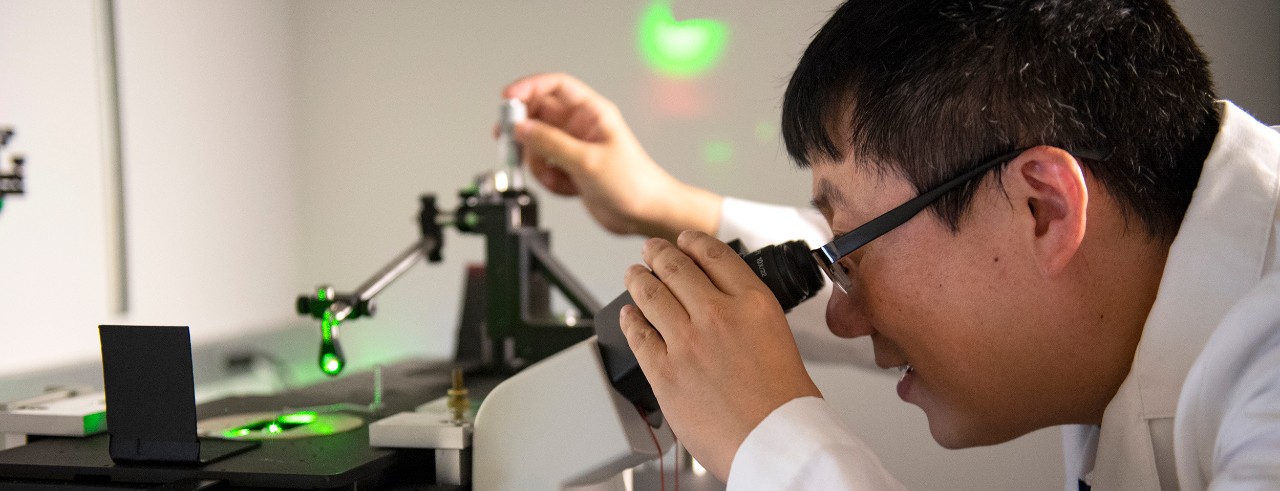
Featured photo at top of Jiajie Diao working in his lab. Photo/Colleen Kelley/UC Marketing + Brand.
Related Stories
Sugar overload killing hearts
November 10, 2025
Two in five people will be told they have diabetes during their lifetime. And people who have diabetes are twice as likely to develop heart disease. One of the deadliest dangers? Diabetic cardiomyopathy. But groundbreaking University of Cincinnati research hopes to stop and even reverse the damage before it’s too late.
Is going nuclear the solution to Ohio’s energy costs?
November 10, 2025

The Ohio Capital Journal recently reported that as energy prices continue to climb, economists are weighing the benefits of going nuclear to curb costs. The publication dove into a Scioto Analysis survey of 18 economists to weigh the pros and cons of nuclear energy. One economist featured was Iryna Topolyan, PhD, professor of economics at the Carl H. Lindner College of Business.
App turns smartwatch into detector of structural heart disease
November 10, 2025

An app that uses an AI model to read a single-lead ECG from a smartwatch can detect structural heart disease, researchers reported at the 2025 Scientific Sessions of the American Heart Association. Although the technology requires further validation, researchers said it could help improve the identification of patients with heart failure, valvular conditions and left ventricular hypertrophy before they become symptomatic, which could improve the prognosis for people with these conditions.