How sickle cell disease affects neurological conditions
UC researcher studies connection between blood disorder, stroke and cognitive impairment

Sickle cell disease (SCD), a blood disorder that primarily affects people of African ancestry, can cause a variety of symptoms in patients, including stroke and cognitive impairment.
Hyacinth I. Hyacinth, PhD, MBBS, studies racial health disparities in neurological conditions at the University of Cincinnati and is currently leading two research projects to learn more about the relationship between sickle cell disease, stroke and cognitive impairment.
SCD and cognitive impairment
Patients with sickle cell disease tend to have high levels of inflammation in their body, including in the brain. Hyacinth said his previous research demonstrated that cognitive impairment is strongly correlated to the presence of inflammation specifically in the brain.
Hyacinth’s research found a drug called minocycline that blocks the inflammation was able to halt or reverse cognitive impairment in early studies of SCD animal models. Supported by a $3 million National Heart, Lung, and Blood Institute grant over five years, Hyacinth is continuing to study how minocycline and other targeted drugs can treat cognitive impairment in sickle cell disease.
Minocycline is an antibiotic that blocks the conversion of molecules that are needed to activate inflammatory proteins. The drug also crosses the blood-brain barrier well and is thought to help neurons in the brain connect and mature.

Hyacinth I. Hyacinth, PhD, MBBS. Photo/Andrew Higley/UC Marketing + Brand
While promising, Hyacinth said minocycline also tends to have some side effects in children, leading to the team also studying the effectiveness of other similar drugs that prevent inflammation and/or help form stronger neuron connections in the brain. The other drugs included in the study have more specific targets than minocycline, with the hope that this would lead to fewer side effects.
As the research in the lab continues, Hyacinth said he is working with members of his team (including Kristine Karkoska, MD, assistant professor in the UC College of Medicine’s Department of Internal Medicine) to design a first in sickle cell patients pilot clinical trial to test minocycline in adult patients with SCD and cognitive impairment.
SCD and stroke
According to Hyacinth, children with sickle cell disease are 300 times more likely to have a stroke compared to peers from the same ethnic group without sickle cell, and adults with SCD are 75 times more likely to have a stroke compared to age and race matched counterparts without SCD.
“So the question always is the same: How do we get from sickle cell to stroke? A lot of things happen in the middle,” said Hyacinth, associate professor of neurology and rehabilitation medicine and the Whitaker and Price Chair in Brain Health in UC’s College of Medicine.
Hyacinth received approximately $2.4 million in separate grant funding from the National Heart, Lung, and Blood Institute to learn more about how blood vessels in the brain are affected by SCD and change over time. Using animal models, the research will aim to determine whether the changes in brain blood vessels due to SCD help lead to the development of stroke.

Hyacinth works in his laboratory. Photo/Andrew Higley/UC Marketing + Brand.
Patients with SCD have high white blood cell counts that Hyacinth said can be “particularly sticky” to blood vessels in the brain, which can potentially lead to a stroke.
Hyacinth and his team are studying if removing certain proteins that help the white blood cells stick to the blood vessels could prevent this process and in turn reduce the possibility of stroke.
“If we know that we can reduce the stickiness by taking out these proteins, then we can develop drug targets that target these proteins so that the white cells aren’t as sticky,” Hyacinth said. “And maybe that could help us prevent the development of stroke down the line.”
Personal motivation
Research into sickle cell disease is personal, Hyacinth said, as his nephew has SCD and he and his son both have sickle cell trait. People with sickle cell trait inherit one sickle cell gene from a parent and typically do not have symptoms of SCD, but they can pass the trait on to their children.
Hyacinth said he sees his research around SCD and other racial health disparities as a way to help right wrongs in society, whether brought about by human actions or by nature.
“So a better understanding of why diseases affect populations differently is something that keeps me going,” he said. “I think if we understand this better then I think we can help people have better lives. That is my fuel every day I wake up: How can I help someone or at least push the boundary further into helping to better understand disease and improve lives.”
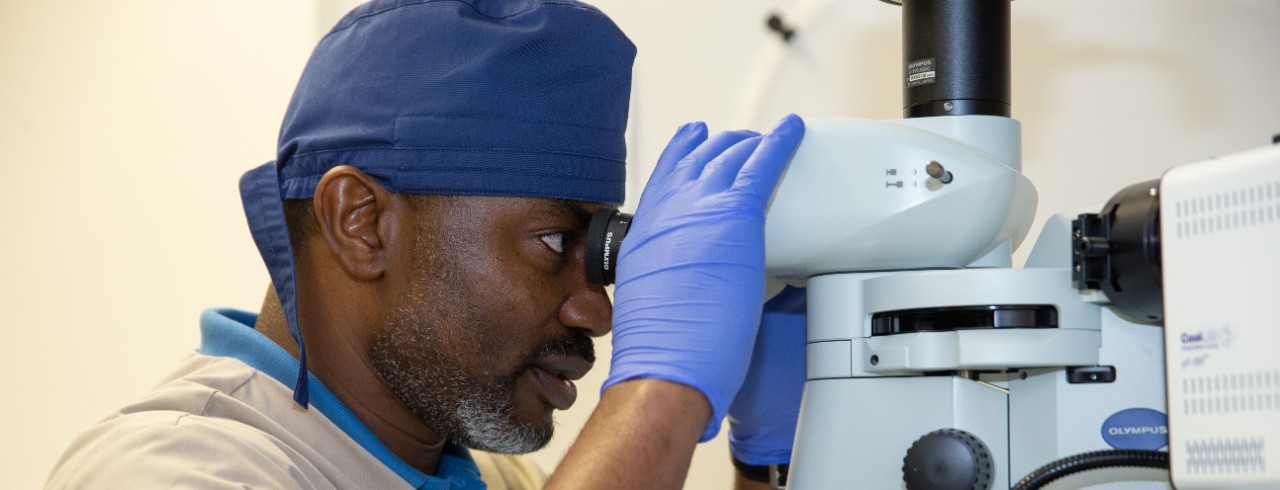
Featured photo at top of Hyacinth working in his lab. Photo/Andrew Higley/UC Marketing + Brand.
Next Lives Here
The University of Cincinnati is leading public urban universities into a new era of innovation and impact. Our faculty, staff and students are saving lives, changing outcomes and bending the future in our city's direction. Next Lives Here.
Related Stories
Sugar overload killing hearts
November 10, 2025
Two in five people will be told they have diabetes during their lifetime. And people who have diabetes are twice as likely to develop heart disease. One of the deadliest dangers? Diabetic cardiomyopathy. But groundbreaking University of Cincinnati research hopes to stop and even reverse the damage before it’s too late.
Is going nuclear the solution to Ohio’s energy costs?
November 10, 2025

The Ohio Capital Journal recently reported that as energy prices continue to climb, economists are weighing the benefits of going nuclear to curb costs. The publication dove into a Scioto Analysis survey of 18 economists to weigh the pros and cons of nuclear energy. One economist featured was Iryna Topolyan, PhD, professor of economics at the Carl H. Lindner College of Business.
App turns smartwatch into detector of structural heart disease
November 10, 2025

An app that uses an AI model to read a single-lead ECG from a smartwatch can detect structural heart disease, researchers reported at the 2025 Scientific Sessions of the American Heart Association. Although the technology requires further validation, researchers said it could help improve the identification of patients with heart failure, valvular conditions and left ventricular hypertrophy before they become symptomatic, which could improve the prognosis for people with these conditions.