WQXR's Artist Propulsion Lab talks to UC biologist
Paleobotanist David Lentz studies ancient cultures in Mesoamerica

WQXR's Artist Propulsion Lab spoke with a University of Cincinnati biology professor about the environmental lessons we can learn from the ancient Maya.
UC College of Arts and Sciences paleobotanist David Lentz and his UC collaborators study ancient cultures in Mesoamerica. They have studied the ancient Maya and their use of natural resources over the centuries more than 2,000 years ago.

A pyramid rises above the rainforest at the ancient Maya city of Tikal. Photo/David Lentz
Lentz told WQXR that the ancient Maya initially used slash-and-burn agriculture. But over time and as their population increased, these farming methods created problems such as erosion that the ancient Maya had to address.
"They developed more sustainable agriculture and agri-forestry techniques to control erosion and intensify food production," Lentz said.
"They protected forest tracts to maintain major amounts of tree cover and conserve habitat," Lentz said.
These forests contained important medicinal plants and sources of timber, he said.
Joining Lentz on the program are composer Layale Chaker and pianist Fabian Alamazan for a discussion on music and environmental stewardship.
Lentz told WQXR that the ancient Maya protected sacred groves and planted parks around their reservoirs in some cities. But they also converted some tropical rainforest to pine savanna through continual use of slash-and-burn methods.
But Lentz said these rainforests recovered over time, giving him hope for deforested rainforests around the world today.
"There is some hope that even though some of that land in Amazonia has been degraded, if we can leave it alone long enough, these forests will return," Lentz said.
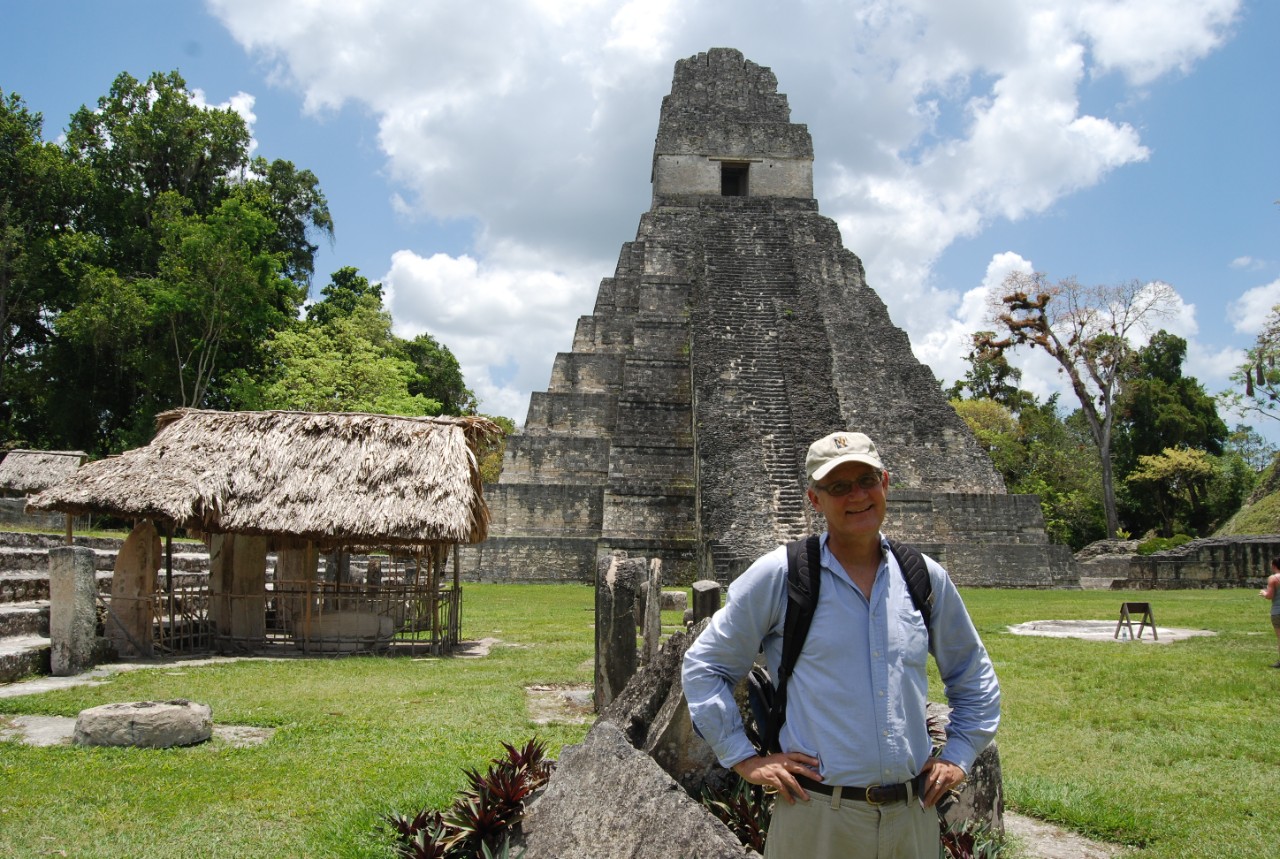
Featured image at top: UC biology professor David Lentz poses at the ancient Maya city of Tikal. Photo/Provided

UC researchers Nicholas Dunning, Vernon Scarborough and David Lentz take sediment samples at the ancient Maya city of Tikal. Photo/Liwy Grazioso Sierra
UC studies ancient Mesoamerica

UC researchers Vernon Scarborough, David Lentz and Nicholas Dunning have collaborated on numerous studies of ancient cultures in Mesoamerica. Photo/Provided
Related Stories
Sugar overload killing hearts
November 10, 2025
Two in five people will be told they have diabetes during their lifetime. And people who have diabetes are twice as likely to develop heart disease. One of the deadliest dangers? Diabetic cardiomyopathy. But groundbreaking University of Cincinnati research hopes to stop and even reverse the damage before it’s too late.
Is going nuclear the solution to Ohio’s energy costs?
November 10, 2025

The Ohio Capital Journal recently reported that as energy prices continue to climb, economists are weighing the benefits of going nuclear to curb costs. The publication dove into a Scioto Analysis survey of 18 economists to weigh the pros and cons of nuclear energy. One economist featured was Iryna Topolyan, PhD, professor of economics at the Carl H. Lindner College of Business.
App turns smartwatch into detector of structural heart disease
November 10, 2025

An app that uses an AI model to read a single-lead ECG from a smartwatch can detect structural heart disease, researchers reported at the 2025 Scientific Sessions of the American Heart Association. Although the technology requires further validation, researchers said it could help improve the identification of patients with heart failure, valvular conditions and left ventricular hypertrophy before they become symptomatic, which could improve the prognosis for people with these conditions.